
The Ridge Historical Society
Beverly/Morgan Park’s “Forgotten House” – Part 1
By Carol Flynn
Today we begin a new series on the long-forgotten history of a house in the Beverly/Morgan Park community that was recently rediscovered.
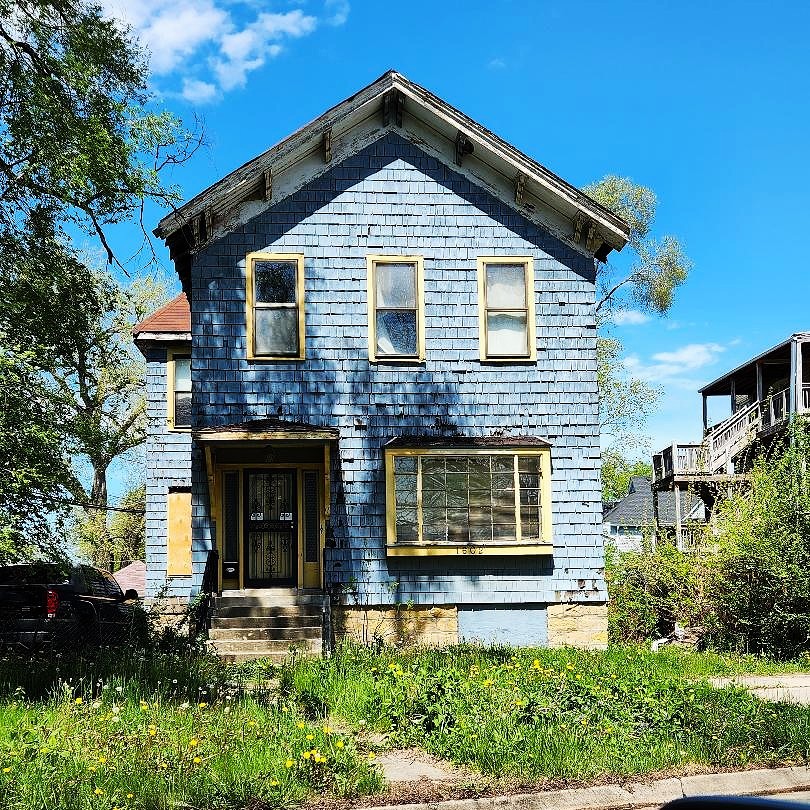
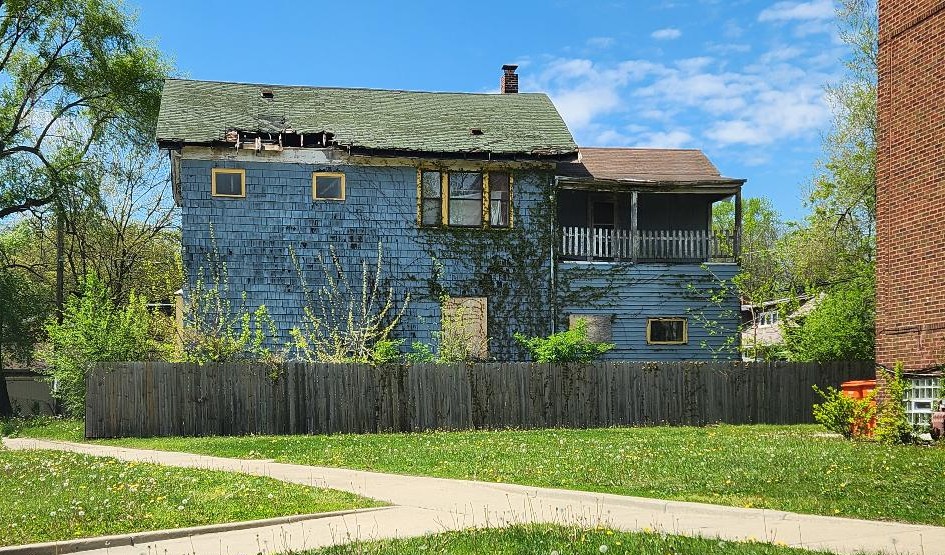
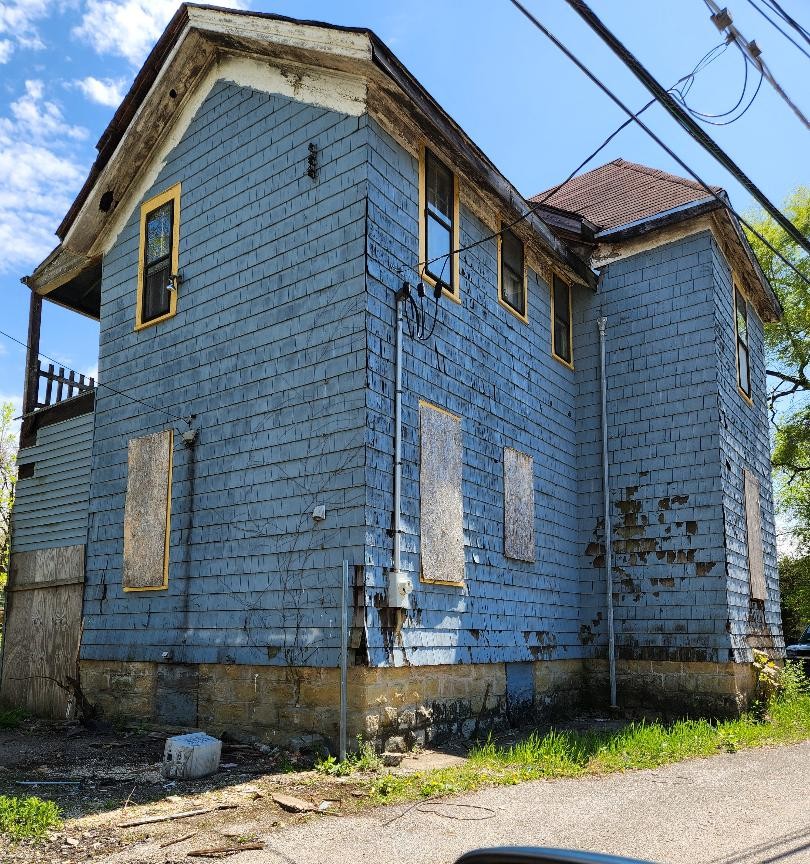
Evidence strongly supports that the old, boarded up house at 1602 West 108th Place is the Erastus A. Barnard I House, built ca. 1865 by one of the first white families to live on the Blue Island Ridge. It originally stood on the southeast corner of 103rd Street and Longwood Drive, where today stands the Starbucks coffee shop that is built in the historic Christian Science Reading Room. It was moved to its current location in 1924.
This house embodies the spirit of the earliest days of the European immigrants and their descendants who created the communities known today as Beverly and Morgan Park.
The discovery was made by Ridge Historical Society (RHS) Board member Tim Blackburn, who has developed quite an eye for and knowledge of local architecture and history during his five years living in Morgan Park.
He recently gave a program on the house and the research he did to identify it. This first post will look at that research process, and the following posts will discuss the history of the house. This offers a wonderful case study of the type of research conducted by the historians at RHS.
Tim is a Chicago marathon runner, and his training runs take him all over the community, offering him the opportunity to observe the structures found here.
On one outing last summer, he headed down 108th Place between Prospect and Vincennes Avenues and noticed a house that was clearly very old that seemed out of place on that block.
He describes the house as Italianate in style, popular for houses from 1840 to 1885. The house was modernized at some point with a rolled steel frame front-bay window and shingle siding. The original siding would have been clapboard. The foundation appears to be quite old, perhaps Joliet or Blue Island limestone or dolomite.
He found the brackets along the roof and other details to be charming, but the lack of more decorative elements led him to believe it was an early farmhouse built before the boom of the 1870s – 1880s.
There was no information about the house in the RHS files, and the other historians at RHS (including the author of this post) were not familiar with the house.
He next looked at Sanborn fire insurance maps.
These are detailed maps of U.S. cities published by the Sanborn Map Company to help fire insurance companies assess their liability for underwriting coverage for fire risk. The maps date back to 1867 and are as recent as 1975 for Chicago. The maps stopped being used for insurance purposes in the 1960s but remain a valuable research tool.
Tim uses the Sanborn maps to understand building size and shape, to determine if a building has been altered, and even to determine if a building has been moved.
The 1911 Sanborn map shows that the lot the house is on was empty at that time. The street’s name, now 108th Place, was then Court Street.
The only other Sanborn map for this part of Morgan Park is from 1950, and the house does appear on that map.
Because the house clearly predated 1911, Tim realized the house had likely been moved to its current location. So now the questions were when, why, from where, and by whom was the house moved?
Tim thought of going through all of the Sanborn maps for the area for 1911 to look for a house with a shape matching the 1950 map, but each map only covers a small area, about a quarter to a half square mile, so that would have meant going through hundreds of pages. That would be a research project of last resort.
He then looked through a collection of almost 500 postcards of Morgan Park houses and buildings from 1909.
The originals of these real picture postcards are in the Chicago History Museum collection and RHS has photocopies of them. It is a fairly comprehensive collection of the houses in Morgan Park at the time, but there are some houses missing. There were no postcards that matched this house.
Tim also looked at building permits for the site. Building permits for houses in what was the Village of Morgan Park do not start until 1914 when Morgan Park was annexed to the City of Chicago. The Beverly area was annexed in 1889-1890.
He found one sundry permit from 1924 for what could have been that address but it was too faded to read. Sundry permits cover minor changes to a building.
Each research endeavor seemed to bring him back to ground zero.
To Tim’s practiced eye, the front window of the first floor of the house appeared to be from the 1920s, so Tim figured that perhaps the permit was for the modernizations.
Tim then turned to another source of information – old newspaper articles.
Several years ago, a former RHS Board member acquired a collection of 6 years of Weekly Review newspapers from the 1920s from Dan Brady and his furniture restoration business, Oddlie Limited, which was on 99th Street but closed in 2018. The Weekly Review was a precursor to the Beverly Review and Oddlie was located in a former Beverly Review office.
The newspapers are privately owned and not part of the RHS collection. The pages are very fragile so great care, patience, and time must be used to go through them.
The effort paid off.
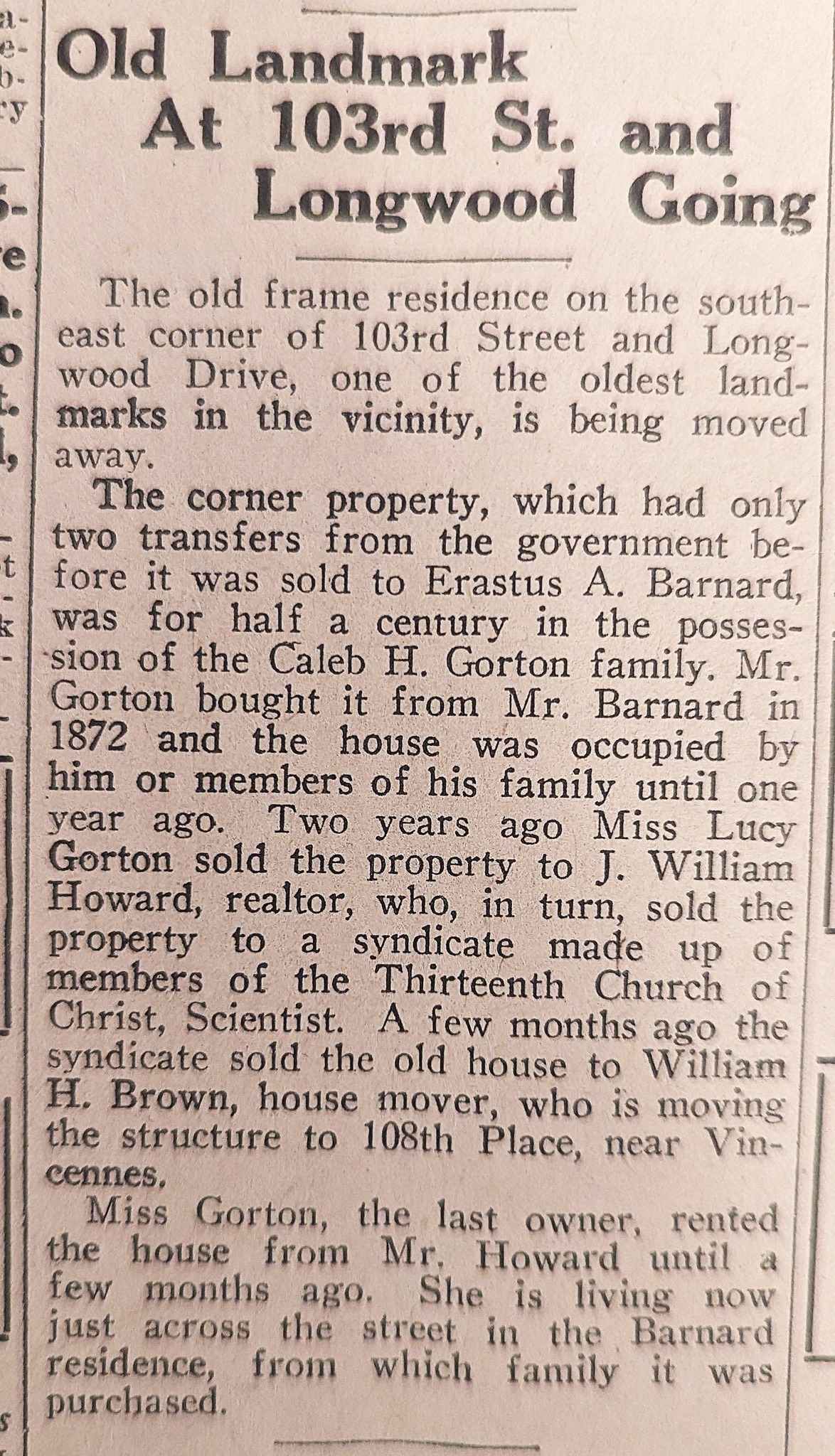
Tim started with the 1924 papers, the year of the building permit. In the November 14, 1924, issue he found the article “Old Landmark at 103rd St. and Longwood Going.”
The article, one of the attachments to this post, reported that one of the oldest houses on the Ridge was being moved from its location at 103rd Street and Longwood Drive to 108th Place near Vincennes.
The article reported that the property had belonged to Erastus Barnard, and was sold to Caleb Gorton in 1872. Caleb’s daughter Lucy sold the property to realtor J. William Howard, who then sold the property to the Thirteenth Church of Christ, Scientist. The house was then sold to William H. Brown, whose business was moving houses.
Fact checking the article, Blackburn found the Cook County property transfer documents. Barnard did indeed sell the property to Gorton, but on June 23, 1879, not 1872, for $800.
The outline of the house at 103rd and Longwood on the 1911 Sanborn map perfectly matches the outline at 1602 W. 108th Place on the 1950 map, the house there today.
The next post will look at the Barnard Family and its importance to the history of the Ridge communities, and more documentation about the house.
Future posts in the series will cover the Gorton Family and William H. Brown, and what was entailed in moving a house like this in 1924. After that, the future of the house will be addressed.
It seems very likely that the old house at 1602 W. 108th Place is the Erastus A. Barnard I House, based on the information that has been found. While the RHS researchers are very confident of this identification, we do caution, however, that in the realm of history research, our evidence might not be considered 100% “proof.”
We will keep looking for additional documentation to substantiate our conclusions.