
Ridge Historical Society
The First Country Club on the Ridge: The Ellerslie Cross Country Club – Part 5 – Hare Coursing with Greyhounds – Continued
By Carol Flynn
The Ellerslie Cross Country Club, the first country club to open on the Blue Island Ridge at the southwest corner of 91st Street and Western Avenue, held hare coursing events on the golf course during the non-golf months.
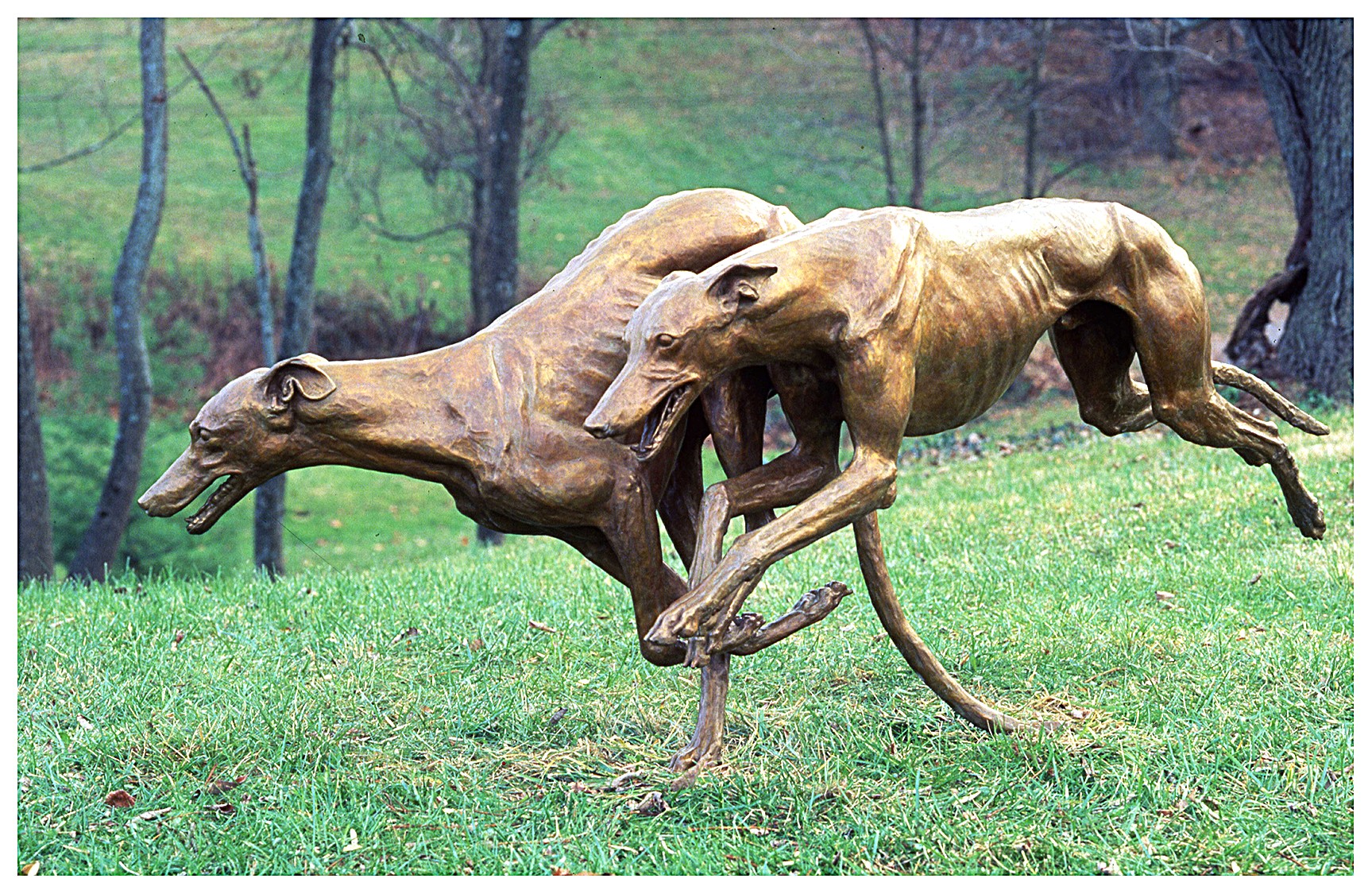
Hare coursing was a sport especially popular in England and Ireland in which greyhounds competed to chase and attempt to capture a hare, which was usually a jackrabbit in the U.S.
The dogs were judged on speed and agility, and the winner was not necessarily the dog that caught the hare. While a point was awarded for catching the hare, if the hare escaped, that was fine, too, although that rarely happened.
Note that humane groups were against this and other “bloodsports” like dog fighting, but they were legal in the late 1800s. Hare coursing eventually turned into greyhound racing, but hare coursing is still legal – and controversial – in some western states where jackrabbits are plentiful.
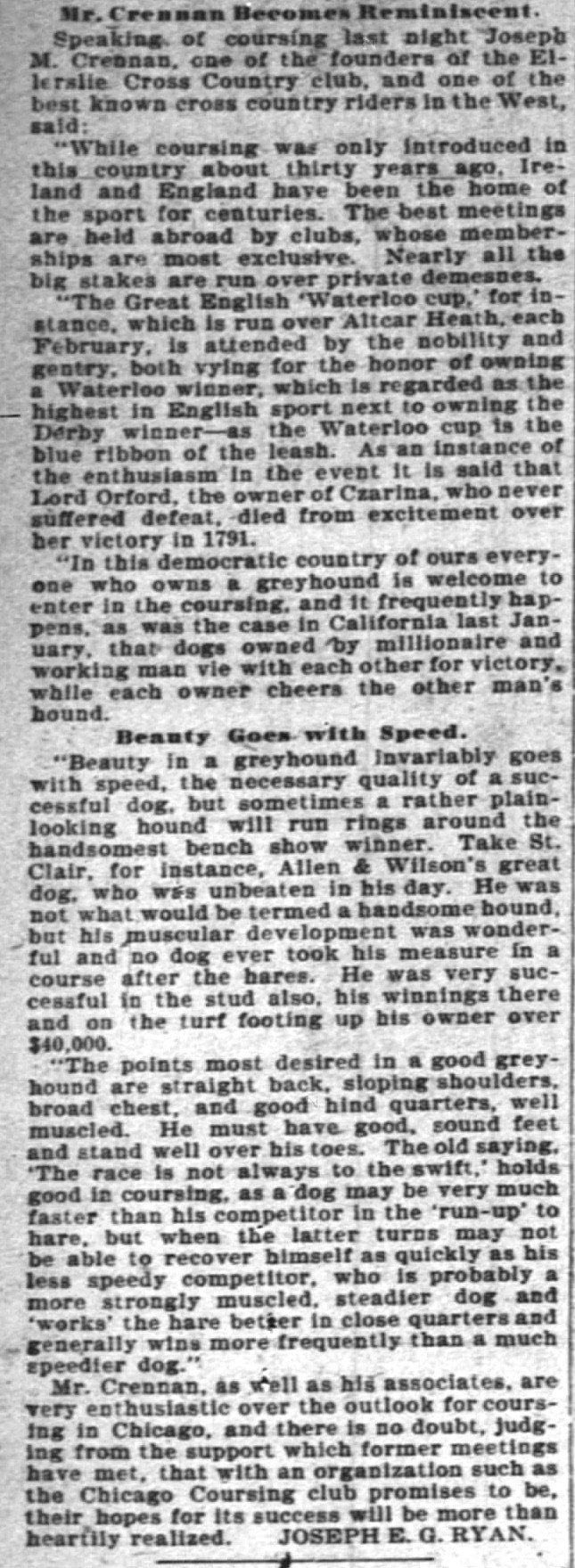
The Ellerslie Club introduced the sport, the forerunner of greyhound racing, in a big way to Chicago. Past Mayor John Hopkins, the uncle of one of the Ellerslie Club’s founders, was a fan of the events at the Ellerslie Club.
Some of the coursing events were written up in great detail in the newspapers. The first coursing event held at the Ellerslie Club, in October of 1899, was discussed in the preceding post.
In a memorable match in April of 1900, the hare escaped the golf course, crossed the railroad tracks to the west, and disappeared into the woods of Evergreen Park.
The two competing dogs followed it and disappeared from the spectators’ sight. After a three-mile run, a dog by the name of Password emerged victorious.
Password was owned by Michael Allen, whose champion dog St. Clair won the first coursing event at Ellerslie. Password was the daughter of St. Clair.
Michael Allen, who was introduced in the previous post, was born in Ireland in 1855 and came to the U.S. in 1874, and by 1899 he was a naturalized citizen. He and his wife Catherine “Kate” (Walsh) Allen, and their three children lived at 4459 Halsted Street and owned a store and saloon.
Although storekeeper and “liquor dealer” were listed as his official employment, Allen had an obvious passion for hare coursing with his greyhounds. He won thousands of dollars from coursing.
Greyhounds usually competed for just a few years and were retired well before the age of five years old, so there were always new, young, fresh dogs coming into competition.
In addition to the champions already mentioned, some of Allen’s other famous dogs were named Pathfinder, Cork Screw, and Apple Blossom. He was considered to have one of the finest kennels (referred to as stables back then) in the country, and participated in matches all over the U.S.
But the sport was becoming increasingly controversial. In 1899, Allen was charged with cruelty to animals by the Humane Society for conducting an informal hare coursing event in an open field in Chicago. In court, he showed that he followed the “sporting principles” for the sport so he was acquitted.
The success of the coursing events at the Ellerslie Club led the founders of the club, including Joseph M. Crennan and Thomas J. Keeley, profiled in Post 2 of this series, to join with Allen and other backers to open a new coursing club in Chicago, and this led to the Chicago Coursing Club in 1904.
There had been an informal “Chicago coursing club” that held events in a field at 47th Street and Western Avenue that was often in trouble with the law and the Humane Society, but this new club was founded outside of city limits where there were no local laws governing this type of operation.
Forty acres of land were leased in Mount Greenwood, running from 105th to 111th Street, Sacramento west to Kedzie Avenue. The course was just to the west of the railroad tracks next to Mount Greenwood Cemetery, so there was already well-established public transportation to the area.
The founders enlisted James “Big Jim” O’Leary to join their efforts, which, according to the Chicago Tribune, was an “indication that the backers of the enterprise mean to give it a thorough trial” “to establish coursing as a regular sport” in Chicago.
Big Jim was the son of Catherine and Patrick O’Leary, whose barn was the site for the start of the Great Chicago Fire of 1871. Big Jim was a famous gambler, the scourge of fellow Irishman Police Chief Francis O’Neill for the illegal operations Big Jim ran.
At the same time, Big Jim was a folk hero to the public because he ran an honest operation and was known to never default on a bet. Betting on the greyhound coursing events was an important part of the enterprise and Big Jim’s involvement meant the betting would be honest and fair.
The first officers of the Chicago Coursing Club included Michael Allen as President, O’Leary as Treasurer, and Crennan and Keeley as Directors.
The Chicago Coursing Club opened with its first event in May of 1904, attended by over “1,000 spectators crowded into the grandstand.” The newspapers described the park as “one of the best in the country.” To comply with the laws of the Humane Society, escapes for the jackrabbits were built into the burlap fences and most of the rabbits managed to elude the dogs.
Twenty-four dogs were entered. Big Jim O’Leary’s dogs were named Troublesome and Yankee Dime. Crennan also had dogs entered, including Colonial Girl, Modern Girl, and Judge Brown.
Allen and his partner Wilson entered Rosie Macree, Bill Dugan, Advertiser, Barefoot Boy, Our Minnie, and Kitty of the Hill.
The second day of the inaugural event, when the finals were held, attracted twice as many people, with over 2,000 in attendance. As no surprise, there was no final round because by then the top three dogs were all owned by Allen – Bill Dugan, Barefoot Boy, and Our Minnie – and the purse of $540, worth about $18,000 today, was his.
The Humane Society was against the new operation from the beginning. In 1905, someone, never identified, managed to steal the fifty rabbits that the Club was going to use for an event, so the event had to be canceled.
After a few years, differences in the philosophy of running the Club caused Big Jim O’Leary to leave the operation. He believed it should be run strictly as a sporting and betting operation, but others felt it should be run as a commercial revenue maker.
And then Mount Greenwood finally incorporated as a village in 1907, and with that came rules and laws and licenses.
The Chicago Coursing Club finally ended operations around 1908.
The next post will look at the other sporting events that went on at the Ellerslie Cross Country Club, the equestrian events that gave the club its name.