
Ridge Historical Society
The First Country Club on the Ridge: The Ellerslie Cross Country Club – Part 4 – Hare Coursing with Greyhounds
By Carol Flynn
The first country club to open on the Blue Island Ridge was the Ellerslie Cross Country Club at 91st Street and Western Avenue, founded by a group of Irish American businessmen in 1899. Although it was technically located in Evergreen Park, the address was often given as Beverly.
The Ellerslie Club introduced golf to the Ridge, covered in Part 3 of this series. Two other sports were also of great interest to the founders of the club – hare coursing and equestrian events.
This post and the next will discuss coursing, then a look at equestrian events will show why “cross country” was part of the name of the club.
Hare coursing is an ancient practice that uses dogs known as “sighthounds,” that hunt by sight, speed, and agility, instead of scent and endurance, to pursue hares for hunting, sport, and pest control. The best-known sighthounds are greyhounds.
The practice was first written about in Greece more that 2,000 years ago, but it was the English nobility under Queen Elizabeth I in the 1500s who turned coursing into a competitive sport.
For centuries in Great Britain, “commoners” were not allowed to own sighthounds and engage in coursing, but by the 1800s, that social order had broken down, and the sport had become more a favorite of the working classes in England and Ireland and less of one for the aristocracy. It really came down to being able to acquire and breed greyhounds.
Greyhounds came to America with the European settlers. Thomas Morgan brought greyhounds with him from England that he used for hunting deer and wolves on the Ridge. The dogs were also used by farmers to control jack rabbit populations.
By the late 1800s, hare coursing was a popular sport in the U.S., with governing organizations, clubs, and numerous competitions, formal and informal.
When the Ellerslie Club started holding events, the formal competitions in Chicago were usually “closed coursing,” that is, held in confined spaces with escape routes built into the “walls” for the hares. There was also “open coursing” where there was sufficient outdoor space, with the rabbits released with the chance to outdistance and outmaneuver the dogs.
Two dogs at a time competed against each other, chasing a released hare, and judges awarded the dogs points for speed and skill in manipulating the hare’s movements (“turning”) and for catching the hare. The dog with the most points advanced to the next round, until there were only two undefeated dogs left for the final round and the grand prize. In large competitions, as many as 400 dogs might be entered and the competition took days to complete.
The hare was given a head start and was more agile than the dogs, but the hounds were larger and could cover the ground faster. Each competition lasted only seconds, and it did not matter if the hare managed to escape because the point of the competition was not killing the hare, it was judging the dog’s performance in trying to catch the hare. A true “sportsman,” in theory, celebrated the hare’s escape, but the hare rarely won.
Coursing was a brutal “bloodsport” for the hares, raising obvious objections from humane groups. Other bloodsports were also tolerated back then, including dog fighting and rat baiting. In fact, John B. Sherman, who started the Union Stockyards, had an experimental stock farm on the land that is now Dan Ryan Woods, and held parties there that featured dog fights for entertainment.
Hare coursing was eventually mostly replaced by greyhound racing, where the dogs chase mechanical rabbits, but some countries still allow live hare coursing. It is banned in England, but in Ireland, it is still allowed, and even though the dogs wear muzzles it still results in severe injuries and fatalities for the hares. In some western states in the U.S. where there are large populations of jack rabbits, it is legal – and highly controversial. Even where banned, hare coursing, like dog fighting and other bloodsports, goes on illegally.
Back in 1899, the sport using live rabbits was legal, and people with prized dogs traveled around the country to compete in events.
Some of the founders of the Ellerslie Club owned greyhounds and actively participated in competitions. Fred Higbie was one of those men, and he was introduced in Post 2.
The first coursing event at Ellerslie was held in October of 1899 and described in the Inter Ocean newspaper as “the first genuine exhibition of the well-known old country sport on a large scale ever seen around Chicago, and the details were carried out to perfection.”
Jackrabbits were brought in from Wichita, Kansas to be used as the lures, and competitors came from as far away as Pittsburg, Pennsylvania.
The final round came down to a competition between Higbee’s prize dog named “Bright Eyes” and a dog named “St. Clair” bred from a champion in England, owned by a man named Michael Allen. St. Clair was the winner.
Michael Allen, born in Ireland, was a famous and successful hare coursing sportsman who lived in Chicago.
He had a kennel of greyhounds that the newspapers called the best in the city and one of the best in the country. He competed all over the country and his dogs won many prizes.
The next post will cover how the success of Ellerslie’s coursing events led the Ellerslie founders to also form the Chicago Coursing Club and build a coursing park in Mount Greenwood on land west of Mount Greenwood Cemetery. Not only were Michael Allen and his dogs major players in this story, so was the famous gambler Big Jim O’Leary, son of Catherine O’Leary, famous for her now known to be innocent role in the Great Chicago Fire.
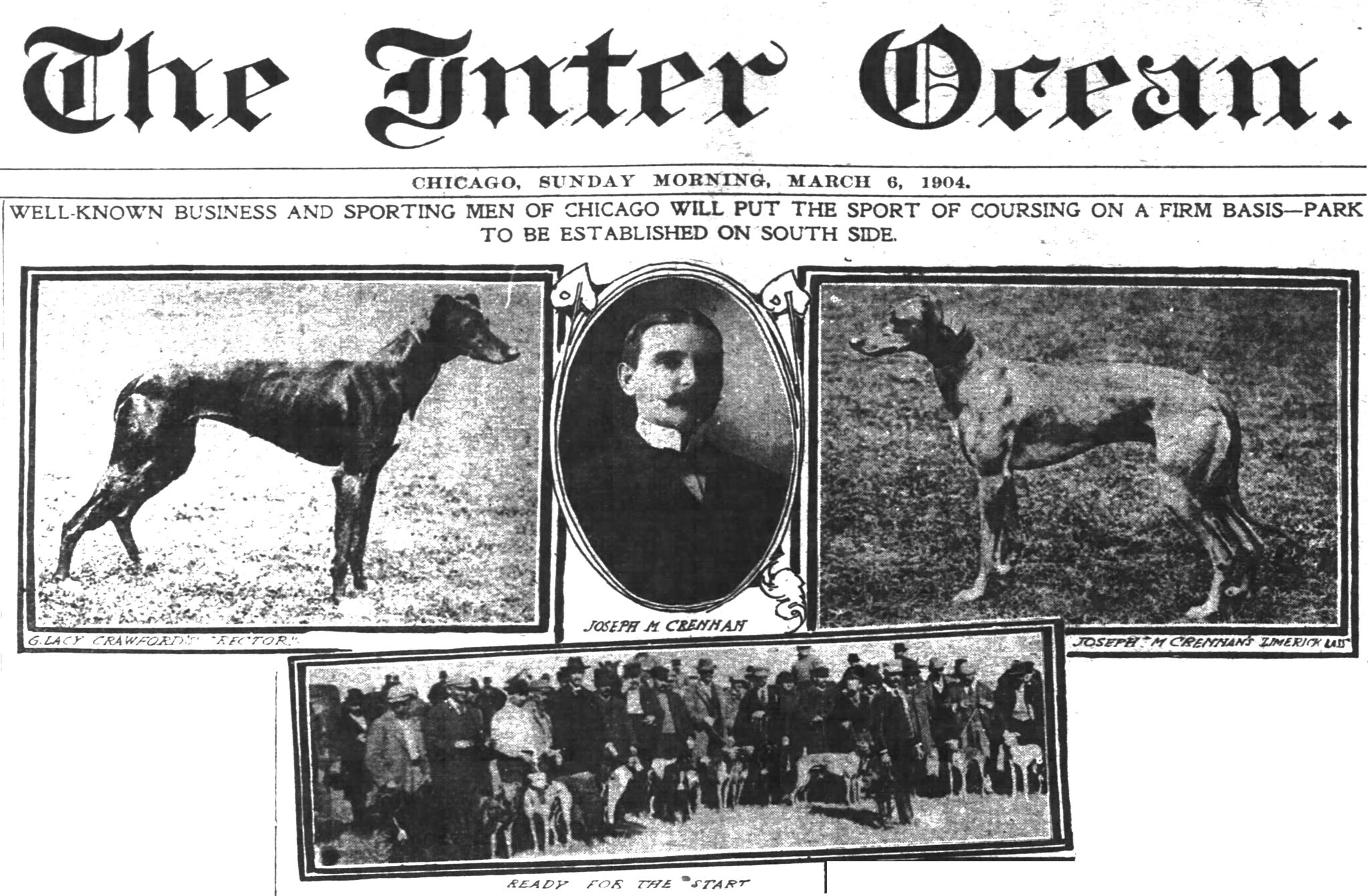
Image from Inter Ocean newspaper, March 6, 1904. Joseph Crennan, from Ireland, was the first president of the Ellerslie Cross Country Club, and he was a founder of the Chicago Coursing Club that built a park in Mount Greenwood.