
Ridge Historical Society
Letter to Metra about 115th Street Station
By Carol Flynn
Metra, the state agency that runs the Rock Island commuter line through Beverly and Morgan Park, recently announced projects for the Rock Island stations along the Beverly line.
The major project that has prompted concern in the community relates to the 115th Street station.
Metra announced it has earmarked $8.69 million for a multi-year plan that includes a new plaza and sidewalks, parking lot resurfacing, accessibility improvements, new lighting, bicycle parking, and landscaping improvements. The funding includes any environmental analyses required by law and will address stormwater management needs.
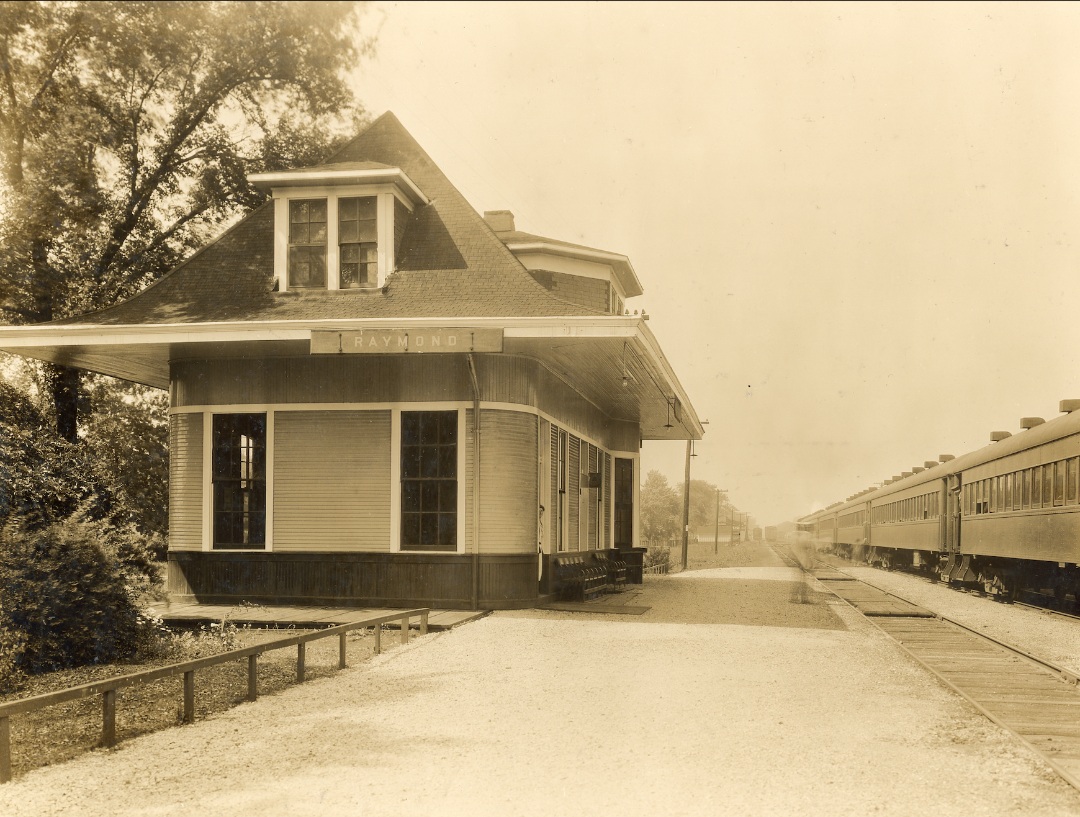
Most significant, the plan includes building a new warming shelter to replace the historic station built in 1892 that was destroyed by fire in 2017.
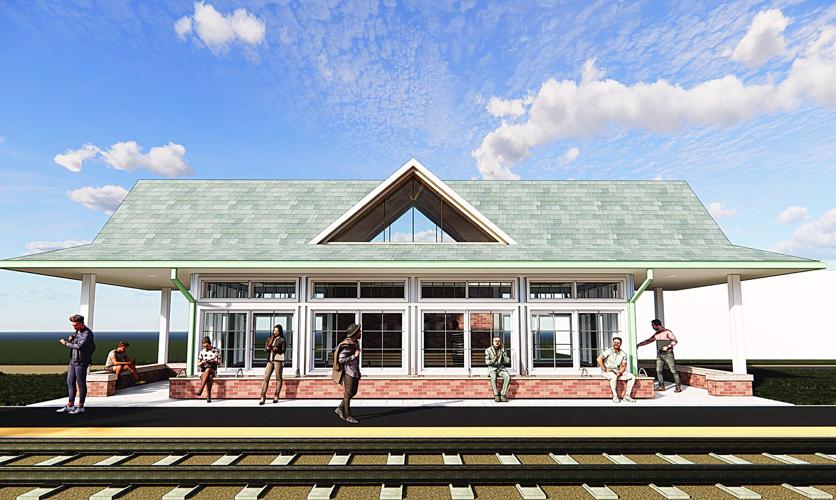
An illustration of the proposed shelter from Legat Architects was shared publicly at the time of the announcement.
The design of the structure raised concern among members of the Ridge Historical Society (RHS) Historic Buildings Committee (HBC). This prompted them to write a response to Metra, detailing the committee’s concerns and recommendations.
The letter was supported by 19th ward alderman Matt O’Shea, and was signed onto by the Beverly Area Planning Association.
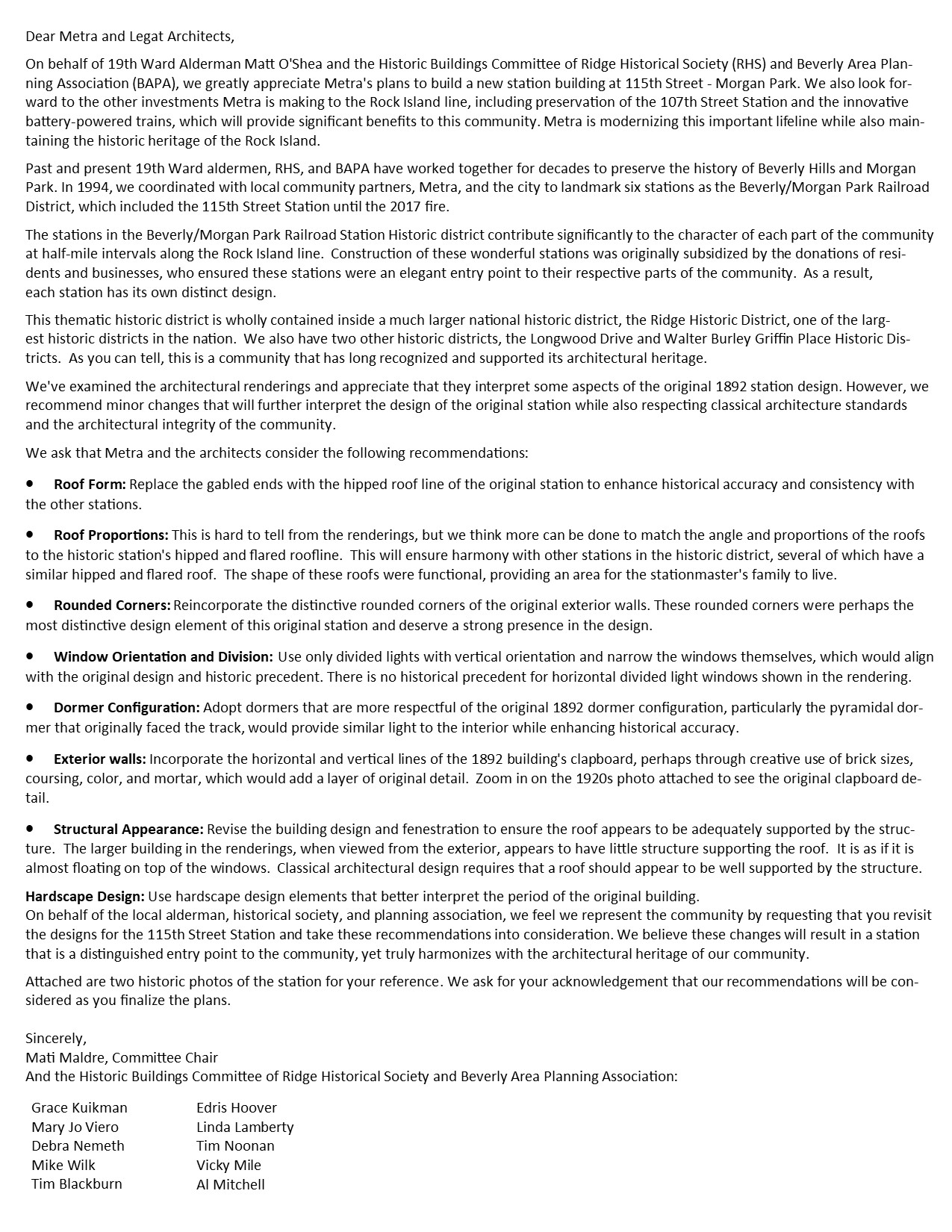
The letter to Metra is attached to this post.
To better understand the situation and the letter, here is background Information.
The reason the design is of concern to RHS is that the train stations are historic buildings, and their look is very important for preserving the visual cohesiveness of the neighborhoods around them and reinforcing the unique historic identity of the Beverly/Morgan Park community. The Historic Buildings Committee feels the proposed structure could be better designed from a historic perspective.
The Metra Rock Island railroad commuter line has always been more than just a convenient means of transportation to downtown Chicago, it is a vital part of the history, tradition, and culture of Beverly, Morgan Park, and Mount Greenwood.
The Chicago and Rock Island Railroad, the original branch to the east of the Beverly branch, running between Chicago and Joliet, began in 1852, and by 1866 had expanded into the Chicago, Rock Island, and Pacific Railroad (CRI&P) connecting Chicago to Denver and Houston.
In 1869-70, the men who owned and operated the CRI&P formed the Blue Island Land and Building Company and bought most of Thomas Morgan’s original estate north of the city of Blue Island.
They built a new branch of their railroad west along 99th Street from the original line to this new land, then south to merge with the original line in Blue Island, creating the route used today.
The land was developed into Beverly and Morgan Park, creating “railroad suburbs” along the commuter line that allowed people to live in the idyllic countryside and easily travel to downtown for jobs, business, shopping, and social and cultural events.
In 1889, the commuter line was extended north to 91st Street.
The train stations along the route, designed to fit in architecturally with the community, became hubs for local business and society and influenced the placement of parks, public buildings, and residences.
In the early 1980s, the state of Illinois took over the line from the declining railroad company through the newly formed Regional Transportation Authority (RTA). Metra is a division of the RTA.
The train stations that mark the stops along the Rock Island commuter line from 91st Street to 115th Street were designated the Beverly/Morgan Park Railroad Stations District by the Commission on Chicago Landmarks in 1995. They are also included in the national Ridge Historic District.
The six stations in the original Chicago landmarks district at 91st, 95th, 99th, 107th, 111th, and 115th Streets created a “thematic-style” landmarks district, with the buildings connected to each other by common purpose, not by geographic closeness.
The stations were built between 1889 and 1945, and, according to Commission staff, “are rare survivors of a once common nineteenth century building type.” They share the scale, materials, and architecture style of nearby buildings, making them “strong visual features” in the community.
The station at 103rd Street was not included in the original landmarks district because it was built in 1967, replacing an 1890 building.
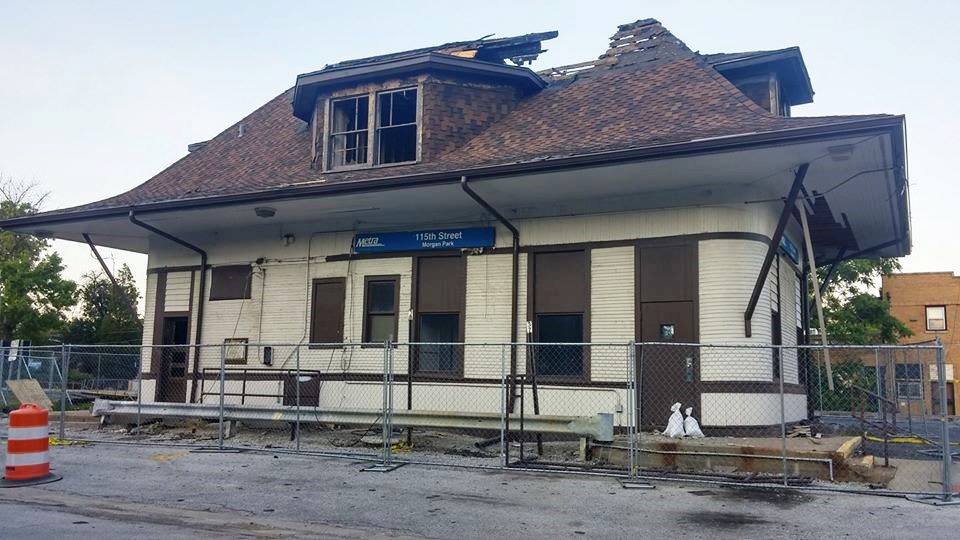
In 2017, the station at 115th Street, built in 1892, was demolished following irreparable fire damage, so that station became another loss to the landmarks district.
At the time the115th Street station was badly damaged by fire in 2017, it was no longer in use for ticket sales and was only occasionally open in winter as a warming house.
The replacement structure is not required by law to meet any historic standards, so Metra’s intent to honor the community’s history is voluntary.
The letter to Metra details several areas that need change.
The concerns and recommendations stated in the letter relate to the roof form and proportions, the loss of rounded corners that were distinctive to the original building, the window orientation and division, the dormer configuration, the lines of the exterior walls, and the lack of a strong structural appearance.
The committee recommended that hardscape design elements be used that better interpret the historic time period of the original building.
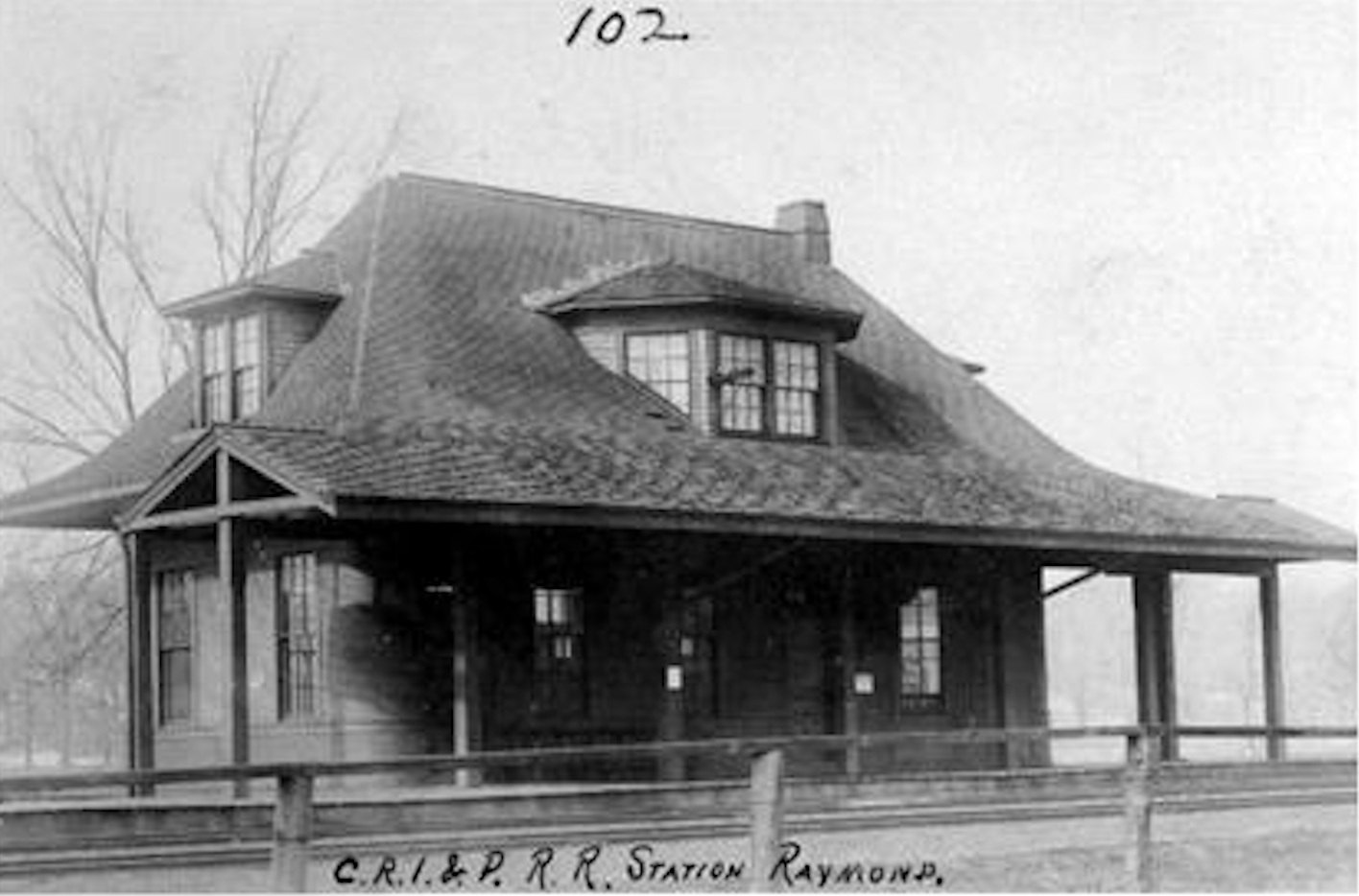
Several early pictures of the 1892 building were included with the letter to Metra.
Call to Action
RHS preservationists have raised a call to action, and encourage commuters, residents, and other interested parties to submit public comments on the proposed design to Metra. Please send email comments to the Metra Board at metraboard@metrarr.com.
Another option is to use the Metra "contact us" form at:
https://metra.com/contact-us
Metra also announced other projects along that line as follows:
– 95th Street – Beautification landscape work
– 99th Street – Accessibility and state of good repair improvements
– 101st Street – Crossing replacement
– 103rd Street – Beautification landscape work
– 111th Street – Accessibility and state of good repair improvements
These improvements may include ramps, handrails, curbs and gutters, parking lots, pavement markings, signage, retaining walls, canopy alterations, and other alterations required to meet accessibility criteria.
In 2024, Metra announced that the historic station at 107th Street would undergo rehab, but did not set a date for that project or provide other details. That structure was built in 1908, and any changes to it would have to meet landmarks criteria.
Metra announced the work on the 115th Street station would begin in 2025.
According to Tim Blackburn, RHS Board member and member of the Historic Buildings Committee, the new 115th Street Station was unveiled and approved with no public debate or feedback at the Metra board meeting on February 19, 2025. Given that Metra plans to start construction in 2025, the committee members knew they needed to act fast to influence changes to the design.
Although the project page for the 115th Street Station reports that Metra will use "distinctive architectural elements and materials that are appropriate for the historic neighborhood," the committee members feel the current plans do not achieve that goal.
Any questions about this should be sent directly to the RHS Historic Buildings Committee at ridgehistory@hotmail.com or 773/881-1675.
And please feel free to share this with any groups that may be interested. Thank you!