
The Ridge Historical Society
New Year 1925
By Carol Flynn
Chicago, Chicago, that toddlin’ town.
Chicago, Chicago, I’ll show you around.
Bet your bottom dollar you’ll lose the blues in Chicago, Chicago, the town that Billy Sunday could not shut down.
On State Street, that great street, I just want to say
They do things they don’t do on Broadway. Say!
They have the time, the time of their life.
I saw a man who danced with his wife
In Chicago, Chicago, my home town.
This favorite, “Chicago (That Toddlin’ Town),” was written in 1922 by Fred Fisher. It appears to have been first recorded by the elusive Joseph Samuels and his jazz band in August of 1922.
The song became best known when recorded by Frank Sinatra in 1957, although many people have sung it through the years, from Judy Garland to James Brown to the band Green Day.
The “toddle” was a jazz dance step in the Roaring Twenties. It was popular with college students and “flappers,” those modern young women who disdained the old social conventions, and wore short (that is, knee length) skirts, bobbed their hair, drove automobiles, smoked cigarettes and drank alcohol in public, listened to jazz, and loved to dance.
Music and dancing were favorite social activities, from time immemorial, and this was certainly true for New Year’s events one hundred years ago.
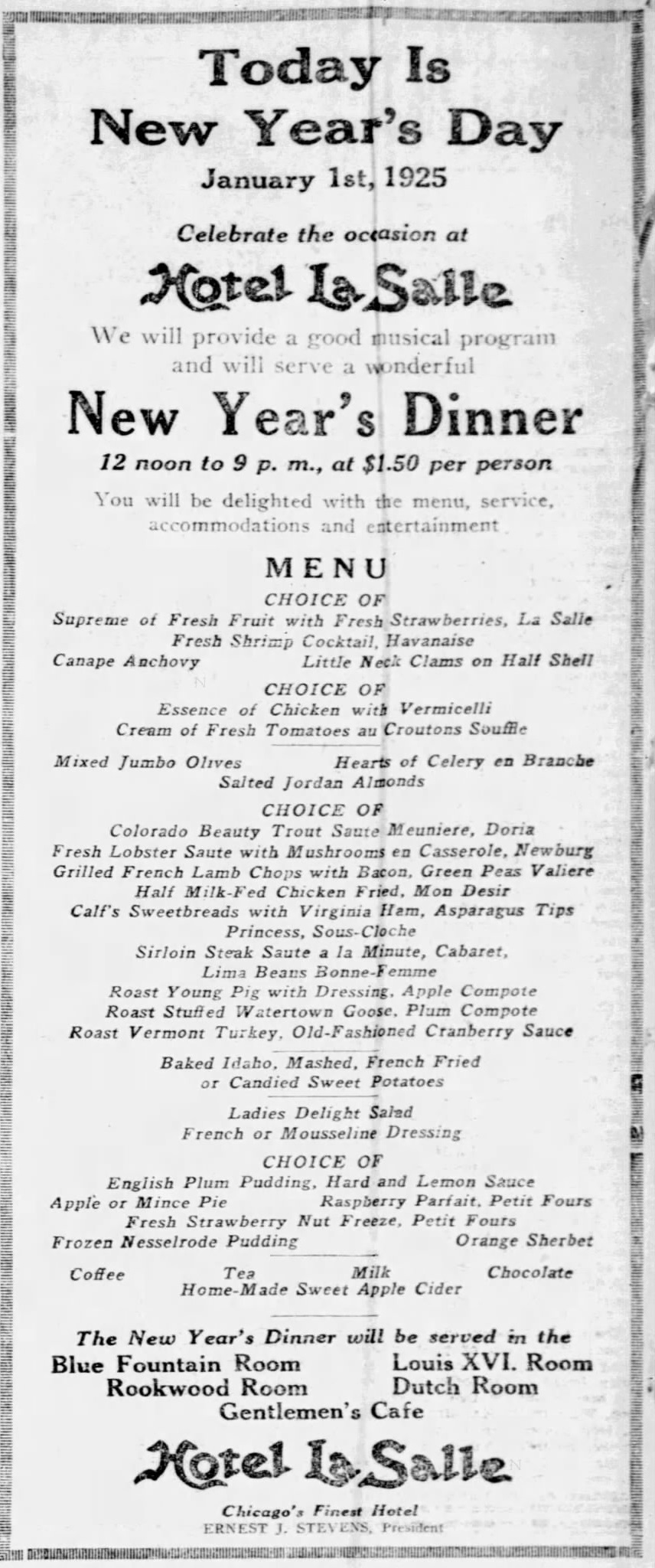
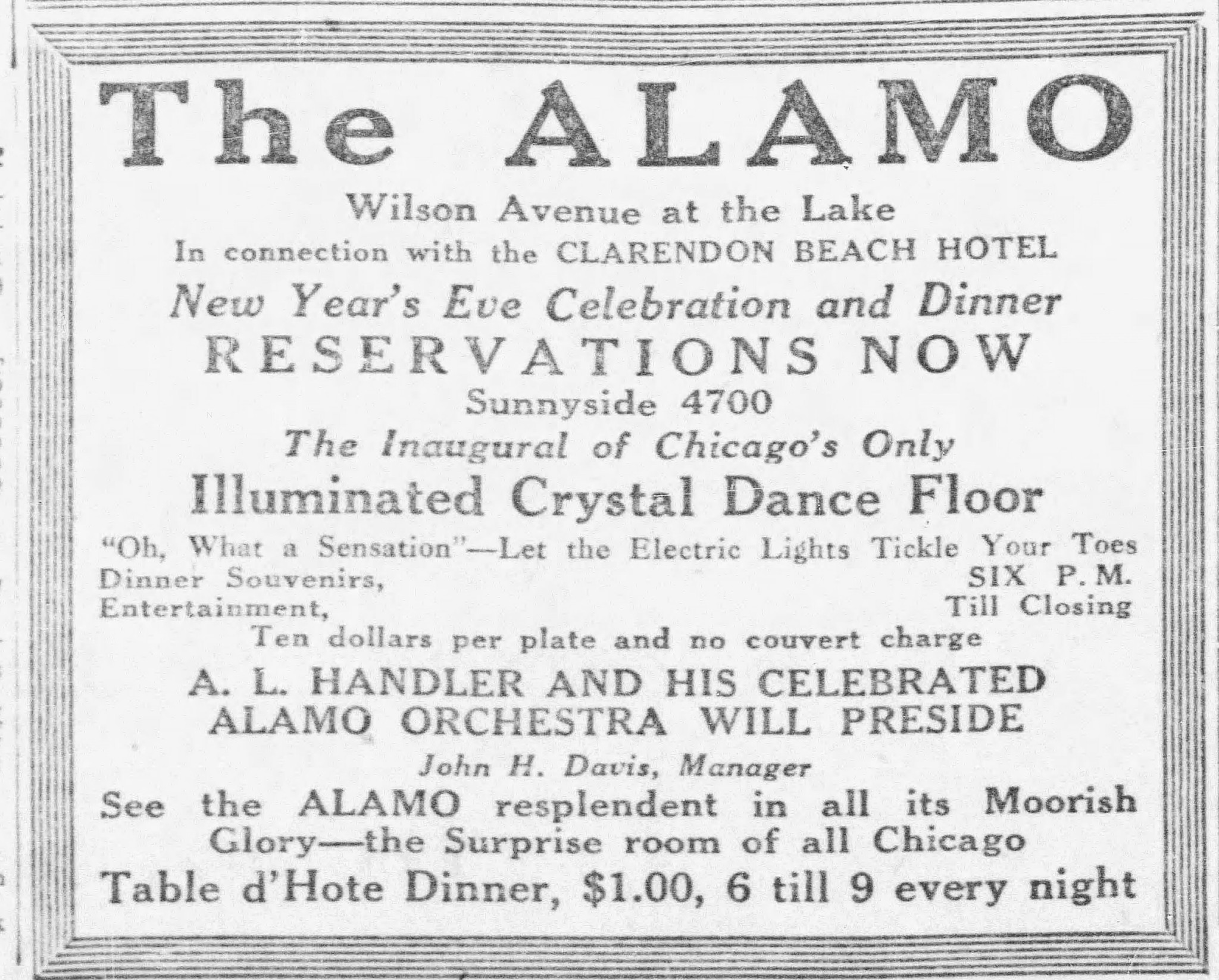
The Chicago hotels and restaurants were completely booked for both New Year’s Eve and New Year’s Day, and many private parties were held, also, at membership clubs and private houses. The parties were called “watch parties,” as in watching the old year exit out the door and the new one enter – at midnight, the doors were thrown open for this to happen.
The general format for a party was an extravagant dinner followed by a live orchestra and dancing. Some games in the evening were also often played – charades and guessing games were popular.
According to a Chicago Tribune newspaper article on December 31, 1924:
“Chicago tonight is going to don its dress suits, silver flasks, and tin horns and step out in search of A.D. 1925 in a spirit of peace and prosperity for the year to come.
“That is the official forecast, based on a canvass last night of hotels, cabarets, and roadhouses, police and federal officials – and bootleggers.”
Yes, bootleggers – Prohibition was in effect in 1924, which meant making, transporting, selling and serving (but not consuming) alcohol were all illegal. People regularly brought in their own alcohol to an event, hence the reference to the silver flasks.
The bootleggers reported that business was better than ever. Scotch was going for $7 per bottle; bourbon for $10; gin for $4. These prices were enough “to make one with a pre-Volstead memory shiver, but cheap enough in modern years.” Champagne, however, was very expensive – “about $1 per bubble.”
At the less well-heeled establishments, moonshine could be had for $1 per quart.
Chief of Police Collins said his men would enforce all liquor laws, but it was a “tough job.” He said they would “see there are no flagrant violations.” The Tribune noted that “handling a flask has never been considered flagrant.”
For New Year’s Eve, 1924, the big event for the social elite was a concert by the Yale Glee, Banjo, and Mandolin Club, in town from the east coast. This was preceded and followed by numerous private parties.
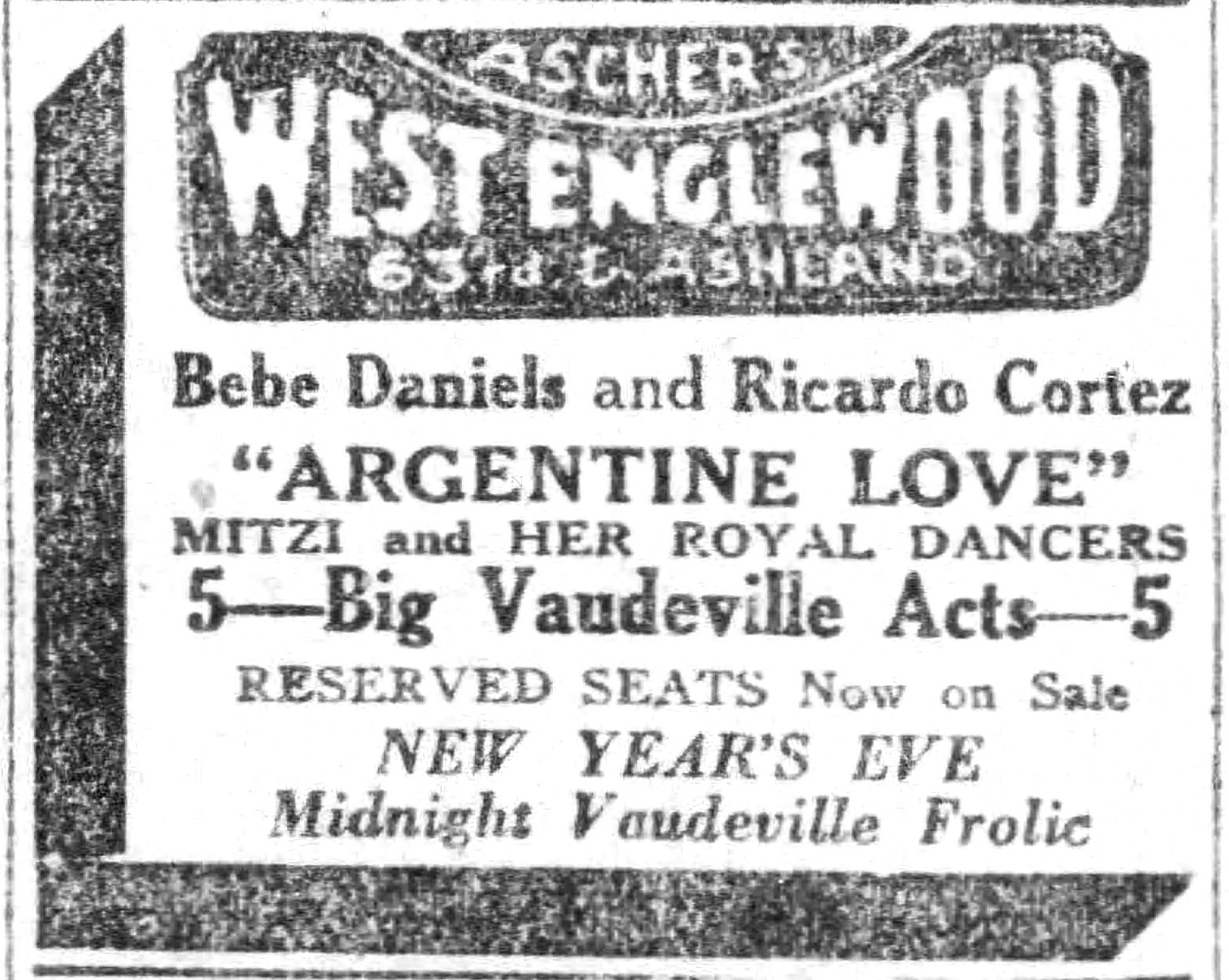
For the less high-brow, there were plenty of burlesque, vaudeville, musical comedy, and cabaret shows scheduled. Taxicabs, which usually made their last runs at midnight, were staying on the streets until 2 a.m.
The people who stayed home for the evening could still have music and dancing, via records played on the family’s gramophone or phonograph, if the family could afford such a machine.
For everyone, though, there was listening to the radio.
The radio stations covered live events, from political and other speeches to football games, and broadcast live orchestras and other entertainment, from the hotels or from the radio station’s studios. The radio stations usually signed off by 10 or 11 p.m.
On December 31, 1924, Chicago Tribune-owned WGN offered dinner music, and a few hours later dance music, from the bands at the Drake and Blackstone Hotels, but ended at 11 p.m.
Three other local stations planned New Year’s programs past midnight, one running until 6 a.m.
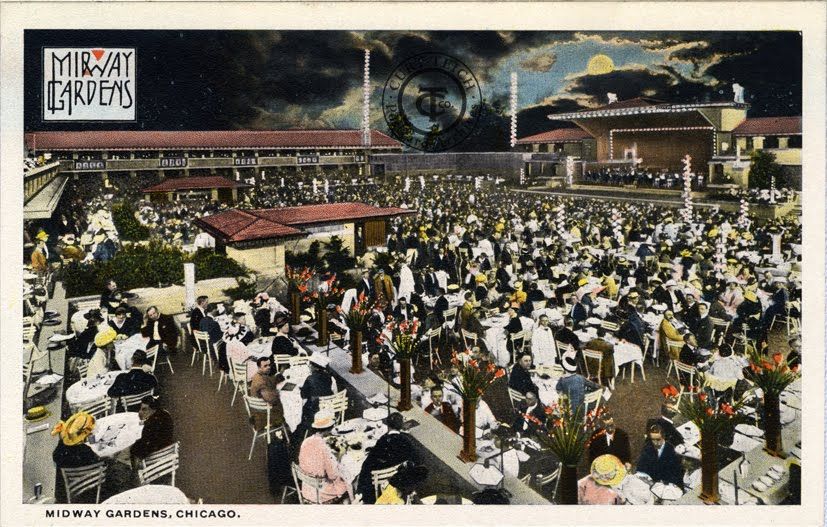
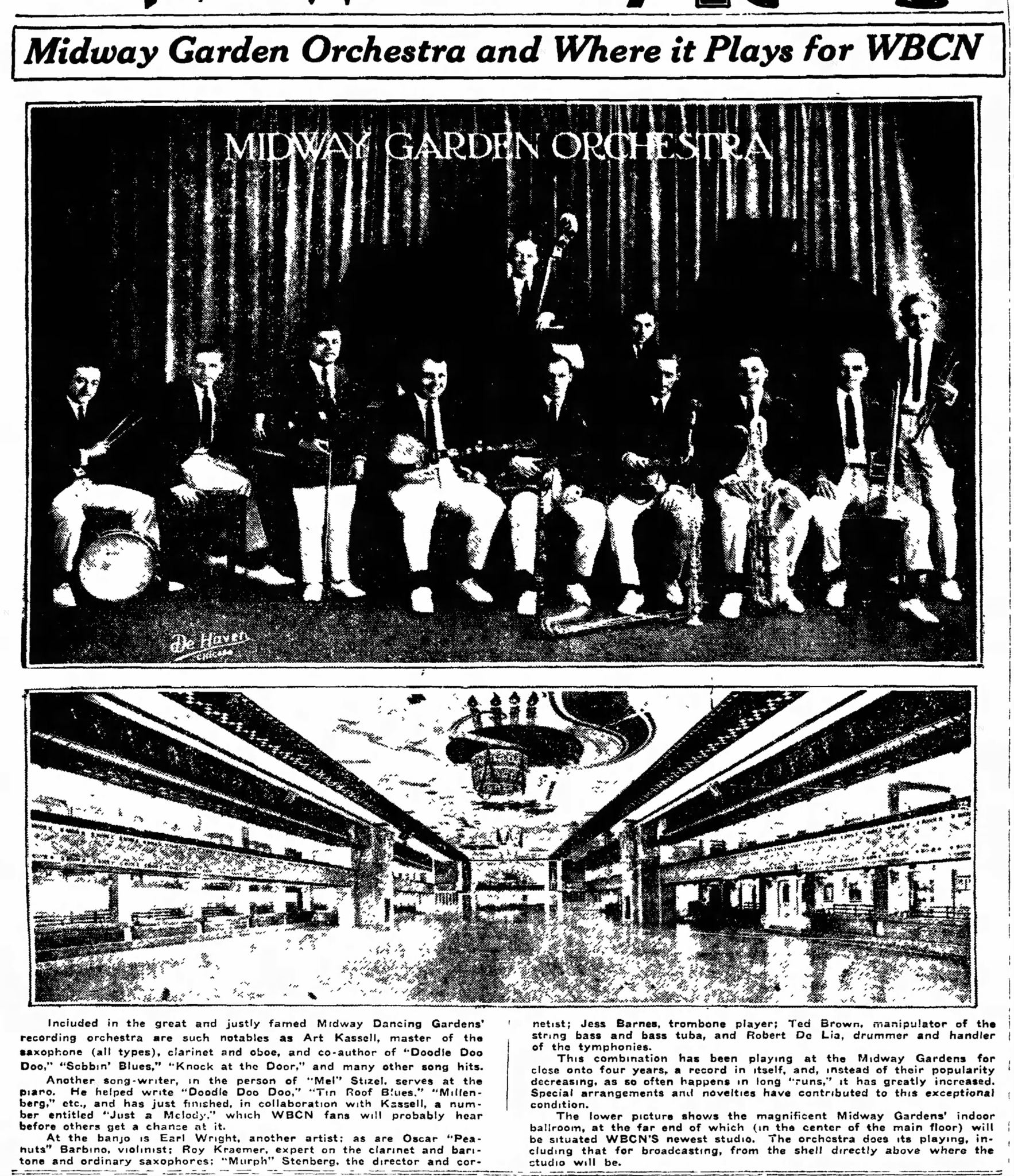
The biggest radio event, however, was taking place on WBCN, the station owned by the Southtown Economist newspaper. The station and the Midway Dancing Gardens had recently signed a deal that the Midway Gardens orchestra would be broadcast live on the radio station six days per week (closed on Mondays), and the inaugural event was scheduled to take place on New Year's Eve.
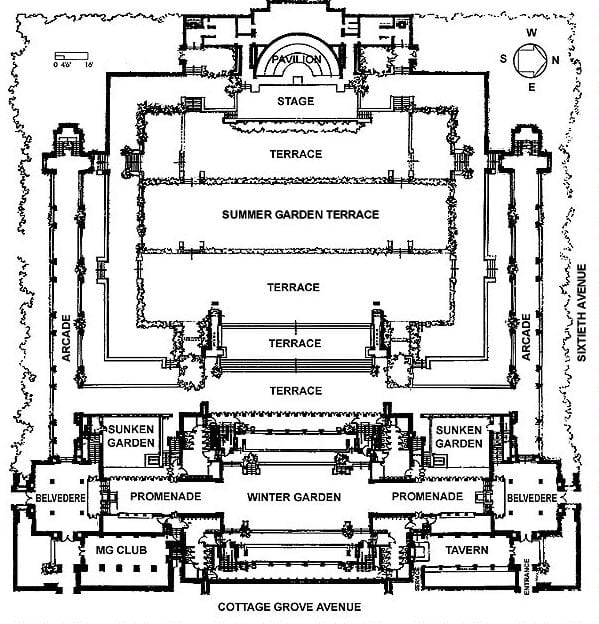
Midway Gardens was an entertainment complex at 60th Street and Cottage Grove Avenue, designed by architect Frank Lloyd Wright, that opened in 1914. It went through several owners before closing permanently and being demolished in 1929.
The facility offered outdoor dining and dancing in the summer and had a smaller indoor “winter garden.” It was considered to have “the largest toddle floor in the world.”
Other names it went by through the years were the Edelweiss Gardens and the Midway Dancing Gardens.
Although very popular with the public, Midway Gardens was never successful from a financial perspective.
In 1924, however, the Midway Dancing Gardens had a superb recording orchestra, and according to rival Tribune, “as a result WBCN listeners are to have dance music equal to any now being broadcast.”
The deal between WBCN and the Midway Dancing Gardens was considered “pioneering” and “highly distinctive” because it was the first time a public ballroom and a radio station had made an agreement on this scale.
On New Year’s Eve, from 10 p.m. to 2 a.m., dance numbers interspersed with specialty numbers were planned to be played continuously by the orchestra, which was in a shell above the dance floor. A microphone was installed suspended from the ceiling, wired into the transmitting equipment of the radio’s operations room at 730 West 65th Street.
This allowed the orchestra to “play for those actually present, and for radio-listeners at the same time.”
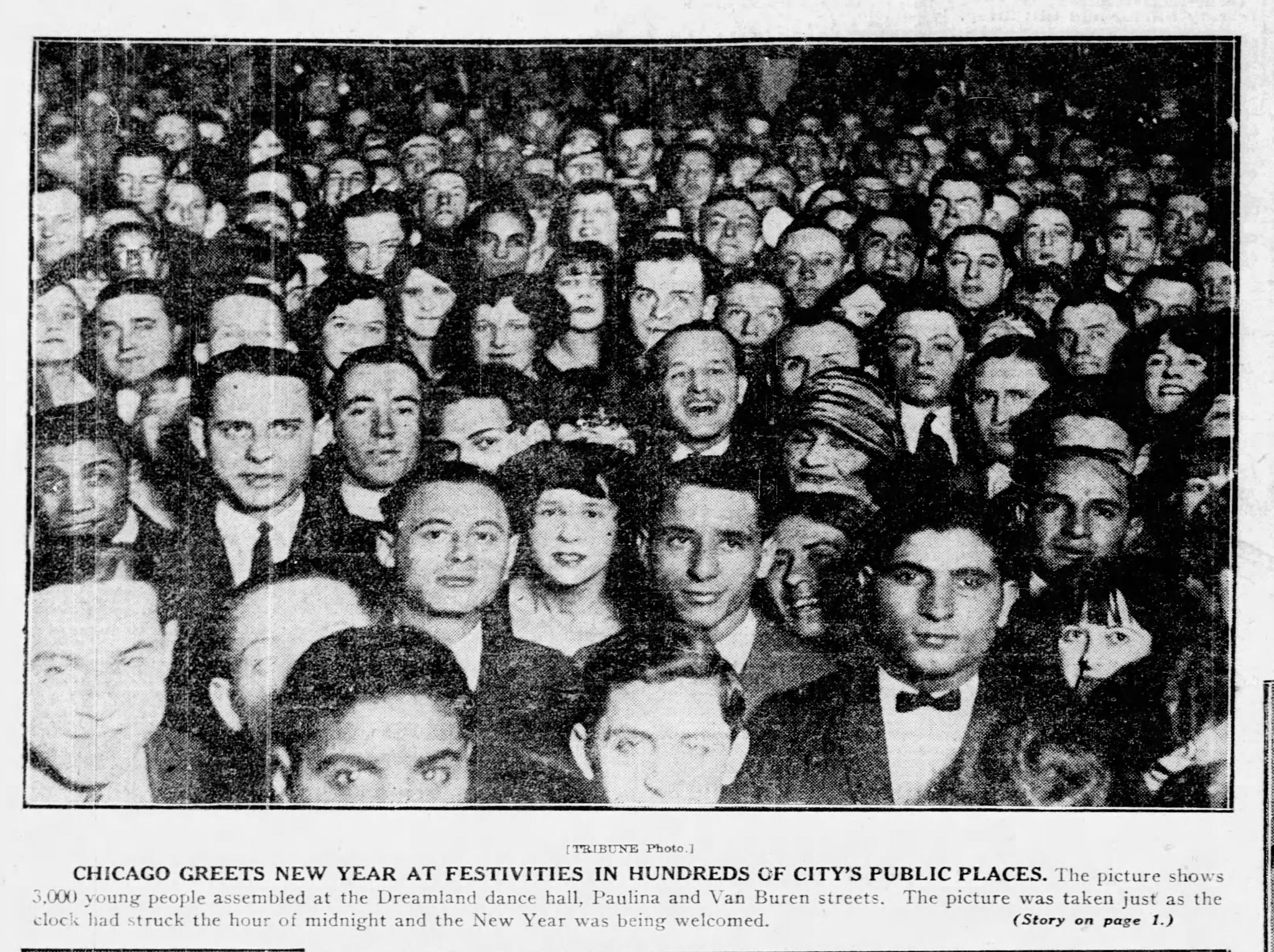
The event was very successful. On January 1, 1925, the Tribune reported that the Midway Dancing Gardens was so crowded in person there was scarcely room to dance.
The people listening from home might have had more space to push furniture out of the way to toddle.
All of the events held around the city did excellently – the hotels and restaurants reported the highest attendance ever. The going rate was $10 per person at the better places, and the Drake Hotel had 3,000 guests.
No attempt was made to conceal the liquor people brought with them – bottles were left in open display on tables and counters. The venues supplied drink set-ups for $1.00 apiece.
The police said the crowds exceeded anything they expected, yet the people were good-natured and there were few disorderly incidents.
The Tribune noted that at the Pershing Palace at 64th Street and Cottage Grove, one of the tables included Archie Benson, the Prohibition enforcement officer. Benson had announced that he would “keep an eye on enforcement measures in the loop,” but here he was among the revelers and their silver flasks.
No arrests were made there, or in the Loop, or at the Midway Dancing Gardens, for liquor.
That was Chicago in 1924-25.