The Ridge Historical Society
October is National Pizza Month – Pizza on the Ridge
By Carol Flynn
People spend countless hours debating which restaurant serves the “best pizza” but it doesn't really matter. One person might like cracker-thin crust with pepperoni, someone else might like “Chicago-style” deep dish with spinach. They’re both correct, and neither is likely to change his or her mind. Pizza preferences, like any other food choice, are subjective and individual.
U.S. residents love pizza and helped take it from a traditional Italian dish to a worldwide favorite.
The annual calendar has at least 10 recognitions for pizza, starting in January with National Pizza Week and ending in November with National Pizza With the Works Except Anchovies Day. October is National Pizza Month, when people are encouraged to patronize local pizza places – as if extra encouragement is ever really needed.
Pizza has been popular in the U.S. since the late 1940s. Although there were a few pizza restaurants prior to that, it was soldiers returning from World War II service in Italy who brought back a newfound taste for the dish, causing it to go mainstream.
Newspaper articles helped Americans learn that the correct way to
pronounce the word was “pete-za.”
The concept of pizza, a flat bread with toppings, goes back to antiquity. Many cultures had some version of that. After tomatoes were introduced to Europe from South America in the 16th century, Naples and Sicily, then part of Spain but later within the boundaries of Italy, came up with the basic template for the “modern” version of “traditional” pizza: flat dough covered with tomatoes in some form and cheese.
Italian immigrants brought pizza with them to the U.S. starting around the late 1800s. They mostly settled in the large northern cities – New York, Boston, Chicago. Like many ethnic dishes, each family had its own favorite pizza recipe. It was quick to prepare, easy to serve, and inexpensive, which helped stretch dollars between paydays.
Pizzas first started showing up in taverns as free snacks, using the tavern owner’s personal recipe. The more pizza the patrons snacked on, the more beer and wine they ordered.
Pizza was also served at church events and festivals in Italian neighborhoods.
To make it authentic pizza, the dough had to be hand-made and stretched out by hand, and the pizza baked in a brick oven over a wood fire. Pizzas were as often made in rectangular form in sheet pans as they were made in the round form. The standard of a pizza as a "pie" came later.
Although its actual origins are obscure, the pizza Margherita from Naples, comprised of simple dough (flour, water, yeast, and salt) topped with extra virgin olive oil, crushed peeled tomatoes, mozzarella cheese, and fresh basil leaves, was one of the earliest “standard” pizzas. It was made in a round shape.
Pizza was mentioned in Boston in 1904, but the first pizza restaurant in the U.S. is considered to be Lombardi’s in New York City. The Lombardi family started with a grocery store in 1897 and sold “tomato pies,” an early name for pizzas, to factory workers at lunch time. In 1905, they opened a pizzeria restaurant.
In Chicago, historians recognize Tom Granato’s restaurant at 907 West Taylor Street near Halsted Street as the first pizza restaurant in the city. The Granato family, with roots in Naples, started with a bakery, then opened the restaurant in 1924.
In a newspaper article, Granato’s pizza was described as “a dough similar to that of an English muffin rolled out as a pie crust with fresh cut up Italian cheese, covered with little Italian pear tomatoes and sprinkled with olive oil” baked in a brick oven for a few minutes. It was served in a tin pie plate, cut into sections, and eaten with the fingers.
Granato’s was torn down in the early 1960s to make way for the new University of Illinois Chicago Circle campus.
Other places started offering pizza as a “specialty.” Tufano’s in Little Italy served it on Friday and Saturday nights. Uno’s opened up and created deep dish pizza which has become a Chicago trademark. The Malnati and Baracco families got involved early in the pizza business.
In the late 1940s, restaurants serving pizza started to proliferate.
Today’s Vito and Nick’s Pizza at 8433 S. Pulaski Road, which grew out of a tavern started in 1923, expanded its menu to include pizza in 1946. One of the oldest pizza places still in existence in the city, people from the Ridge likely visited there as they still do today.
Although it will never be known with any certainty when the first bite of pizza was enjoyed on the Ridge, pizza likely first showed up in the city of Blue Island, which had a large Italian community. By 1950, pizza was mentioned as being served in taverns, and at the annual festival and carnival at St. Donatus Church, where it was made by the women of the parish.
At the time, a store in Blue Island advertised the ingredients for making pizza at home – homemade sausage, scamorza and other cheese, and oregano.
At least two restaurants on Western Avenue in Blue Island advertised pizza by 1950–51. They were Nino’s Club Trieste at 13312, and the Pizzeria Palace at 12424. These restaurants served “American” dishes like ribs, steaks, and chicken along with Italian specialties.
In the 1950 – 70s, musical entertainment in restaurants in the Blue Island area was frequently provided by the Garetto Twins, Larry and Angelo, who had a music business. They eventually got involved with their own pizza establishment, Beggar’s Pizza, started in 1976. Still in operation with multiple outlets, this is the oldest pizza business in Blue Island.
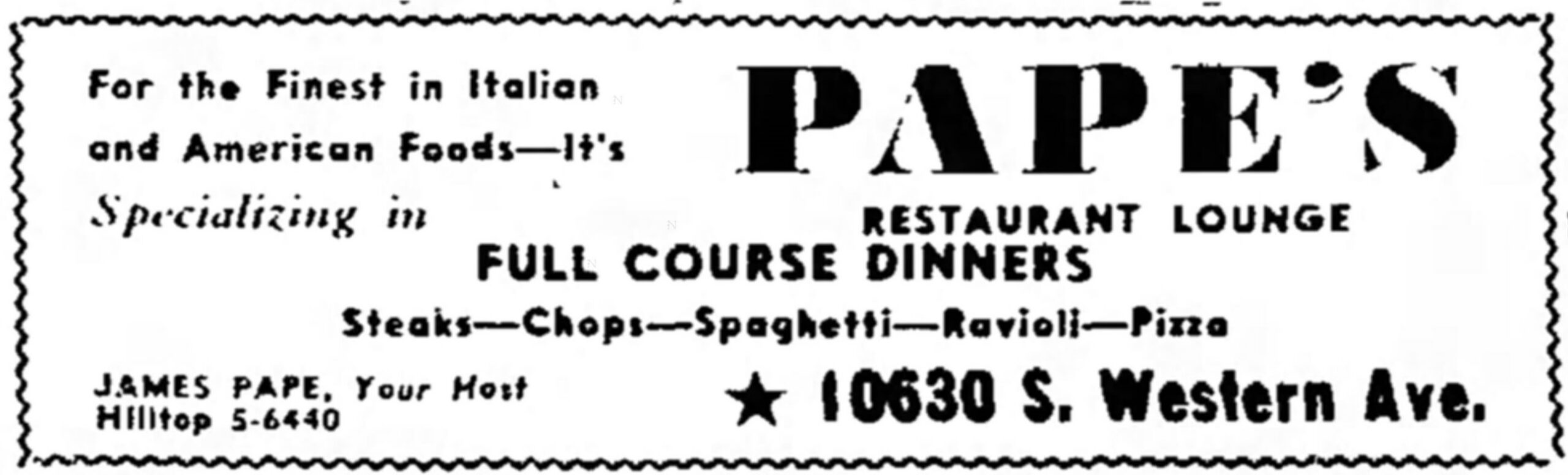
The first advertisement found for a restaurant serving pizza in Beverly was for Pape’s Restaurant and Lounge at 10630 S. Western Avenue in 1950. In a review, Pape’s was described as “a handsome restaurant and lounge where every attention goes into making your dining and wining visit a most enjoyable one.”
Owner James Pape featured “wonderful Italian food” including pizza pie, “along with plenty of American items.”
Around this same time, fresh and frozen pizzas were made available to the South Side at the popular food court in the lower level of Gately’s Peoples Store at 112th Street and Michigan Avenue.
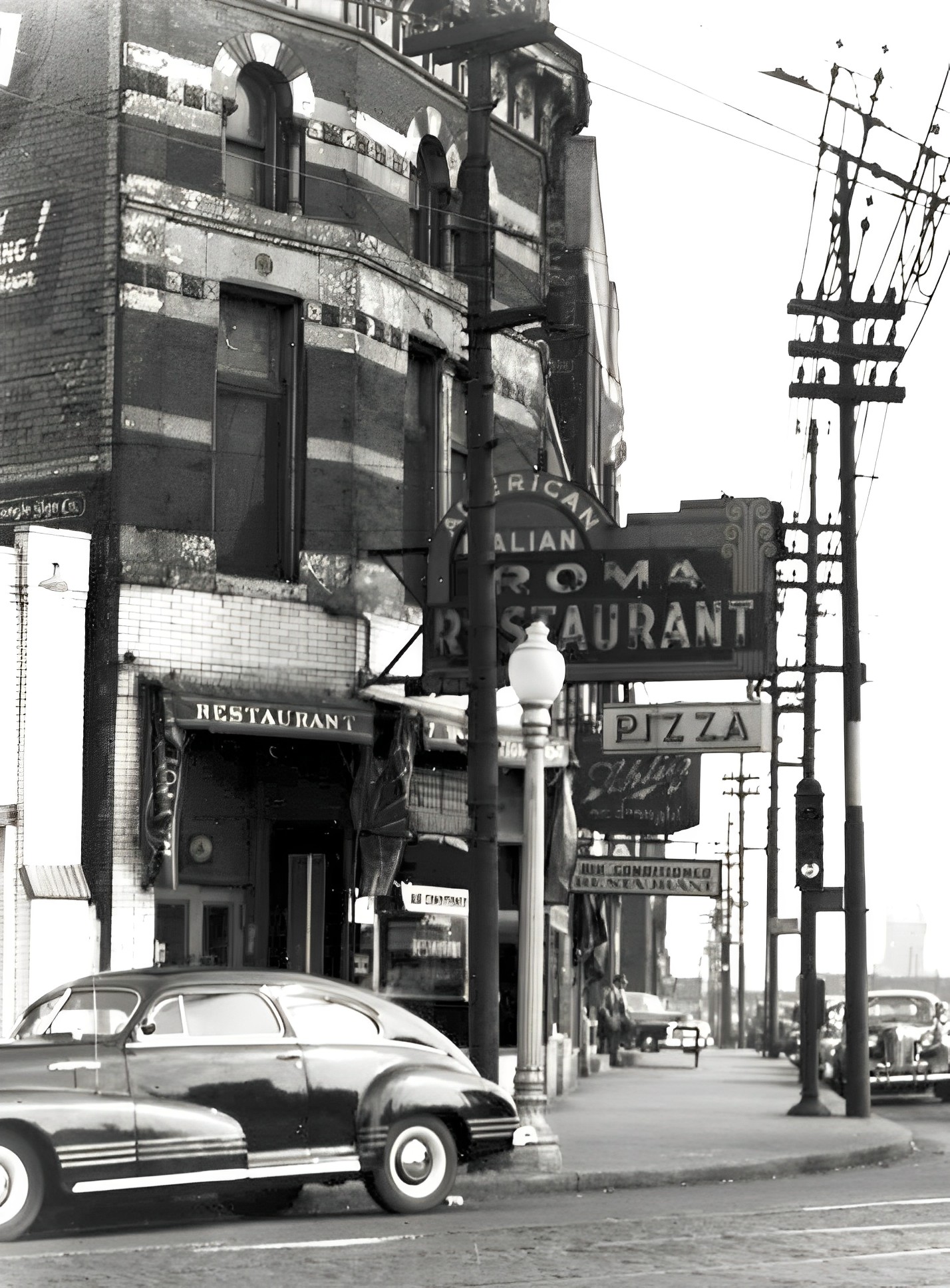
James Gately, head of the Irish family who owned the store and a resident of Beverly, apparently purchased the pizzas from Roma’s Banquet Hall, Restaurant and Tavern at 93rd Street, Commercial Avenue, and South Chicago Avenue.
By then, restaurants were not only delivering hot pizzas (for free), but they were also selling fresh unbaked pizzas and frozen pizzas. Frozen dinners were just being introduced to the post-war baby-boom families.
According to the Southeast Chicago Historical Society, the Roma’s location started as a restaurant in 1918. In 1948, the business was bought by the Lombardi family, and Roma’s began. A pizza oven was installed at that time. Roma’s is still open.
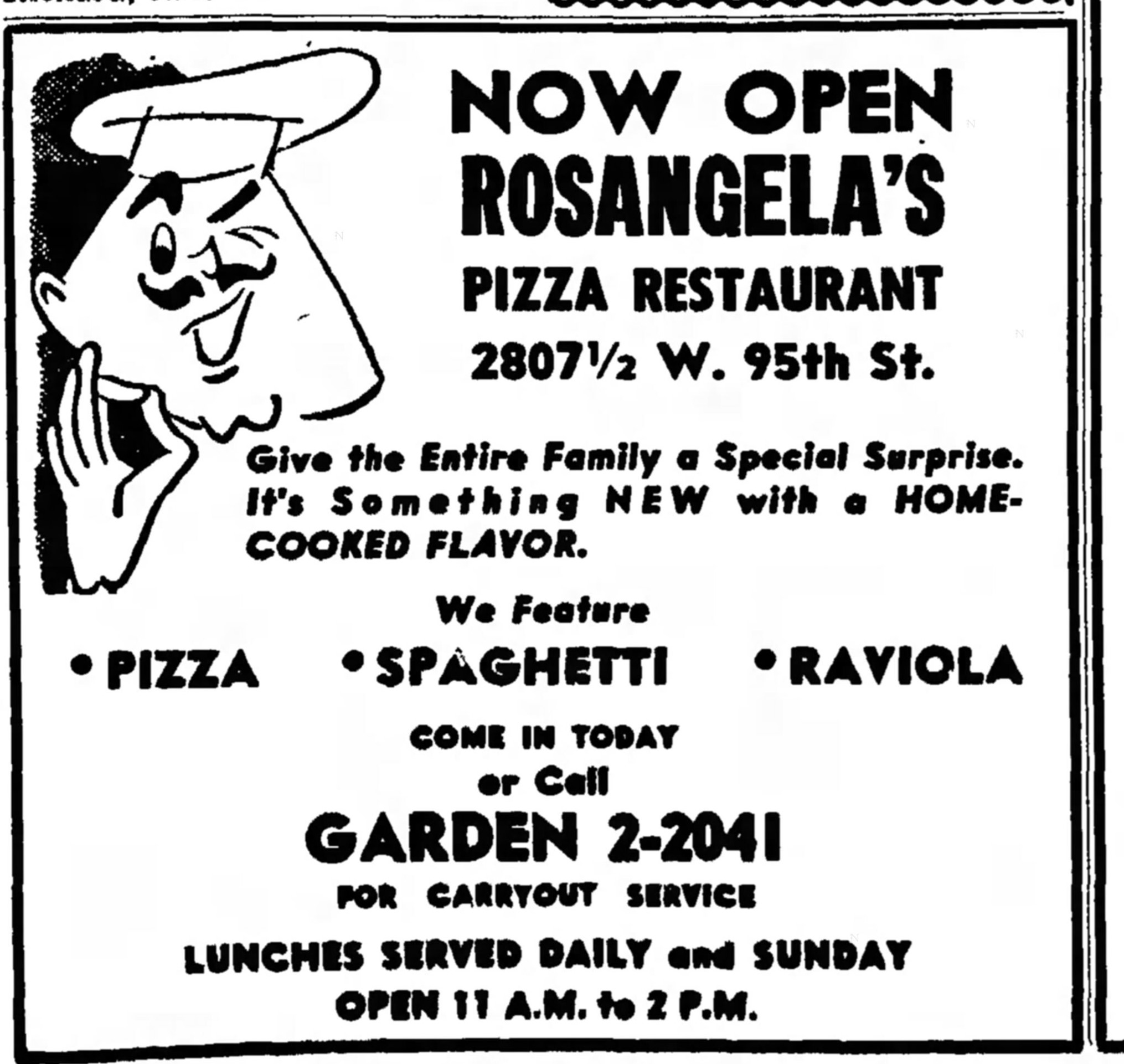
Rosangela’s Pizza on 95th Street in Evergreen Park started as a luncheon place that served pizza in 1954. Often described as an “old school pizzeria” the restaurant is still in operation today, now likely the oldest pizza place on the Ridge, celebrating 70 years in business.
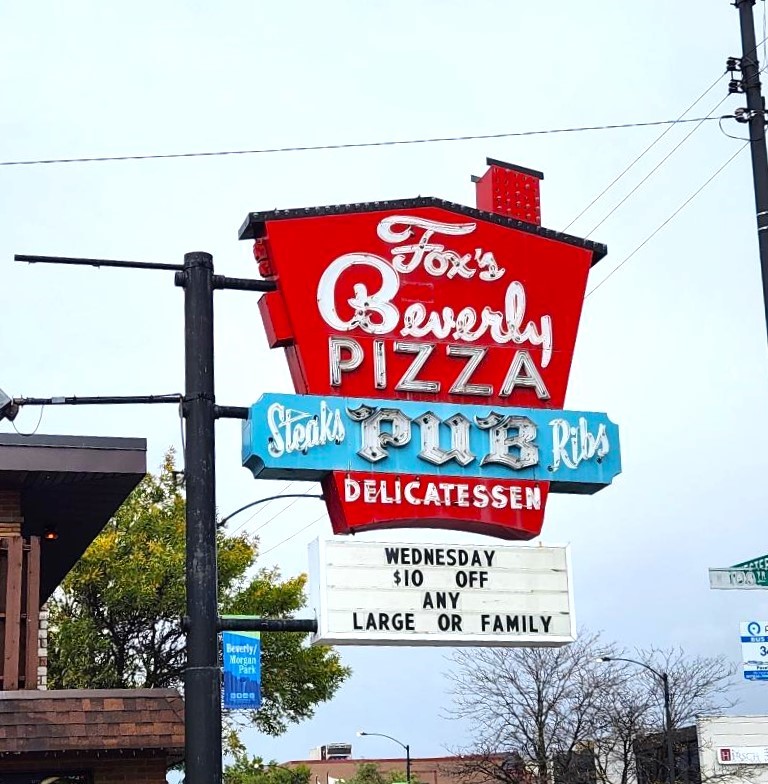
In 1964, Tom and Therese Fox took over a pizza carry-out business on 99th Street and Walden Parkway, and they renamed it the Beverly Pizza House. In 1967, they took over the building and deli business at 100th Street and Western Avenue from Mafalda Capone Maritote, Al Capone’s sister, and opened Fox’s Pub, an Irish pub serving pizzas as its specialty.
Now the oldest pizza place on the Ridge in Beverly/Morgan Park, Chicago, Fox’s Restaurant and Pub is run today by Tom Fox, Jr., and is celebrating its 60th anniversary this year.
To answer the question of who has the best pizza – well, it depends on what you have a taste for, as each pizza restaurant has its own way of doing things, growing out of the tradition of serving a family’s specialty.
For patrons who want to check out the pizza places near or on the Ridge that have stood the test of time, here is the summary:
Vito and Nick’s Pizza at 8433 S. Pulaski Road, although not on the Blue Island Ridge, started serving pizza in 1946 and is one of the oldest pizza places in the city of Chicago.
Rosangela’s Pizza at 2807 W. 95th Street in Evergreen Park, likely the oldest pizza place on the Ridge, started serving pizza for lunch in 1954.
Fox’s Restaurant and Pub, 9956 S. Western Avenue, started serving pizza at its first location on Walden Parkway in 1964, making it the likely the oldest pizza place on the Ridge in Beverly/Morgan Park, Chicago.
Beggar’s Pizza opened in 1976 at the corner of 127th Street and Western Avenue, and today with multiple outlets is likely the oldest pizza place still in operation in the city of Blue Island.