


The Ridge Historical Society
The History of Brood XIII Cicadas in the Chicago Area – Part 4 REVISED and Conclusion
By Carol Flynn
The earliest emergence of Brood XIII of the 17-year periodic cicadas, also known as the Northern Illinois Brood, that people are around to remember occurred in 1939.
Since then, there have been five more emergences – 1956, 1973, 1990, 2007, and 2024.
By 1939, the basics of the cicada life cycle and behavior were known. Future years brought fine-tuning and additions to this knowledge.
In 1956, newspaper articles were still advising on how to use dangerous, deadly insecticides to kill the emerging cicadas and newly hatched nymphs before they could burrow too deeply. Once they got underground, they were harder to destroy.
One article, which appeared in the Chicago Tribune, stated “If you rate yourself a public spirited citizen who wants to help suppress this pest, here is the procedure,” then related how to use nerve gas developed by the Nazis in World War II on the harmless insects.
The chemical could only be used safely if special protective clothing and face masks approved for use with poisonous gases were worn.
It seems incredible today that these chemicals were not only available for purchase by the public back then, but encouraged for use at their homes.
In 1973, the County Extension Offices advised against spraying the cicadas.
“The best alternative to spraying is to have patience for about two weeks and the Cicada will complete its life cycle and pass out of the picture for another 17 years,” said one advisor.
In between 1956 and 1973, biologists realized that Brood XIII is made up of three distinct species of periodic cicadas that are on the same 17-year cycle, and emerge together. Each species has a distinctive “song” adding to the community cicada chorus.
1973 was also the first year that an official “census” of Brood XIII was started to see if the population stayed consistent or fluctuated from one emergence to the next emergence 17 years later.
In 1990, it was reported that the populations of cicadas were down due to the vast numbers of elm trees that had been lost in the last few decades.
The loss of the trees was due to Dutch Elm Disease, a fungal infection, introduced into the U.S. via imports that came through the Netherlands, although the beetle that carried the fungus came from Asia.
The elm trees in the U.S. had no natural immunity to the fungus, so the spread of the disease to the Chicago area, beginning around 1960, led to the destruction of hundreds of thousands of trees here. The Forest Preserves District of Cook County, a major habitat for Brood XIII, lost over 100,000 trees, including many in the Dan Ryan Woods on the Ridge.
2007 was the first time “cicada mania” took over.
“Cicada cuisine. Cicada sculptures. Cicada poems. Cicada blogs. Cicada tank tops, baseball hats, and coffee mugs. Even a traveling CicadaMobile,” reported the Chicago Tribune. Photographing cicadas became a popular undertaking in 2007. Chicago became a destination spot for people wanting to experience the cicadas.
Cicada cuisine has been a topic over the years.
That animals in the wild, as well as pet cats and dogs, enjoyed them was well known. In 1956, Brookfield Zoo requested that the public collect cicadas and bring them to the zoo, where they fed them as a treat to the birds, reptiles, and even some of the monkeys. The zoo received so many cicadas they froze them for use during the winter.
It is reported that the Brood XIII emergence, as well as other large brood events in other parts of the country, has unexpected consequences – the creation of temporary imbalances in local ecosystems. As the wildlife fills up on cicadas, the usual insects and small prey they eat, including some considered “pests” for crops and gardens, proliferate, and it can take several years for levels to return to “normal.”
Human consumption of cicadas remains of interest. It was reported early on that some Native Americans and early settlers ate them.
Newspaper articles give directions for harvesting cicadas, and recipes for preparing them, from coating them in egg-batter and deep frying them to using them in pies. Their taste has been described as “sweet and nut-like,” “crispy chicken nuggets,” and “new potato with a hint of avocado.”
Cicadas also have their place in myths and superstitions.
They were considered locusts for centuries, and a bad omen, that would destroy crops. This was not true; cicadas are not related to locusts at all.
In some ancient cultures, they were considered a sign of rebirth and transformation. They were also often a symbol connected to music.
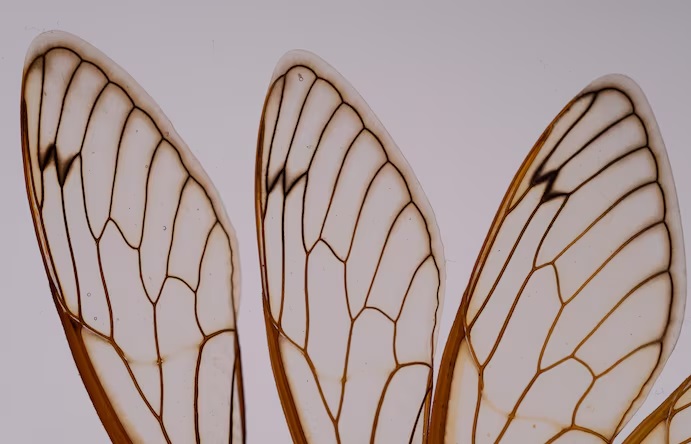
For a long time, before their regular lifecycles were understood, they were considered the forecaster of wars, because there is the appearance of a “W” on their wings.
Of all their traits, though, the one that fascinates people the most is the periodic cicadas’ emergence in 13- and 17-year cycles.
These “prime number” occurrences have resulted in several theories as to their origins, usually relating to “survival of the fittest” natural selection to avoid predation.
However, to some conspiracy theorists, there may be something more sinister going on here. Cicadas could be human-engineered, or even from another planet.
The emergence of Brood XIII is coming to an end for this cycle.
Although very dramatic, and loud, in some places, there is anecdotal evidence on the Ridge that the numbers are down this year due to the decrease in old-growth deciduous trees, those that drop their leaves annually, like the old oak trees that grace the area.
These trees are dying off due to old age, and they have not been replaced over the years. As the trees die off, so do the cicadas that live in their root systems.
There will be many less trees and therefore less cicadas in the coming years if trees that can host and sustain cicada populations are not planted to replace the ones that are removed.
This brings to a pause this series on Brood XIII of the North American periodic cicadas. The story will resume in 2041.