
The Ridge Historical Society
The History of Brood XIII Cicadas in the Chicago Area – Part 3
By Carol Flynn
By the time settlers from Europe started putting down roots in the Chicago area in the late 1700s, the people on the East coast had been documenting and discussing the periodic cicadas for over a century.
The periodic cicadas of the genus Magicicada, found only in North America, have characteristics that make them unique in the animal kingdom.
These characteristics are the 13- or 17-year lifecycles they have evolved, and the synchronized emergence of almost all the insects in a species at the same time in the same year.
In the early 1800s, cicadas were still confused with locusts, but really the two insects were very different. Cicadas did not descend upon and destroy crops the way the biblical swarms of locusts did, and this difference was starting to be slowly recognized.
The thinking about the cicadas was shown in a succession of articles in the Chicago Tribune in 1871, a year that the same species of cicadas emerged that are emerging now. By that year, the communities of Beverly and the new Morgan Park were being built, so these insects certainly would have been noticed on and around the Blue Island Ridge.
Some excerpts from those articles are:
May 30: “The much-dreaded seventeen-year locust has already appeared in Illinois. They will probably be found all over the northern part of the State, in greater or less numbers, and will undoubtably make immense havoc among the fruit trees and shrubs, while they threaten but little damage to the grain. The locust is reported to have last appeared in this section in 1854, so that it is due in 1871.”
June 19: “The insects are said to be really no locusts at all, no more than a horse is a hog. [They are] scientifically quite distinct. We saw them on the trees in myriads, and the smaller limbs and twigs were bored by them and millions of eggs deposited in the wood. The noise made by them in the forest is wonderful…. Of all the curious creatures that we have seen, they ‘beat all nature.’”
June 28: “The mission of the seventeen-year locusts has apparently been discovered. It having been ascertained that these celebrated insects have not visited … for the purpose of devouring the crops, as the farmers had anticipated, it came to be a question what under heaven they did come for.” With tongue in cheek, the article decided the cicadas came to entertain schoolboys, providing them with a means to disrupt classroom activities.
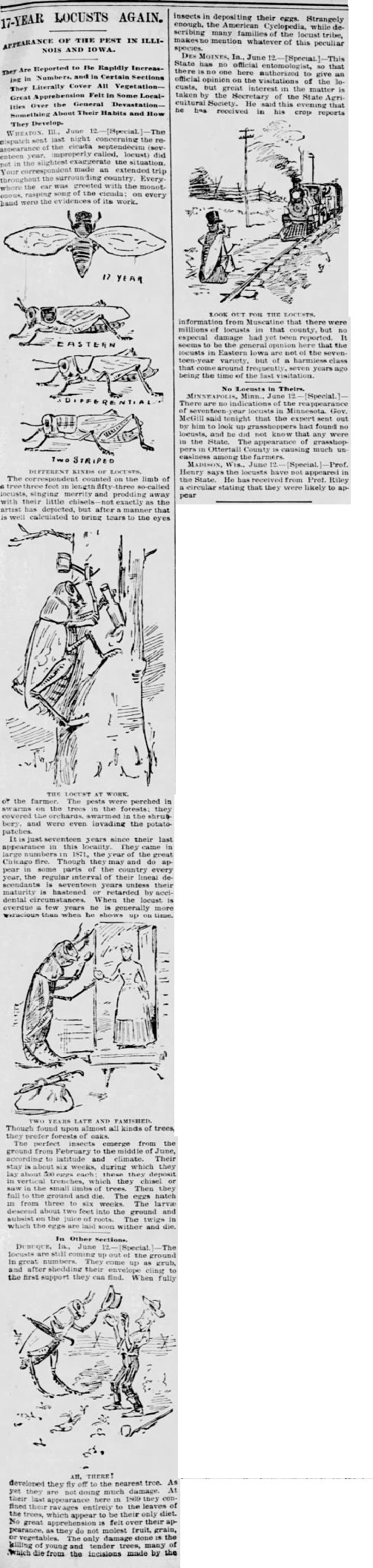
In 1888, seventeen years later, the newspapers covered the next emergence of the periodic cicadas in the Chicago area. By then much of its lifecycle was documented, but still not well understood.
Chicagoans were familiar enough now with the cicadas, however, to start thinking of them in more entertaining ways. An article in the June 13 Chicago Tribune, included as an attachment to this post, used illustrations giving them some human characteristics.
They were still having trouble with a common name for the insect, however. On July 5, the Inter Ocean newspaper reported: “The insect known as the seventeen year locust is not a member of the locust but of the cicada family, and its correct name is the harvest fly.”
By 1905, Chicagoans were starting to get downright blasé about the cicadas, and the comments were sarcastic or ironic.
Some examples were:
Chicago Tribune, April 24: “The seventeen year locusts … are due again this spring. They will have to come early if they expect to hold their own with the every-year insect pests.”
Chicago Tribune, June 7: “’What are you making such a hideous racket about?’ asked the caterpillar. ‘Mind your own business!’ retorted the seventeen year locust. ’This is the first chance I’ve had to make a noise since 1888!’ Whereupon he started up his buzz saw again.”
Chicago Tribune, June 8: “If the seventeen year locust could be grafted on the mosquito there might be sixteen consecutive years worth living, anyway.”
Chicago Tribune, June 26: “In addition to its other objectionable qualities the seventeen year locust labors under the hallucination that it can sing.”
However, with every emergence, new facts about the cicadas were being learned. In 1905, it was reported that sometimes the 17-year cicada “gets dates mixed up and comes out ahead of time.”
Scientists have observed that some of the periodic cicadas emerge one or four years too soon, or four years too late. Why this occurs is still a mystery. One theory is that these “stragglers,” as they are called, may be developing too quickly or too slowly, but that does not explain why this occurs in four-year cycles.
By 1922, the value of cicadas was starting to be recognized, and actual praise and fondness for the insects started to creep into reports about them.
In the Chicago Tribune on July 9, an article called them a “magnificent visitor” with “rich coloring” and “intense coral eyes,” “the least pestiferous pest that ever swarmed over the country.”
The article noted the fondness animals had for eating them, from birds to cats and dogs. It was noted that animals filling up on cicadas left their usual food uneaten, and “if the cherries hang in rich, red clusters it is because the birds and squirrels are too fed up with locusts to notice their former favorite food.”
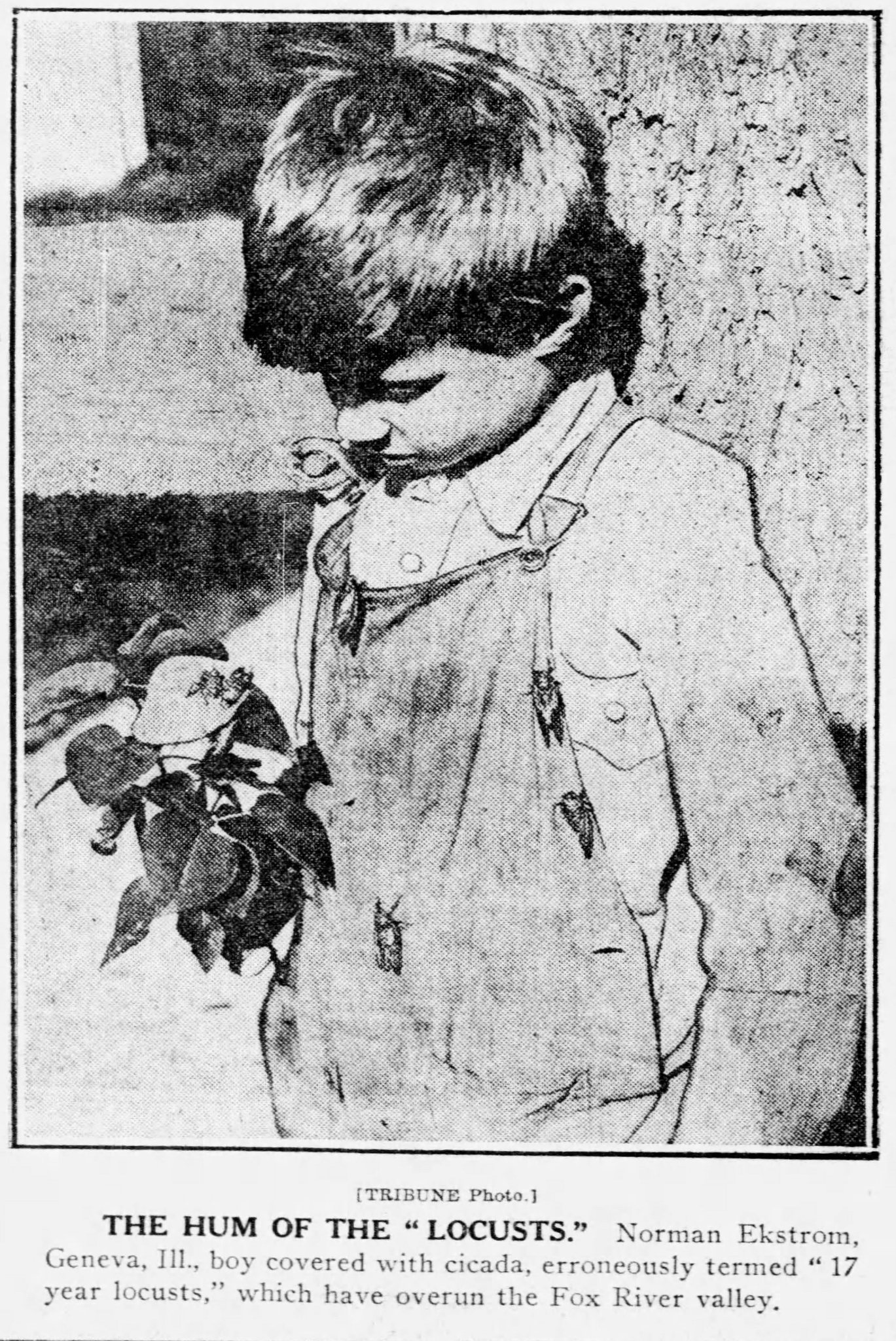
Photos of the cicadas started being used in the papers.
This was also their first emergence year when they started being referred to regularly as Brood XIII of the 17-year cicadas. This numbering system started in 1893, developed by Charles Marlatt to replace the very complex and difficult system that existed previously.
A “brood” has been described as like a graduating year for a classroom of cicadas that have all grown up together. In the system, the numbers 1 to 17 denote the 17-year cicadas, and 18 to 30 the 13-year cicadas.
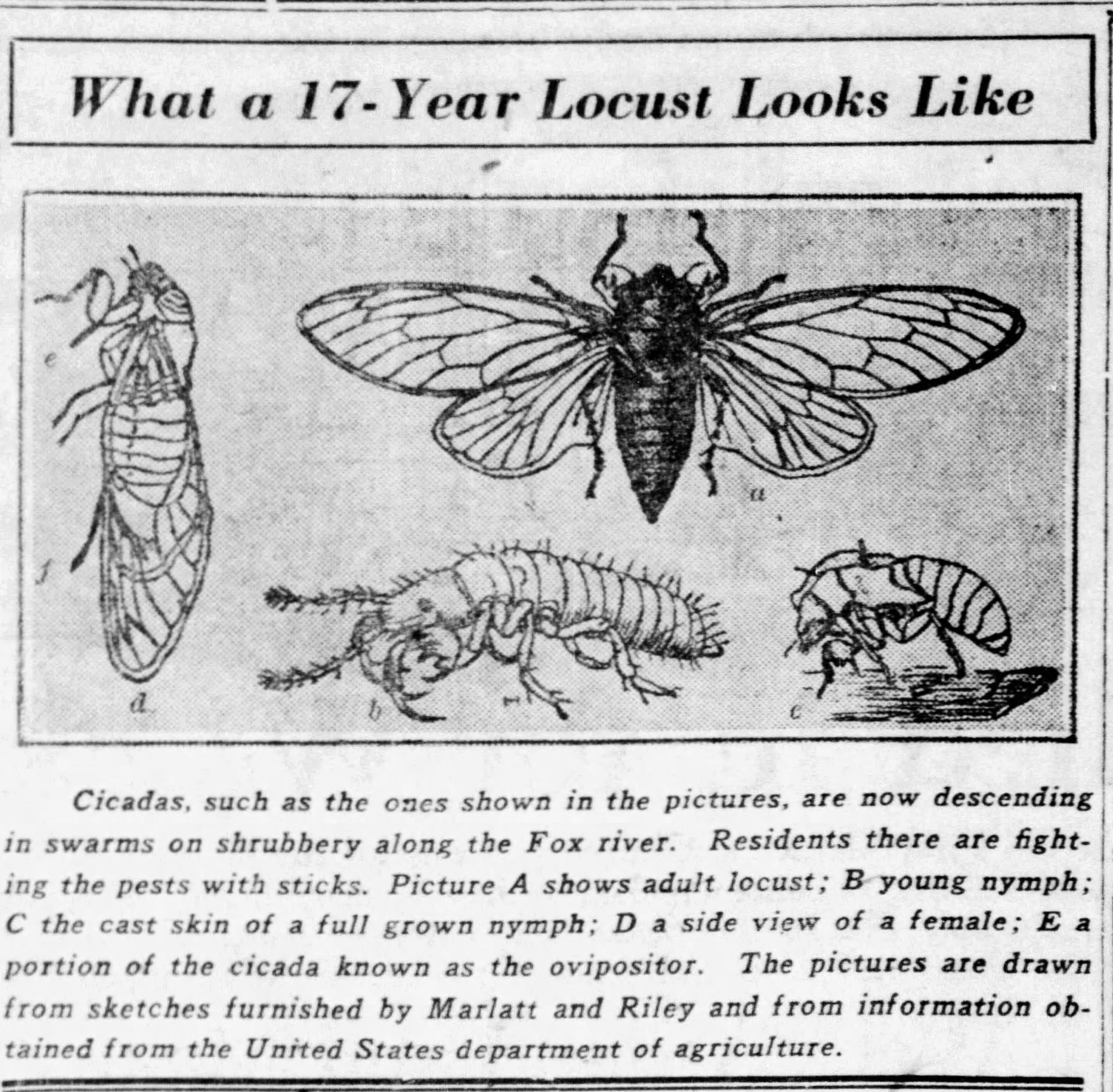
An illustration by Marlatt of the “Seventeen Year Locust” which is now known as Brood XIII appeared in the Chicago Tribune in 1922.
The next emergence of Brood XIII was in 1939. That would be the earliest year that people who remember it are still around. The next post will look at cicadas in “recent memory.”