The Ridge Historical Society
Louise Barwick – Part 2
By Carol Flynn
The Ridge Historical Society’s new exhibit, “Louise Barwick’s Lost Ridge,” may be viewed on Tuesdays and Sundays from 1:00 p.m. to 4:00 p.m. or by appointment. RHS is located at 10621 S. Seeley Avenue in Chicago. The exhibit is free.
This exhibit focuses on life on the Ridge from 1893 to 1905 as seen through the watercolor paintings of Louise Barwick, an artist and educator who lived on the Ridge. Other components of the exhibit include a section on aerial photography taken by cameras attached to kites, and “lost and found” architecture – historic photos of buildings, some of which remain and some of which are gone from the Ridge.
This Facebook series on Louise Barwick complements the exhibit, but does not repeat it. More information on Louise herself, her family and her history, is being presented in this series. The exhibit concentrates more on visual images of the Ridge in the late 1800s.
This post will look at Louise’s maternal ancestors.
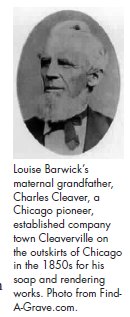
Charles Cleaver, Louise’s maternal grandfather, was born in London in 1814 into a family famous for soap-making. The Cleavers began the company that would change its name to Yardley of London after two Cleaver sons married Yardley daughters, and the Yardley family eventually took over the business.
In October 1833, Cleaver arrived in Chicago, when the city, in his own words, “… was just springing into existence … when the only sidewalk Chicago then had was an Indian trail along the river bank.”
Cleaver started the first soap and candle factory in what is now downtown Chicago. Cleaver also had a general store which he ran with his brother William.
Soap and candles were made from animal fat, usually beef tallow or pork lard. Therefore, essential to the operation were slaughterhouses and meat packing plants. Cleaver took all the lard and tallow from the meat packing houses of the city, and rendered it, that is, melted it down and clarified it (strained it to remove impurities) in the melting house adjoining the factory. He soon was the major supplier of rendered oils and other products made from the oils for the country west and north of Chicago.
In 1838, he married Mary Brookes, from another pioneer family, and they had eleven children.
Around 1851, Cleaver bought land around what is now 35th Street and Cottage Grove. He built a meat packing facility and soap making and rendering works, and a general store. He created Cleaverville, a company town, to house his employees. He erected numerous homes and a meeting house, which was also the first church. Cleaver paid the Illinois Central Railroad to run trains to his settlement. Brother William served as postmaster and ran the store, among other duties.
Cleaverville ran from 35th Street and the lake west to Cottage Grove/Vincennes Road, and south to 43rd St., just north of Hyde Park. In fact, Cleaver coined the name Cottage Grove, because, yes, there was a cottage in a grove on the site.
Cleaverville was a smaller version and forerunner of the Pullman area, which would be built 30 years later by George Pullman as a company town for his railroad car business.
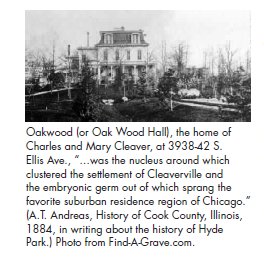
In 1853, the Cleavers built a grand house at 3938 Ellis Ave., which became the center of Cleaverville activities. The house was known as Oakwood Hall or Oak Wood Hall.
Up to 1856-57, Cleaver did all the melting for all the meat companies in the city. In 1857, Cleaver discontinued his soap factory, and turned his attention to real estate. He became one of the leading real estate men of the city.
The Cleavers, and later the Barwicks, were active in numerous organizations and listed in social registries. They were often covered in the society pages. One example occurred in 1864, when the Chicago Tribune described a holiday “Fair and Festival” planned to take place at the residence of Charles Cleaver, Esq., arranged by the ladies of the Salem Congregational Society, the church founded by Cleaver and his father-in-law Samuel Brookes. The event was a fund raiser for the church.
“There will be room for all, and the attractions will be of the very first order,” promised the Tribune. Plans called for an “excellent supper, and a choice collection of toys and fancy articles, most seasonable just at this time among the little folks.” Admission was 25 cents, “and the locality is just the pleasantest of all directions for an evening sleighing party. The ladies of Cleaverville deserve to be well-rewarded for their enterprise….”
Beginning in the late 1860s, Cleaver shared his experiences and memories of the very earliest days of Chicago in articles and talks. A collection of these materials was published as “Early Chicago Reminiscences” in 1882 by Fergus Printing Co. and is well worth a read by Chicago history buffs.
Charles Cleaver died in 1893 and is buried in Oak Woods Cemetery.
The next post will look at the Brookes family, Louise Barwick’s maternal grandmother’s side, another very early family in Chicago history.