The Ridge Historical Society
Myrtle’s Doll
By Carol Flynn
Today on All Souls Day when we remember and honor our departed loved ones, little Myrtle McCray’s story is especially touching. The researchers at the Ridge Historical Society brought this story to light.
Myrtle was not quite two years old when she died of influenza and pneumonia in 1918 during the historic influenza pandemic. Her family lived downstate near Coal City, where her father worked as a miner. The large family, ten people, slept in one room as was common at the time. Only Myrtle became ill and died from the flu.
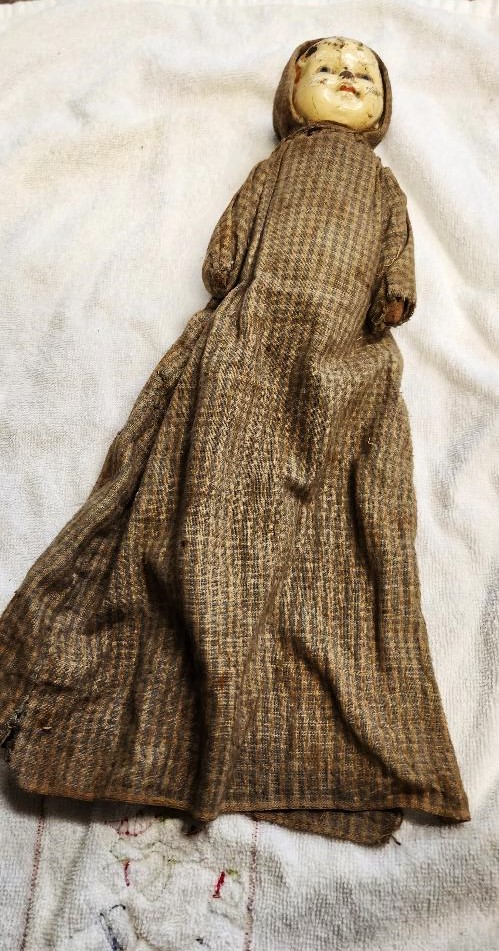
According to McCray family stories, Myrtle died holding her beloved doll, which had been passed down not only through her own generation but likely also through previous generations. The handmade doll was already well loved and well worn by the time it became Myrtle’s treasure.
Myrtle’s older sister, Hazel, who was about ten years old at the time, saved the doll as the only remembrance she had of her baby sister. There was no money then for photos of a little girl like Myrtle.
Hazel kept the doll in a cedar chest all her life. Hazel had two daughters, and she would show them the doll and tell them about Myrtle and her beautiful blond curls. The daughters came to cherish the doll and the story of their Aunt Myrtle. When their mother died, the doll was passed along to the oldest sister, and when that sister died in 2021, the doll became the property of the younger sister, Patricia Rose Wulf, of Beverly/Morgan Park.
Patricia and her husband, the late Col. Jerry C. Wulf, USMC (Ret.), moved to Beverly/Morgan Park in 1964. They raised their son and daughter here. Patricia was a member of the Beverly Juniors and has many friends and contacts in the area, including Elaine Spencer, past President of the Ridge Historical Society. Elaine’s husband, the late Carl Spencer, also a military veteran, and Jerry Wulf were good friends.
Now in her eighties, Patricia became concerned about what would happen to the doll when she was no longer able to care for it. With its peeling plaster face and its old worn fabric body and clothes, by the standards of many people, the doll was “creepy.” The next generation of Patricia’s family showed no interest in continuing to hold onto this doll, and she did not want to see it thrown away.
Patricia realized what she really wanted to do was to return the doll to Myrtle, at least in spirit.
She did not want to bury the doll in her backyard where it could be disturbed. She lived at 108th and Fairfield Avenue, right by Mount Greenwood Cemetery, so she decided to leave the doll at the cemetery with the hope that the cemetery would give it a permanent home.
Although Myrtle was not buried in Mount Greenwood Cemetery, but in a cemetery downstate in Girard, Illinois, Patricia believed that Myrtle’s spirit would know the doll had been returned.
Patricia lovingly wrapped the doll in towels and a little blanket, and placed it in a plastic box. She included a note that read: “Dear Little Myrtle: You have waited over a 100 years for your baby doll. Now she is returned to you from your loving family. Myrtle died in the 1918 Spanish flu.” She also included a tag with her contact information. This was in the summer of 2022.
The President of the Mount Greenwood Cemetery Association, Paula Everett, who is also a long-standing member of the RHS Board of Directors, found the plastic box behind an urn by a mausoleum in the cemetery. Taking the box back to the office, she was surprised and intrigued to discover the doll inside. She checked cemetery records, but there was no Myrtle buried in that mausoleum. Busy at the time, she put the doll in its box aside for further investigation in the future.
About three weeks ago, Paula mentioned the doll to the RHS Facebook page administrator. A search of the burial records from 1918 had not turned up any Myrtle buried at Mount Greenwood Cemetery. Paula wondered if the RHS researcher/writer would have any interest in this story, and of course the answer was a resounding yes.
Patricia Wulf was located, now living in Clarendon Hills. As she frequently comes to Beverly for appointments and to visit friends, she met the researcher at Beverly Bakery for brunch one Friday morning, and shared the story of Myrtle’s doll.
Despite its appearance, there’s really nothing “creepy” about the doll once the story is known. It is a story of family love and memory and preserving a family’s history.
The doll is now safely put away in a storeroom at the cemetery with other items that have been left at the cemetery through the years.