
The Ridge Historical Society
The Early Days of Morgan Park – Part 5: More Founders of Morgan Park
By Carol Flynn
In previous posts, we looked at two of the prominent Chicago businessmen who developed Morgan Park, Frederick H. Winston and John F. Tracy. Both were executives with the Chicago, Rock Island, and Pacific Railroad (CRI&P) and both were founders of the Blue Island Land and Building Company (BILBCo).
Other men important to Chicago’s history were also part of the BILBCo.
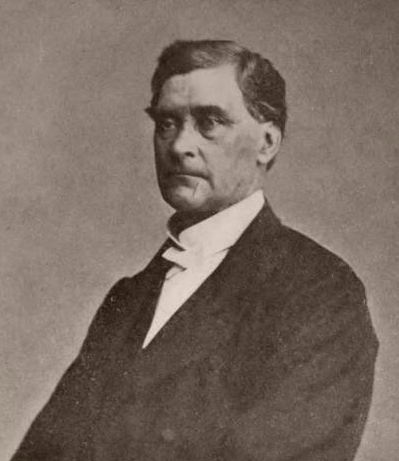
CHARLES VOLNEY DYER (1808-1878) was a physician who came from Vermont to Chicago in 1835, where he served as Surgeon for the garrison at Fort Dearborn, and later went into private practice.
Dyer made the wise decision to invest in real estate, and he was able to retire in 1858. Presumably, his investment in the BILBCo paid off favorably.
He and his wife Louisa had three children and an adopted daughter who lived to adulthood.
Dyer is best known for being an ardent abolitionist. As early as 1837, he held a protest meeting in reaction to the murder of Elijah Lovejoy by a pro-slavery mob in Alton, Illinois. Lovejoy was the owner of a newspaper that advocated for ending slavery. The Lovejoys were good friends of Abraham Lincoln, and their nephew Austin Wiswall lived in Morgan Park and was a member of the Village Board of Trustees in the 1890s.
Dyer actively fought against slavery. He became a stationmaster on the Underground Railroad, hosting many escaped slaves, some brought to him by Owen Lovejoy, Elijah’s brother.
In a famous incident, a young escaped slave staying with Dyer was re-captured by slave traders and held at a hotel. Dyer burst into the room and cut the ropes to free the youngster and told him to flee through the window. One of the slave traders attacked Dyer with a knife and Dyer beat him unconscious with his walking stick.
A later connection between Dyer and Beverly/Morgan Park was the Loring School for Girls. Dyer’s daughter Stella Dyer Loring established this private school in 1876. From 1935 until the school’s closing in 1962, it was located in the England J. Barker House at 107th Street and Longwood Drive.
Dyer's photo is attached to this post.
CHARLES W. WESTON (1833-1880) was born in Massachusetts and had a career in manufacturing and merchandising. He came to Chicago in 1866 and made a new career in real estate investment. He also invested in elevated railways, or streetcars, and was named as Treasurer of the West Chicago Elevated Railway in 1879.
Weston died of consumption (tuberculosis) at the age of 48. He was living at the Palmer House at the time with his wife Mary and their ten-year old son. A special funeral train brought his coffin and mourners to Mount Greenwood Cemetery.
JOHN BACON LYON (1829-1904) was born in New York in 1829 and came to Chicago as a grain merchant in 1857. He joined the Board of Trade and became one of the longest-standing members. It was reported that he was involved in more deals than any other grain trader in the west.
Lyon was also involved in real estate, and had interests in the timber, turpentine, oyster, and sugar industries. He was known for his insightful investments, and keen judgment, making him one of the most successful businessmen in Chicago. He was also a founding member of the Chicago Historical Society.
He, his wife Emily, and their five children lived at 262 Michigan Avenue.
The next post will look at some of the BILBCo men who lived in and developed sections of Beverly.