The Ridge Historical Society
The Early Days of Morgan Park – Part 1
By Carol Flynn
Selecting a date to recognize the “beginning” of Morgan Park is arbitrary.
Indigenous people lived in the area for thousands of years before the European settlers came, so habitation is not really the measure.
What is really being decided is a date to mark the transition from Natives to non-natives as the predominant inhabitants of the Ridge.
The identity of the first non-native to step foot on the Ridge, and when that person came, will never be known with certainty. The first written records of explorers in the Chicago area date to the 1600s. Jean Baptiste Point du Sable of African descent is recognized as the first non-native to take up residence in the downtown area around 1790.
Fort Dearborn was established in 1804 and survey teams operated from there. They could see the Blue Island rising from the prairie twelve miles to the southwest.
In 1972, a group of Beverly/Morgan Park residents proposed that the community recognize the year as the sesquicentennial of the founding of Beverly/Morgan Park. This was based on the arrival of French-Canadian fur trader Joseph Bailly in 1822 at Porter, Indiana, on the Calumet River, where he established a homestead. Bailly was from a well-known family that ran trading posts from Michigan to Chicago. He interacted with the local Native Americans, predominantly the Potawatomi, and travelled their paths and waterways.
It was surmised that Bailly knew well the local Natives, and the Vincennes Trail that ran through the Ridge, and that he “opened up” the Blue Island Ridge to the fur trade. Therefore, they believed this was the start of current history, at the time 150 years in the past. There was a year’s worth of celebrations in 1972 to mark this anniversary.
A decade after Bailly, in 1832, DeWitt Lane built a cabin at what today is about 102nd Street and Seeley Avenue. He didn’t own the land; the U.S. government had not yet put it up for public sale.
The Native Americans gave up ownership of the land with the Treaty of Chicago in 1833, and began to leave the area.
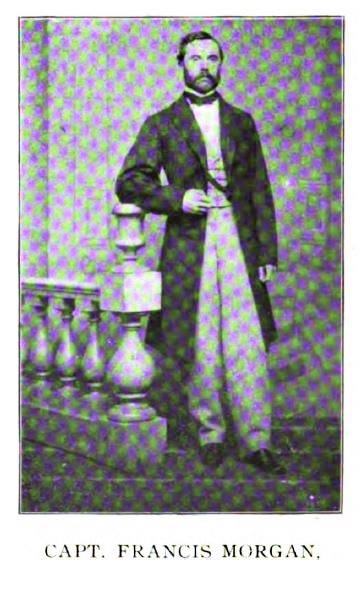
The government began public domain land sales in 1834. John Blackstone bought up substantial property on the Ridge in 1835 and 1839, and reportedly built a house in today’s North Beverly. In 1844, he sold the land to Thomas Morgan from England who moved here with his family, livestock, and hounds, and established an estate he called Upwood around 91st Street and Longwood Drive.
At the same time, settlement was going on at the southern tip of the Ridge, where the city of Blue Island was being established. Other homesteads were being established along the Vincennes Trail; Norman Rexford and Jefferson Gardner were there in 1834. Because Morgan did not like the Vincennes Trail running through his property, he rerouted it to the east below the Ridge.
Thomas Morgan died in 1851 and the estate passed to his widow, Anna, and their nine children. In 1868, a substantial portion of the estate was sold to a group of investors headed by Frederick H. Winston, and Winston took legal title from the Morgan heirs. In 1869, the group of investors incorporated as the Blue Island Land and Building Company (BILBC), and Winston transferred the title to the company.
Some of this land they sold off immediately, and it became the Village of Washington Heights that included today’s Beverly. Washington Heights was incorporated as a village in 1874, and was annexed to the city of Chicago in 1890.
The BILBC developed some of the land into a section they called Morgan Park, which was incorporated as a village in 1882, and was annexed to Chicago in 1914.
The next post will look more at the BILBC and the establishment of the Village of Morgan Park.