
The Ridge Historical Society
Part 10 – The Hofer Sisters and Politics
By Carol Flynn
The Hofer family lived in Beverly from the early 1890s to the mid-1910s, about 25 years, during the height of the Progressive Era.
That era was marked by widespread reform and change in just about every area of life, from education to business to human rights. Today, kindergartens and other early development programs for young children, playgrounds, parenting classes and resources, and related activities are taken for granted. However, 100 to 150 years ago, they were considered radical, “progressive” social movements that visionary people fought to establish.
They also fought to establish rights for children. Using children for hard labor, in sweat shops, and out on the streets, was condoned for centuries, like slavery had been. Slavery was abolished in the 1860s, and the Progressive Era saw the beginning of the end of that kind of abuse of children.
While the Hofer sisters were leaders in these movements, their political activities extended beyond these issues. The five Hofer sisters were all politically active, but especially so was Andrea Hofer Proudfoot, who rose to international fame for her contributions to the international peace and amnesty movement.
The progressive spirit came from the Hofer parents, Andreas and Mari, revolutionaries from the German-Swiss border area. In the U.S., they moved from the east coast to Iowa seeking new opportunities and to be closer to friends. There, a brief stint in the early 1850s in a socialist commune called Communia left them disillusioned with socialist and communist systems, but still believing in the need for social and political reforms.
The Hofer family ran a newspaper in Iowa for many years which gave them the opportunity to share their progressive beliefs. All of the children worked at the newspaper, and the three sons moved to the west coast to pursue careers in the newspaper publication business.
The Hofer parents and the five daughters moved to Chicago to allow the daughters education and employment opportunities, itself a progressive attitude toward women.
The Hofer sisters, as no surprise, were suffragists, believing that women should have the right to vote. In an article in 1912, Andrea was described as “outspoken and sweeping in her advocacy.” When another woman suggested “indirect influence” was preferable to voting, Andrea “scathingly denounced this as immoral and wrong.” She used parenting as an example to explain her view. A parent does not “influence” children; a parent would “inculcate right principles and teach children to stand firmly by these.”
Women received the right to vote in the U.S. in 1920 when the Nineteenth Amendment to the U.S. Constitution was ratified. Long before that, however, they were involved in politics at the local, national, and international level.
The kindergarten movement was an international movement that originated in the Switzerland/Germany/Prussia area and spread to the U.S., thanks to women like the Hofer sisters. The kindergarten movement started with Swiss educator Johan Pestalozzi in the late 1700s, and was furthered in the 1800s by Friedrich Froebel in Prussia/Germany. Several of the Hofer sisters did graduate work in Berlin, Germany, at the Pestalozzi-Fröbel-Haus. Froebel’s niece ran the program in Berlin.
Andrea spent time in Europe, not just for her own education, but with her children. For periods of time, she left her school in Beverly in the capable hands of her sisters Elsa and Mari and resided overseas.
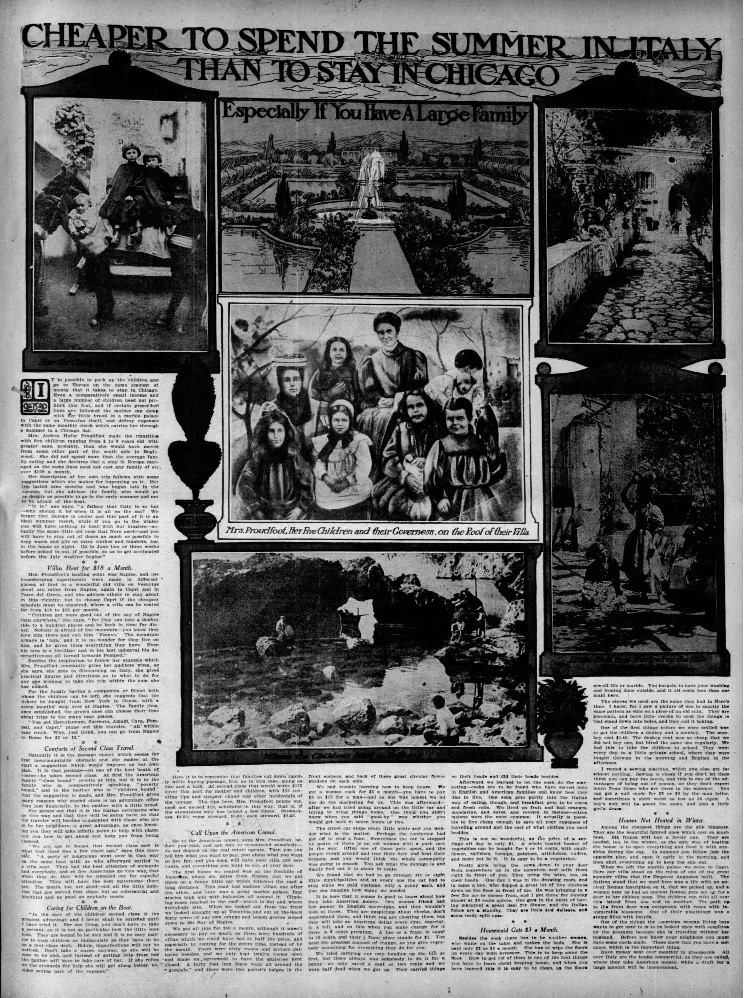
In May of 1907, the Chicago Tribune ran a full-page story about Andrea and her five children, ages 2 to 9, moving to Italy for nine months. The article focused on how economically she was doing this, spending no more than it would have cost to stay home in Chicago. The article was full of advice from Andrea, from booking second class steerage on a ship to renting a villa and hiring local help to keeping warm in winter. The children traveled by donkey cart to a private school that taught German. Andrea’s husband Frederick, a lawyer with the Chicago Board of Trade, stayed home in Chicago, and sent the adventurers money on a monthly basis.
Quite a few pacifist and women’s rights organizations were formed in the late 1800s, in the U.S. and in Europe. The pacifist and feminist causes became intertwined at an international level; in fact, historians have found that pacifism and this first-wave of feminism were equated in the minds of the general public at the time.
One very prominent international woman pacifist was Baroness Bertha Von Suttner (1843 – 1914) of Austria. The Baroness founded the Austrian Peace Society in 1892, and in 1905 she was named the Nobel Peace Prize laureate, in part due to her 1889 anti-war novel “Die Waffen nieder!” as well as numerous other political pacifist writings and lectures. [Andrea Hofer Proudfoot adapted the Baroness’s novel into English (Disarm! Disarm!) in 1913 and it is still available today.]
The Baroness addressed many of her communications directly to women and the women’s clubs of the U.S. became her followers. In 1912, thanks to the Hofer sisters, she made a coast-to-coast tour of the U.S., speaking to women’s groups and peace organizations. She advocated for universal peace and women’s suffrage, declaring them “the two great movements for the betterment of humanity.”
The next post will cover the Baroness’s visit to the U.S., and other political activities of Andrea and her sisters.