
The Ridge Historical Society
The History of the Graver-Driscoll House – Part 7: The Fenn Family
By Carol Flynn
Every house has a history.
Today we return to the history of the Graver-Driscoll House, the headquarters for the Ridge Historical Society, which celebrates its centennial this year.
Designed by architect John Todd Hetherington, the house was built in 1921-2 for Herbert. S. Graver, Sr., his wife Anna, and their infant son Herbert, Jr. Graver was an executive with the family’s business, the Graver Tank Works, and a college football star whose University of Michigan team played in, and won, the first game in Pasadena in 1902 that became the Rose Bowl.
In 1940, the Gravers sold the house to John Grant and Grace Fenn. The Fenns had two children, Helen and Grant. The address used for the house at the time was 10616 South Longwood Drive, and the only entrance to the property on the top of the Ridge was via the steep driveway on Longwood Drive.
The Fenn family only owned the house from 1940 to 1946, yet it became a legendary location in their family history due to a special event that occurred there, the wedding of Helen to Lt. Alden J. “Buzz” Ritter in August of 1943.
The Fenn – Ritter family and RHS formed a bond over the years, and the family has shared numerous pictures and family stories with RHS. This past summer, the family donated Helen’s wedding dress to RHS.
John Grant Fenn was born in Chicago in December of 1890. His father was a traveling salesman at the time, then later worked at the steel mills in accounting.
Grace Harrison was born in September of 1891. Her father was the superintendent of schools in Union, Indiana.
John Grant and Grace married in 1916 in Cook County. Daughter Helen was born in 1918 and son Grant in 1924.
John Grant, usually referred to as J. Grant, earned a B.S. in mechanical engineering from the Armour Institute of Technology, which merged into the Illinois Institute of Technology. At the time he married, he was employed by the London Guarantee and Accident Co. as a factory inspector.
By 1920, the Fenns were living on 100th Place in Beverly. They were active in the local social scene; for example, one newspaper article reported that in December, 1929, they were part of the Entre Nous Dancing Club that held a dance the Ridge Park field house. J. Grant was on the committee for the dance.
In 1934, J. Grant Fenn and W. Proctor Roberts formed a corporation, Air Tempering Systems, Inc., to manufacture heating, refrigeration, and air-conditioning equipment and parts.
Air conditioning was an emerging industry. The concept of cooling went back to ancient times, using ice and snow. By 1900, ammonia–cycle artificial refrigeration systems were being used in the food industry, especially the Chicago meat packing houses. Air conditioning premiered at the 1904 World’s Fair in St. Louis. At the time, the machinery was too large, cumbersome, and expensive to be considered for home use.
Engineers, however, kept working on improvements, and in 1927, General Electric released the Monitor Top, the first refrigerator to run on electricity. By 1930, with the synthesis of artificial refrigerants like chlorofluorocarbons (which were eventually banned), the practicality of cooling systems for home use finally became realistic. The 1930s and 1940s saw the innovations that led to window air conditioners and by the 1960s, central air conditioning.
J. Grant apparently did well with the business through the years of the Great Depression. In 1934, the Fenns began purchasing property in Clearwater, Florida, and to divide their time between there and Chicago. The Florida newspapers reported they entertained aboard their cruiser, Goldreme.
In 1940, they purchased the Graver House. According to the family, sometime during the 1940s, they also purchased the strip of land between the house and Seeley Avenue to the west to build a second driveway entrance, at 10621 South Seeley Avenue, the address RHS uses today. The drive up the steep hill on Longwood Drive in the winter ice and snow was no longer a necessity.
On his World War II draft registration, J. Grant listed his occupation as a self-employed mechanical engineer.
The Fenns lived in the Graver House during the years of World War II. Grace was mentioned in the newspapers for helping to entertain servicemen. Son Grant attended Morgan Park Military Academy, and Grace was active with the Alumni Mothers group.
John Grant Fenn died in 1945 and was buried in Mount Greenwood Cemetery, where his parents had been buried many years before.
Grace sold the Graver House in 1946. She eventually moved to Clearwater, Florida, where she died in 1988 at the age of 96. Her remains were returned to Chicago for burial in Mount Greenwood Cemetery.
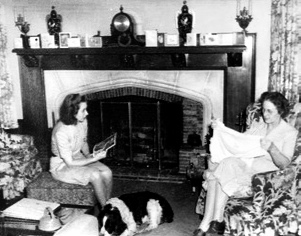
In this photo, Helen and Grace Fenn relax in their family home from 1940-1946, the Graver House.
Next installment: The Fenn children, Helen and Grant.