
The Ridge Historical Society
The History of the Graver-Driscoll House – Part 5: The Graver Family and the Graver Tank Company
By Carol Flynn
Following the U.S. Civil War, the United States experienced the American Industrial Revolution, a period distinguished by vast technological innovations that moved the production of goods from handcrafting in homes to machine production in factories.
The Graver family and their business, the Graver Tank Works, are a prime example of this revolution. The company’s operations lasted for 125 years.
William Graver was born in 1842 in Pennsylvania, the son of parents who immigrated from Germany. He apprenticed under his older brother Michael in a machine shop near Allegheny. The brothers started the Graver Tank works in 1857. Using hand tools, they specialized in making metal storage tanks for grain and oil, and hot water boilers. 1872, Michael sold his interest to William, who became sole proprietor of the business. Around 1880, William began to use steam-powered machinery to manufacture tanks.
William married Christina Penman in 1866. Christina was born in Glasgow, Scotland in 1848. The Gravers had nine children, seven who lived to adulthood, all born in Pennsylvania: Alice, James, Elizabeth, William, Philip, Herbert, and Alexander.
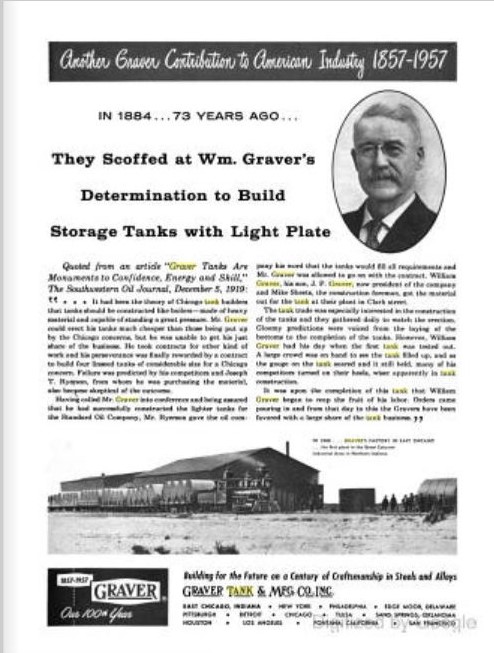
William worked for a few years for the Standard Oil Company as an appraiser of oil storage tanks. The tank business grew due to the boom in oil wells and refineries. The Gravers decided to relocate the tank-making business to the growing Midwest, arriving in Chicago in 1884. There William proved his lighter weight tanks were reliable and cost-efficient, and his reputation and business grew.
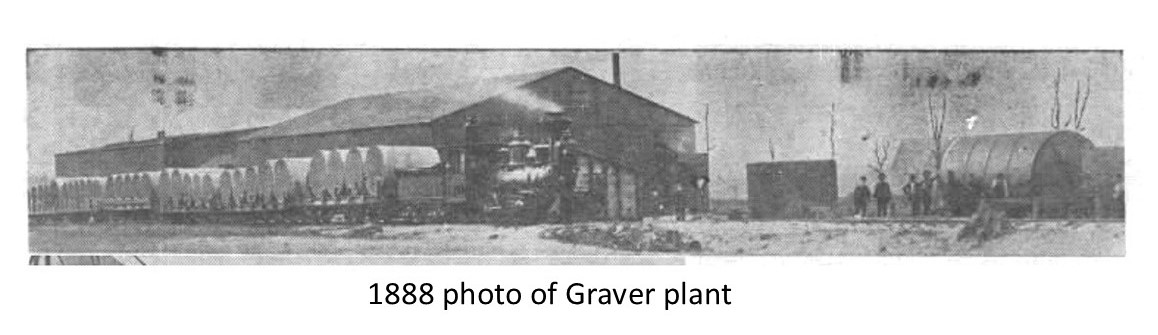
Graver moved to Ohio in 1886 to accommodate a large order from the Standard Oil Company. The business then moved to East Chicago, Indiana, in 1888, and the name was changed to the William Graver Tank Works. The business was the first important industrial concern in that city. Graver maintained a Chicago office in the famous Rookery Building.
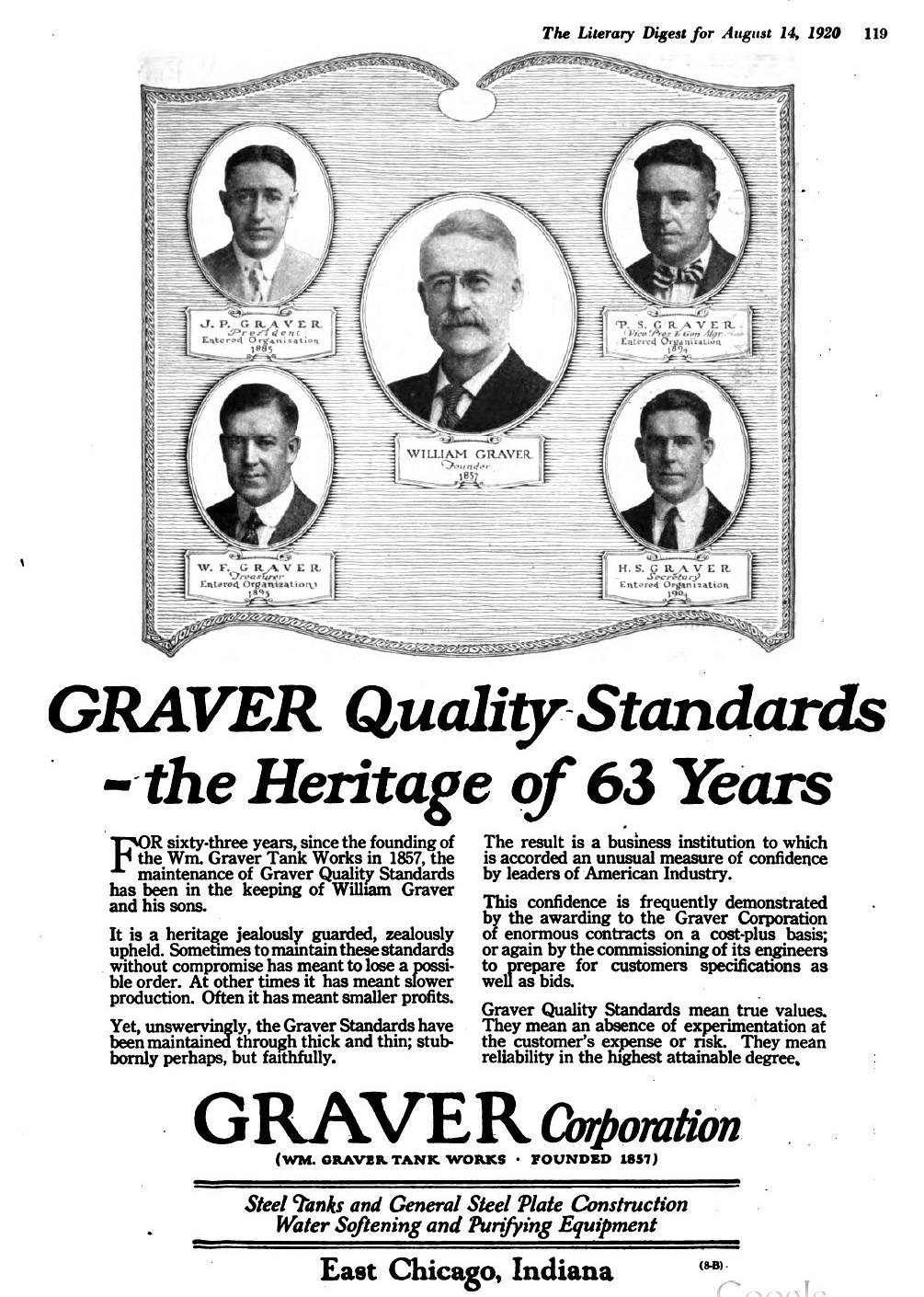
In 1895, William began taking his sons into the business. All five brothers made their careers in the tank works. They took over running the business when William retired in 1909. William died in 1915, and Christina in 1936.
Oldest son James became president of the corporation. Sons William, Philip, and Herbert were vice-presidents. Youngest son Alexander was also with the company until his death from influenza in 1920. The daughters and their spouses did not work for the company.
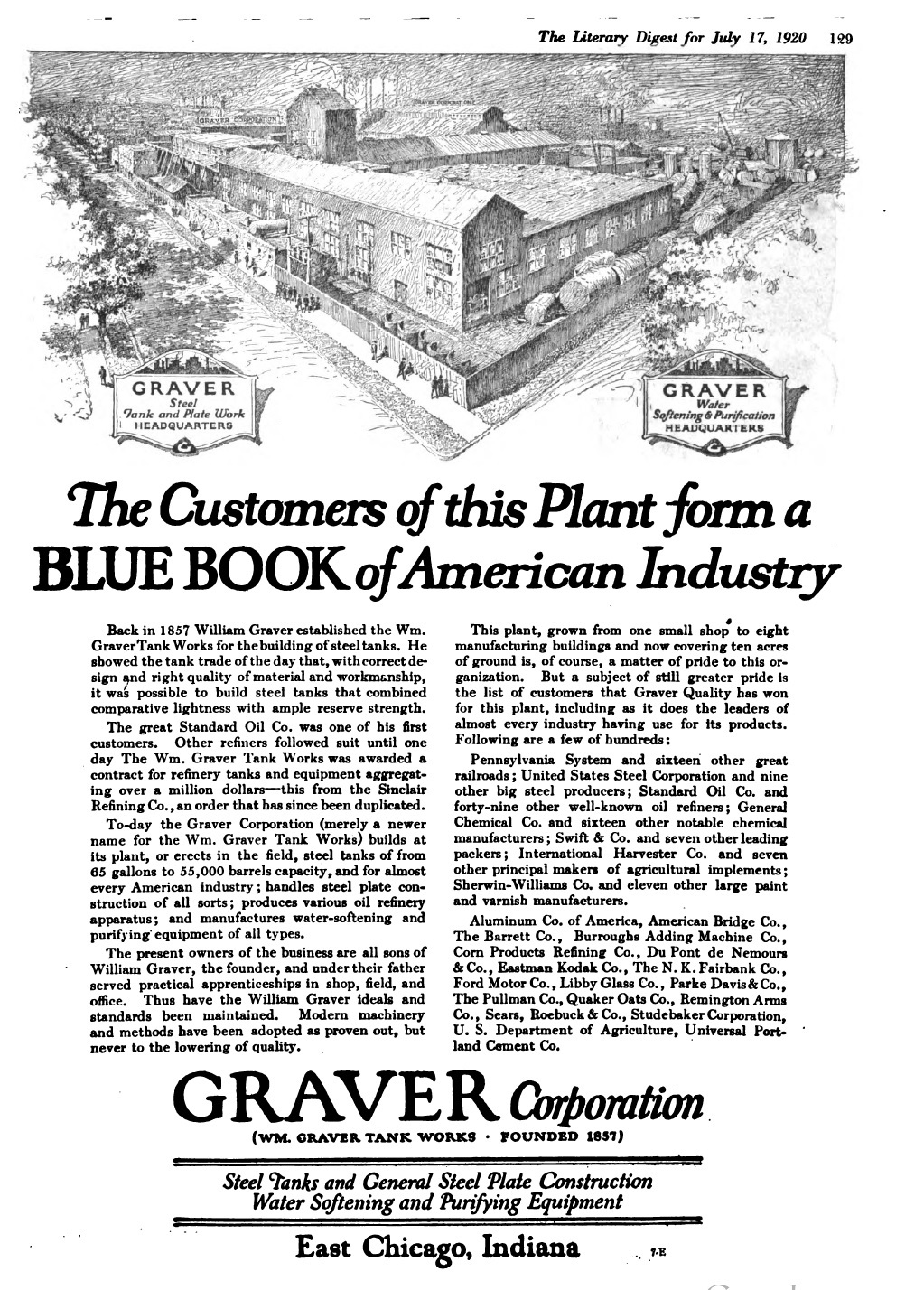
By 1915, the plant occupied ten acres of ground and employed 225 workers. The Graver company continued steel plate work of every kind, concentrating on tanks, smokestacks, and refining equipment. They added a line of water treatment systems and services which benefitted businesses from laundries to steam-engine railroads.
The company grew rapidly during the World War I years, making its facilities available to the U.S. government, and greatly increasing its manufacturing facilities to handle large war orders for ship plating for the new American Merchant Marine and for tanks, many shipped overseas. A major fire, some considered arson due to anti-German sentiment against the family’s roots, destroyed an important part of the manufacturing facility, but the employees rallied without additional pay to finish the government orders.
The Graver brothers were known for their employee benefits, including insurance for every employee. Recreation was encouraged, and there was a ball field on the grounds for summer-time teams, and in winter, there were bowling teams.
The name was changed to the Graver Corporation in 1919, and an advertising department was added to the business. At the end of 1920, according to Moody’s Analysis of Investments, the business had assets close to $3 million, and the stock of the company was all held by the Graver brothers.
In 1930, the company was acquired by the Phoenix Manufacturing Company and reorganized as the Graver Tank & Manufacturing Company. Oldest son James left the company at that time. Sons William, Philip, and Herbert stayed with the company.
Both firms were acquired by the Union Tank Car Company in 1957. The company was purchased by the Aerojet-General Corporation in 1971 and operated under its Envirogenics Company division. The plant shut down in late 1982.
Next post: Herbert Spencer Graver