Ridge Historical Society
Halloween – October 31, 3021: The “Tombstone House”
By Carol Flynn
It’s Halloween, so it is a good day to look at the macabre in the neighborhood. This isn’t a ghost story – in fact, it’s pretty much the opposite, a “debunking” story. But it also illustrates that true history can be as interesting – and strange – as legends.
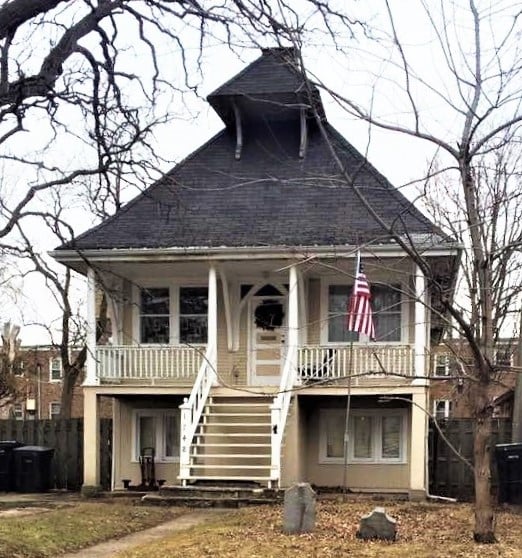
The Ridge Historical Society (RHS) is regularly asked about the tombstones that are on the front lawn of a house in the 1700 block of West 96th Street. Are they real? Yes. Are people buried there? Not very likely. Was that a cemetery? No. How did the tombstones get there? That’s a good question and the answer remains elusive.
Here is the information RHS has gathered to date. Let’s start with the house. The house was actually originally a church.
St. Paul’s Bible Church at 94th and Winchester started as a Sunday school in the Longwood train station at 95th Street, then the congregation used a tent. One of the founders of the church was William Merchant Richardson French, the first executive director of the Art Institute of Chicago, whose historic house still stands in north Beverly.
In 1893, the congregation built a small wooden church. This wooden church was replaced by a stone church in 1902-3. The wooden church was moved and became a private home on 96th Street.
Moving houses was not uncommon in the past. They were placed on rollers and dragged to the new location by horses. It could take days to move a house but it was easier than building a new one.
Now, the tombstones. The names on them are Johan Sandtner, d. 1914; and Barbara Sandtner, b. 1859 d. 1915. RHS researchers located death and burial records for these people. These markers belonged to a couple that is buried in St. Mary’s Cemetery at 87th Street and Pulaski Road. Their names are recorded as John and Barbara Santner. John died at 4313 Lake Park on March 9, 1914, and Barbara died at 5836 Princeton on May 11, 1915.
It was not unusual to have multiple spellings of names in the past. Sometimes people changed their names to be more Anglicized. One conjecture is that the tombstones were replaced to correct or change the names from Sandtner to Santner, and from Johan to John. Then the old gravestones were discarded.
What is still the question is exactly how the tombstones wound up in front of the relocated church-turned-house on 96th Street. They’ve been there for decades. In the 1980s, the owner or resident of the house told the RHS Historian that he placed the markers there, but he would not say where he got them originally.
A few years ago, another person reported to RHS that he was told by the man there that the tombstones were found in the basement of the house when he moved in, and he put them out in front. The man at the house said that perhaps there had been a graveyard there with the church.
That seems very unlikely because there is no documentation that that building was ever a church at that address, only a private residence. If St. Paul’s had a graveyard, it would have been at the church site a few blocks to the north.
So are people buried on 96th Street? Well, the Santners are not, and there is no record of any kind of cemetery ever being there. THAT much can be confirmed.