The Ridge Historical Society
Native Americans and the Blue Island Ridge – Part 17: Native Americans after the 1830s
By Carol Flynn
According to John H. Volp in his book “The First Hundred Years – 1835 to 1935 – Historical Review of Blue Island, Illinois,” many young Native Americans started moving west before the 1830s, and most of the Native Americans left the Chicago area in 1835. However, some of those living around the Blue Island Ridge clung to their ancestral grounds until 1847, when a caravan of thirty-five to forty wagons departed the area.
Up until the 1860s, some returned to visit their seasonal homes. In 1835, the Potawatomi who left Chicago moved to Council Bluffs, Iowa. From there, some migrated to Wisconsin and Michigan.
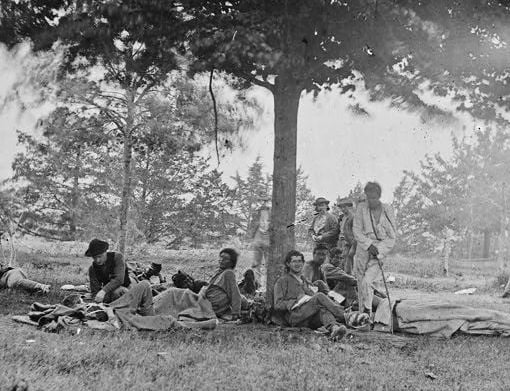
Native Americans fought on both sides of the U.S. Civil War. The most famous Native American unit in the Union army in the east was Company K of the 1st Michigan Sharpshooters. Most of this unit were Ojibwa, Ottawa, and Potawatomi – the Council of Three Fires. There is a likelihood they included Indians who had lived in or were descended from those who had lived in Chicago.
Company K was known for its marksmanship and strategic fighting capabilities. The Indians taught the white soldiers how to camouflage themselves and infiltrate the enemy. They were highly esteemed for their service.
Native Americans had a presence at the 1893 Chicago World’s Fair, also known as the Columbian Expedition. Many of the exhibits that involved Native Americans that were staged by whites, including the independent Buffalo Bill Cody’s Wild West Show, portrayed negative stereotypes of American Indians as primitive, savage aggressors.
However, several Native American groups used the Fair to represent themselves, their cultures, and their handiwork. The Inuit people set up their own village outside of the fairgrounds, and the Navajo weavers made decent money selling their rugs. Other tribes also sold work to collectors.
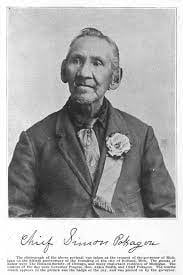
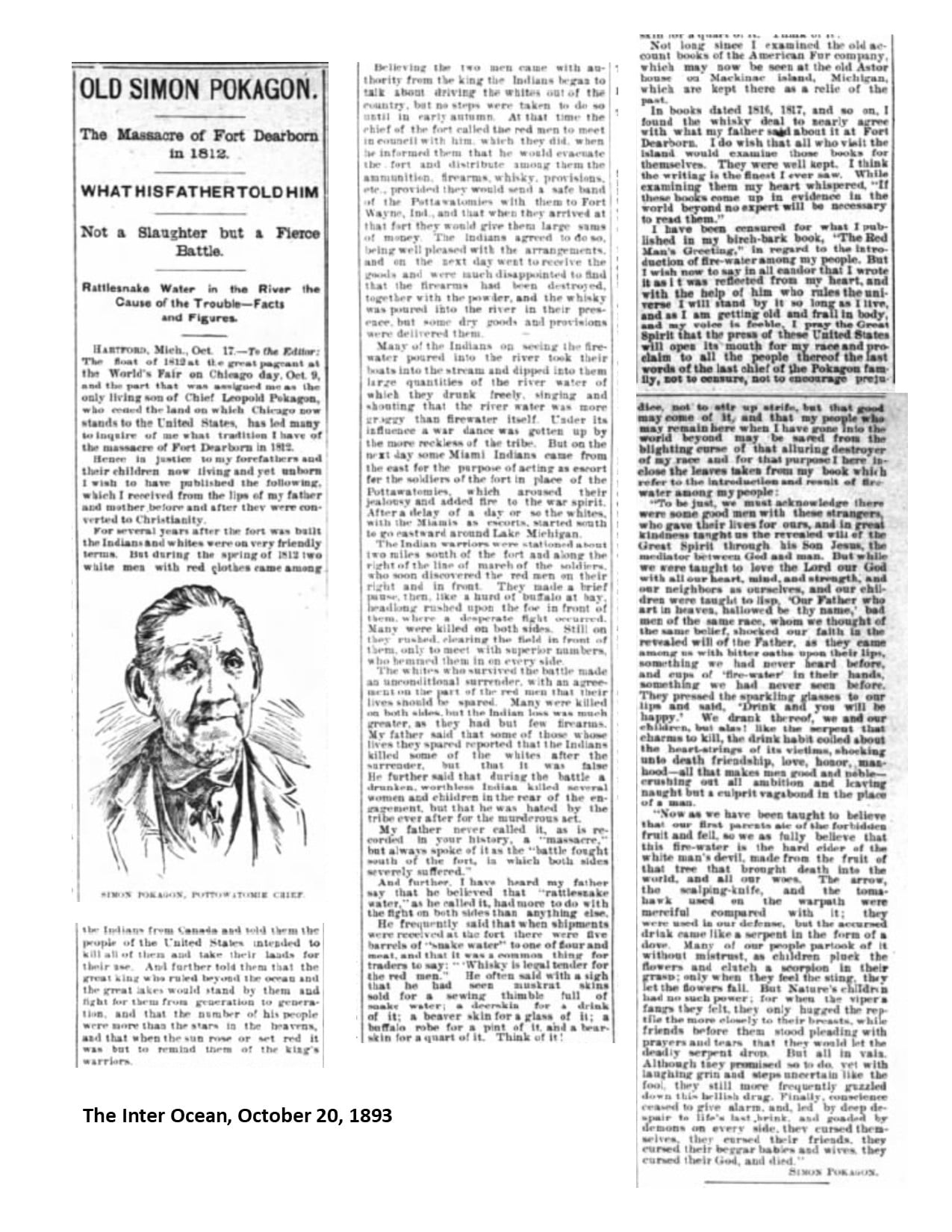
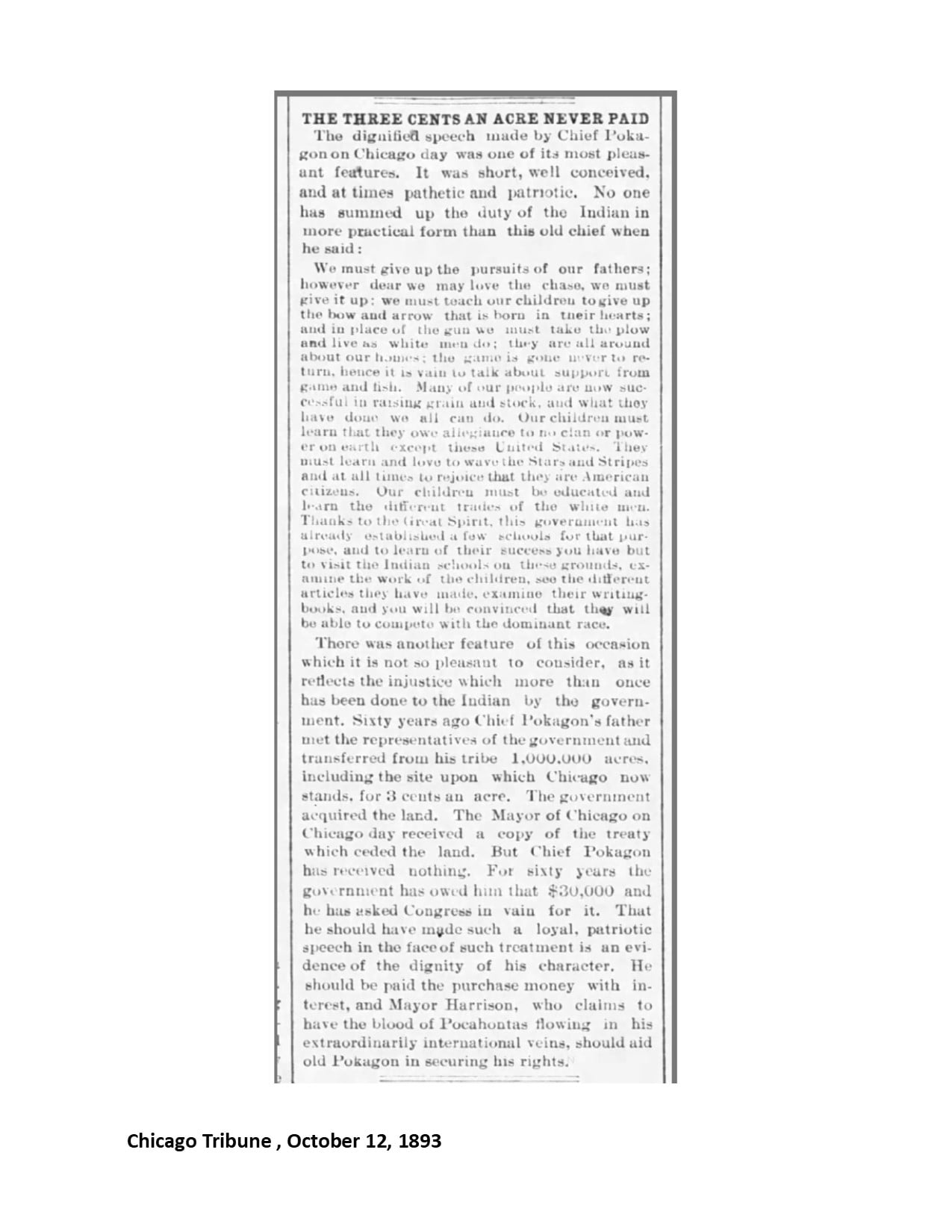
Simon Pokagon, the chief of the Pokagon Band of Potawatomi Indians in Michigan, was a celebrity at the Fair, popular with the high society of Chicago. He was an author and activist trying to get the U.S. government to honor the treaties that had been signed with Native Americans. He gave a speech to 75,000 people that was published in the Chicago Tribune.
Pokagon began pressing land claims to the lakefront on behalf of the Potawatomi people. The area in question was the section known as Streeterville, built on landfill. The land claims were carried on after Pokagon’s death in 1899, but the U.S. never recognized any ownership of that land by Native Americans.
While there were always Native Americans in Chicago, the Indian Relocation Act of 1956 brought Native Americans back to Chicago in significant numbers. The intent of this law was to encourage Native Americans to leave reservations and their traditional lands and assimilate into the general population in urban areas. The tribal status of numerous groups was terminated at this time.
Chicago was an obvious relocation city, supposedly offering employment, education, and housing opportunities. However, Native Americans across the country quickly learned that not only were the opportunities not there, they faced discrimination in employment and housing. The American Indian Center was founded in Chicago to provide both social services and a gathering place for people faced with drastic life changes.
Today, it is reported that 65,000 Native Americans representing 175 tribes live in the greater metropolitan area of Chicago. The majority lives on the North Side.
As for Native Americans in the Ridge communities, depending on the source, the population of Native Americans or “Other” which includes Native Americans is less than 1%. One source lists 0% for Mount Greenwood and Washington Heights, 0.4% for Beverly, 0.9% for Morgan Park, and 0.8% for Blue Island.
Many Native Americans intermarried with other nationalities and may identify with other groups on census forms. The people of Native American heritage in Ridge communities who have introduced themselves to the Ridge Historical Society are of mixed-race background and assimilated into mainstream business and society, and also celebrate their Native American roots.
Next post: Conclusion, Land Acknowledgement Statement for the Ridge