
The Ridge Historical Society
Native Americans and the Blue Island Ridge – Part 16: Captain Billy Caldwell aka Chief Sauganash
By Carol Flynn
While there is documentation of Native American sites all around the Blue Island Ridge, no historical records have been located that identify individual Indians who lived in the area. However, there are references that the area was frequented by Captain Billy Caldwell, also known as Chief Sauganash, a notable figure from Chicago’s earliest days.
Caldwell was born in the early 1780s near Fort Niagara in New York, from a marriage between a high-ranking Native American woman, variously identified as Potawatomi or Mohawk, and a Scots-Irish officer in the British Army during the Revolutionary War. This type of union was not uncommon, but such marriages were rarely recognized as “legitimate” in the white community. Caldwell’s father later settled in Canada, married a white woman from settler stock, and raised a white family. Billy was taken to live with the white family and received formal education. He forged his own life and left Canada after his father’s death.
Caldwell was commissioned as a captain in the Indian Department of Canada during the War of 1812. He made his way to Chicago where he was accepted by the local Potawatomis and he befriended the earliest white settlers. The name Sauganash was given to him by the Indians, loosely translated as “one who speaks English.” He was known to the European traders and settlers as the “Irish Indian.” He was well respected, referred to as Captain Caldwell. Being well-educated and speaking English, French, and several Native American dialects well, his services as a guide and translator were often sought out.
Although his life story is rich, we will only concentrate on Caldwell’s known involvement with the Blue Island Ridge.
According to James Bucklin, chief engineer of the I & M Canal project, Caldwell originated the idea of the Cal-Sag Channel. A passageway between the Great Lakes and the Mississippi River had long been sought. The I & M Canal was built to connect the Chicago River to the Illinois River as one leg of the journey. Feeder canals were built to keep water flowing into the canal, and one came from the Calumet River in Blue Island. Bucklin wrote in a report referring to the 1830s: “From Billy Caldwell, a half-breed with some education and great intelligence, who had explored the country in every direction, I often procured valuable information during my exploration. It was he who first suggested making a feeder of the Calumet River.”
Caldwell helped survey the Vincennes road in 1832-33. This was the earliest road that ran through the Blue Island area and connected Chicago with trading posts to the east.
A recounting of a survey party by J. P. Hathaway, Jr., dated July 23, 1833, documents just one visit to the Blue Island by Captain Caldwell others. They found a log house on the Ridge, and the owners not being home, milked the cows and made dinner with ham and bread. They continued south to Stony Creek, at the southern tip of the Blue Island, “a delightful place, commanding a view of thousands of acres of prairie and patches of timber. At this point, there were Indian graves.”
They forded the creek in the area around what is now Western Avenue. Later, returning north, they decided to recross opposite their first encampment. However, the horse got away and their wagon was swamped, and they lost most of their provisions. Continuing north, they found the folks of the log cabin at home, and purchased a pan of milk for supper. They spent a wet night on the ground, keeping the fire going all night. They were back in Chicago by eight o’clock the next night “with keen appetites for regular living again.”
In 1870, John D. Caton, a lawyer and judge on the Illinois Supreme Court, read a paper before the Chicago Historical Society on “The Last of the Illinois, and a Sketch of the Pottawatomies.” In this first-person account, he related, “…[W]hen riding over the prairie south of Blue Island, in 1833, with Billy Caldwell, … the old chief as usual was answering my questions about the past and what portion of the country he had visited. …[H]e commenced giving an account of an expedition of the British from Canada across to Ohio, of which he and a number of his warriors formed a part ….”
Caldwell was instrumental in negotiating the 1833 Treaty of Chicago that led the Potawatomi to peacefully leave the area. He moved with them to Council Bluffs, Iowa, where he reportedly died in the early 1840s, although his gravesite is not known.
Both his white and Indian names grace locations around the Chicago area, including Caldwell Woods, Billy Caldwell Golf Course, Caldwell Avenue, the Sauganash neighborhood on the North side, and Sauganash Park.
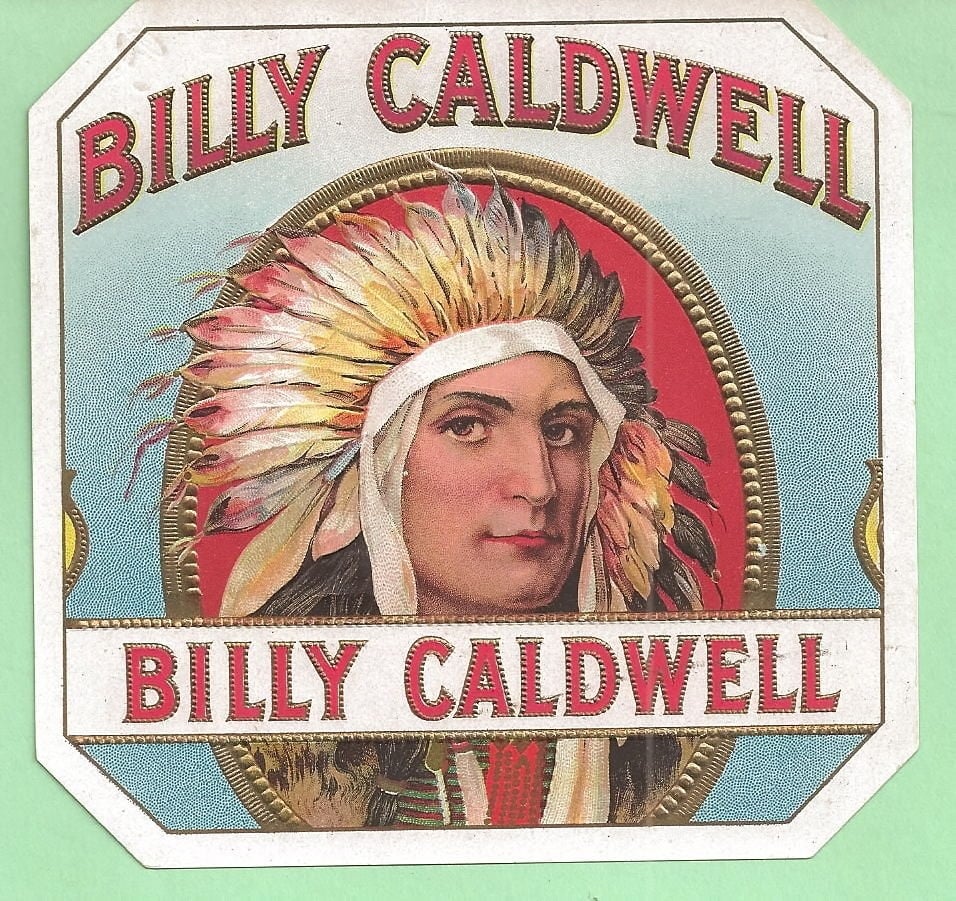
There are no photographs to be found of Billy Caldwell. There were some sketches and paintings done after his death. This likeness was invented for a cigar brand made by a Chicago company. From the collection of C. Flynn.
The tobacco and cigar industry was very important in the past. By the 1860s, there were more than 200 cigar makers in Chicago. By 1900, there were over 40,000 cigar makers in the country. Many of these were small operations out of homes. But the numbers started to decline in the 1930s for several reasons – the Great Depression, increased use of machinery replacing hand-rolling, rationing of tobacco during World War II, the release of cancer studies, and the embargo on doing business with Cuba which led many cigar makers to leave the country.
Next: Native Americans after the 1830s