
The Ridge Historical Society
Native Americans and the Blue Island Ridge – Part 15: Native American Stories and Artifacts on the Ridge
By Carol Flynn
The known sites connected with Native Americans on and around the Blue Island Ridge as indicated on an 1804 map were covered in the last post.
Most of the Native Americans left the Chicago area in the 1830s. Some stayed, of course, and there were even exceptions to the treaties that allowed some chiefs and their groups to remain in certain locations. Some returned annually for a while to their summer home grounds. But they were no longer a dominant presence in the area.
The white settlers who followed the Native Americans recorded various versions of “history” and found artifacts. These are a few of the more interesting stories.
John H. Volp shared a number of stories about the Native Americans in the Ridge area in his book “The First Hundred Years – 1835 to 1935 – Historical Review of Blue Island – Illinois.”
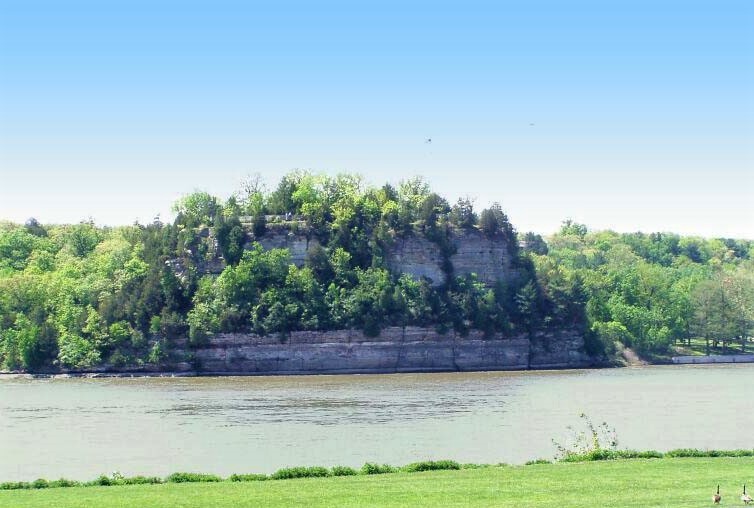
He reported that the Native American villages and sites at the southern tip of the Ridge (called Blue Island and Wildwood to the immediate east, now a part of the City of Blue Island) were the site of a battle in 1769 between the Ottawa and Potawatomi against the Illinois Confederation. The story goes that the Illinois people were ultimately driven to the landmass that became known as Starved Rock, where they were surrounded and isolated, and most of them perished from starvation. This removed the Illinois people from the Chicago area. However, as much as the story of Starved Rock has appeared in Illinois historical lore, researchers today doubt its accuracy. The story has passed down through oral means but there is no other documentation to support it.
Local histories in the Ridge Historical Society collection include reports that early settlers found many Native American artifacts in the area. Postholes were reported being found in the 1840s at what is now the east side of Hale Avenue, between 104th and 105th Streets, and stone tools were found in the area.
The History of Cook County published by A. T. Andreas in 1884 includes this entry: “The neighborhood of Washington Heights also claims some archaeological importance. Since 1859 the members of the Barnard family alone have collected 36 flint arrow-heads, two battle axes, a spearhead, several pieces of ancient pottery, and other evidences of the former savage residents. The remnants of pottery were found in a small mound surrounded by large cobble-stones, and embraced, as it were, within the roots of a small oak tree which sprang up from the mound.”
The location and significance of this mound are not known.
One clarification of local folklore needs to be addressed, concerning the Hopkinson-Platt House at 108th and Drew Streets. The house was built in the 1870s, and Dr. Robert and Mrs. Harriet Platt moved into the house in the 1920s. Dr. Platt (1891-1964) was a geography professor at the University of Chicago, and Mrs. Platt (1899-1979) traveled with him, and also tended to the many foreign students and refugees they invited to live with them.
Mrs. Platt claimed an oak tree in the yard of the house was 800 years old and was the site of Native American councils. She called it the “Council Oak” and there is a plaque installed in the yard. The tree blew down in a storm in 1988.
Whether or not the tree was a “council oak” cannot be verified. That species of oak tree has only about a 200-year lifespan, 300 years at best, not 800 years. That means it was old enough to be growing at that spot during the time of Native Americans prior to 1833, but it would have been a younger tree, and there would have been older and bigger trees for use for council meetings.
The land included with that property has never been developed and excavation would be very interesting.
Native American sites are being excavated in the forest preserves surrounding Chicago, the only land that has not been totally lost to development. In the area of the Ridge, excavation was reportedly going on at an undisclosed location in the Joe Louis Golf Course, which is located in the Whistler Woods Forest Preserve, along the Calumet River, just southeast of the Ridge.
Next post: Captain Billy Caldwell aka Chief Sauganash