
The Ridge Historical Society
School Series – Profile 13: Medgar Evers
Carol Flynn
As the new school year begins, we will continue to run profiles of the people for whom schools in the Ridge communities are named.
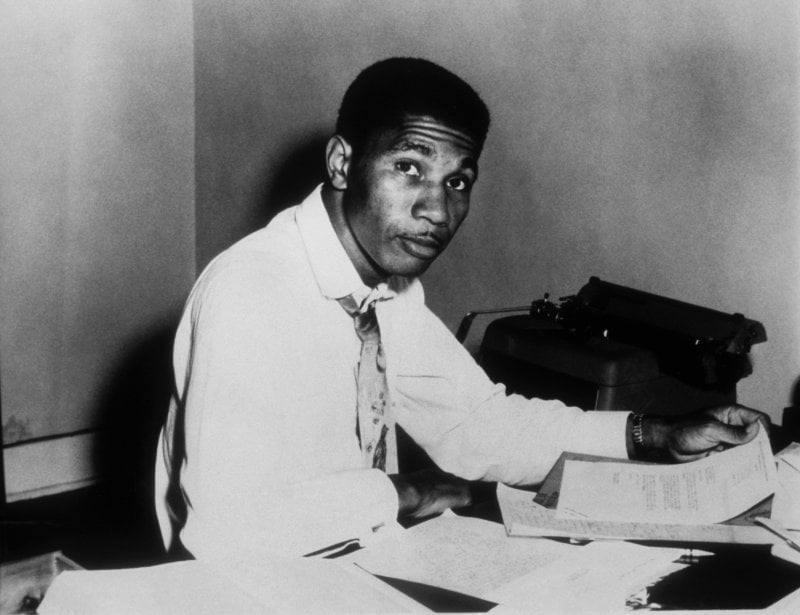
Medgar Wiley Evers (1925-1963) was a civil rights activist in Mississippi who worked to end segregation and expand opportunities for African Americans, including the enforcement of voting rights.
Evers was a World War II veteran who served in the segregated U.S. Army, rising to the rank of sergeant. His unit participated in the D-Day invasion of Europe.
Returning home, he was forced away at gunpoint when he tried to exercise his right to register to vote in Mississippi.
He attended Alcorn College on the G.I. Bill, majoring in business administration. He was an honor student and president of the junior class. He competed on the debate team, sang in the school choir, and participated in football and track.
He worked as an insurance agent under a man who was a leader in the Regional Council of Negro Leadership (RCNL), a civil rights and pro-self-help organization. Involvement in the RCNL gave Evers crucial training in activism.
When his application to the University of Mississippi Law School was rejected due to a technicality, he approached the National Association for the Advancement of Colored People (NAACP) for help. Impressed with the young man, the NAACP offered him a position as the organization’s first field secretary in the state. Evers accepted, opening an office in Jackson, and nearly doubled NAACP membership to 15,000 within three years.
As a field worker for the NAACP, one of his first assignments was to investigate the murder of Chicagoan Emmet Till, the 14-year-old African American boy kidnapped and murdered for flirting with a white woman in 1955 in Mississippi. Evers helped locate and protect witnesses.
In 1961, Evers was sentenced to 30 days in jail and fined $100 for speaking out against the sentence handed down to a young Black man who stole several bags of chicken feed. Evers appealed his own conviction all the way to the Mississippi Supreme Court, which surprisingly found in Evers’ favor. The court was lauded for “courageously deciding the case in accordance with the law of the land,” something that was recognized would not have happened even a few years before. The Chicago Tribune declared, “The time is not yet here but it is approaching when Negroes in the deep south can look with growing confidence to the state courts as well as the federal courts to equality before the law and protection of their rights as citizens.”
Evers was part of the movement to integrate the University of Mississippi in 1962, which led to President John F. Kennedy sending in 30,000 National Guardsmen to stop the riots that started when Blacks tried to register for classes.
In 1963, Evers was elected to the board of the American Veterans Committee (AVC). He was scheduled to receive the group’s meritorious achievement award at its annual convention in Washington, D.C., but he was arrested in Jackson, Mississippi, and charged with a felony, restraint of trade, for picketing for desegregation of public places. The AVC attendees instead took up a collection of money to send to Jackson to “keep courageous children safe and well.”
After nine years of civil rights and voting registration work, several attempts to kill him, and numerous death threats, Evers was assassinated outside his home by a white supremacist in June 1963. At first, the hospital refused him admittance because he was Black. His wife and young children pleaded while he bled to death in the car. The hospital admitted him, but he died within an hour. He was 37 years old.
Evers had spoken at an integration rally the night before. Over 700 African American citizens were arrested that month alone in his area for protesting for the end to Jim Crowe laws which enforced racial segregation in the military, public places, schools, transportation, federal workplaces, restaurants, drinking fountains, and restrooms, creating institutionalized economic, educational, and social disadvantages for many African Americans living in the United States. Hundreds more were arrested when they attempted to march after Evers was killed. African Americans were rounded up for trying to enter whites-only restaurants and picketing other places and taken via garbage trucks and other means to campgrounds put aside for their holding which were declared no better than concentration camps. African Americans were not allowed positions on police forces in Mississippi in the 1960s.
Rewards for information on Evers' killer/s were offered by the city of Jackson, the NAACP, the United Steel Workers Union, local newspapers, and other groups. U.S. Attorney General Robert Kennedy assigned FBI agents to track down the sniper. However, Evers’ murderer was tried and released twice by white juries in the 1960s.
It took until 1994 for a racially mixed jury to find the murderer guilty and sentence him to life in prison.
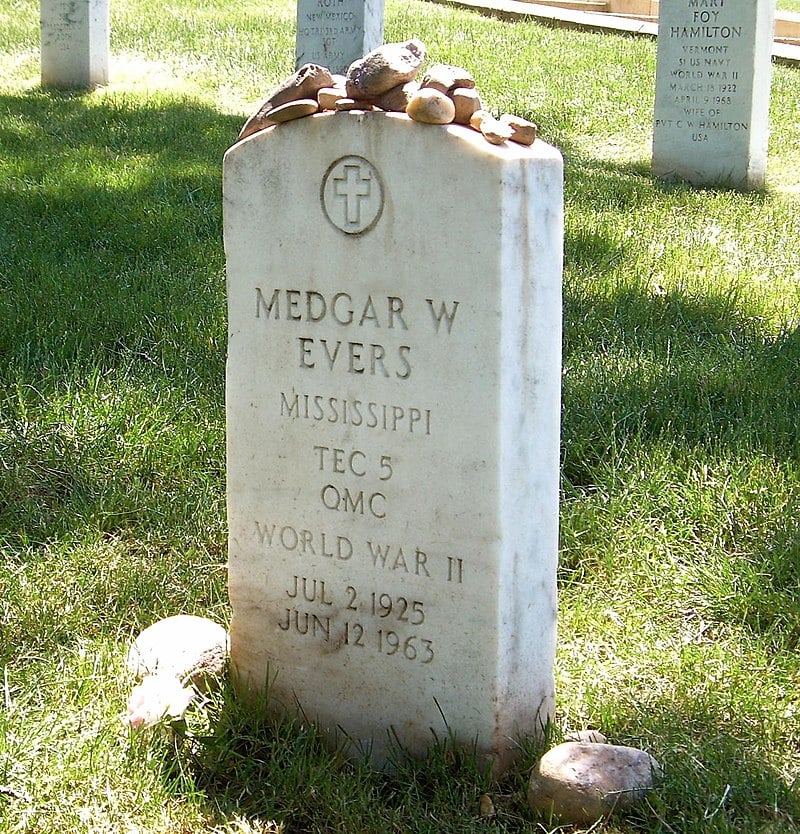
Evers stated in 1960: “Threats sometimes frighten me, but I’m going to continue the work even if it means making the ultimate sacrifice.” He made that sacrifice. Evers was buried in Arlington National Cemetery with full military honors. Over 3,000 people attended the ceremony. However, his legacy is not his death, it is the many positive contributions he made to advancing rights for all people.
The Medgar Evers School at 9811 S. Lowe Street opened in 1969.