
The Ridge Historical Society
Carol Flynn
School Series – Profile 12: George Cassell
As we start the new school year, the Ridge Historical Society will run a few more posts about the people for whom Chicago Public Schools (CPS) in the Ridge communities are named. So far, we have covered eleven schools and people: Alice Barnard, Percy Julian, Charles Wacker, John Vanderpoel, Johnnie Colemon, John S. Shoop, Annie Keller, Marcus Garvey, Henry Clissold, Rudyard Kipling, and Kate Starr Kellogg. You can look back on the RHS Facebook page to find any of these previous posts, or send a message and we can send you the post.
Today we will look at George Frederick Cassell (1884-1958), a lifelong educator and administrator in the CPS system.
Cassell was born on Chicago’s west side to parents who had immigrated from England. His father’s occupation was listed as a machinist.
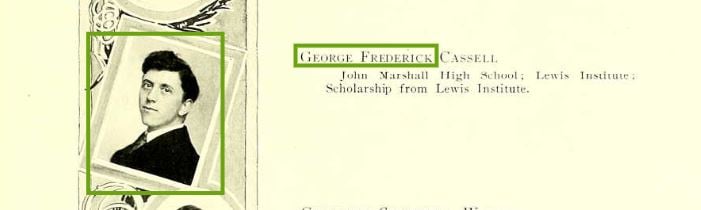
Cassell was educated in Chicago’s schools. He graduated from Marshall High School in 1901, and attended every one of the school’s alumni reunions throughout his life. He was honored at the 1947 event. He married Lettice Owen, a fellow Marshall graduate, in 1918.
He received an associate degree from the Lewis Institute, a school that merged into what today is the Illinois Institute of Technology. He received a bachelor’s degree from the University of Chicago. His bios report he briefly attended the University of Berlin and later Northwestern University, but he did not pursue a master’s degree.
Cassell took his first teaching job in 1908 at Lewis, where he taught English and German. In 1912, he became an English teacher at Marshall. In 1921, he became principal of a Chicago public elementary school, and served as principal at four other elementary schools until 1934, when he was named principal of Harrison High School.
He was active in the Illinois State Teachers Association during these years, and in 1930, at a conference of the National Education Association of the U.S., he presented a paper on “English and Its Value to Our Schools” which was widely circulated. In this paper he not only advised of the importance of students, including those of immigrants, learning the proper English language, but also the benefits of studying and learning from good literature, both fiction and non-fiction.
In 1935, Cassell was named district superintendent of high schools, and in 1936, assistant superintendent in charge of all Chicago high schools.
The Chicago schools weathered the Great Depression of the 1930s and World War II in the 1940s. Cassell navigated Chicago high schools through a dramatic shift in priorities due to the war effort.
Manufacturing plants turning out war items lured young people away from school and into jobs by offering high pay. In 1943, the number of summer work permits for 16 and 17-year-olds soared, and school registration for fall dropped. Cassell encouraged the industries to not renew work permits for this age group so they would finish high school. Alternative work/study programs in partnership with businesses were implemented and counseling services were provided for young people seeking employment.
This tied into the other shift in high school education that came about as a result of World War II – a new emphasis on trade and vocational education programs and less emphasis on academic programs. Chicago had one of the largest war training programs in the country.
In 1946, Cassell was named acting superintendent of schools upon the resignation of William H. Johnson.
The North Central Association of Colleges and Secondary Schools (NCA) had announced it was considering withdrawing its accreditation of Chicago schools because the city did not have a politically independent school board whose members were recommended by a citizens’ advisory committee, with the superintendent serving as the chief executive officer of the schools. Johnson was considered a political appointee and the school board had a structure of departments reporting to the board, not the superintendent. Accreditation was important for the prestige of schools, and high school graduates from non-accredited schools had to take special entrance exams to get into colleges.
Cassell’s appointment was first met with resistance by the NCA because Cassell did not have a master’s degree, but due to his accomplishments and reputation, he was accepted in the position and even proposed as permanent superintendent. However, he announced that because he was so close to retirement, he would not consider the position as a permanent appointment.
Cassell dealt with everything from high school football issues to school board politics in his short time as acting superintendent. His philosophy and priorities as an educator and administrator are perhaps shown best by three instances from his time as acting superintendent.
First, he made this statement: “The success of the schools is conditioned largely by the abilities and attitudes of the teachers and their happiness in the conditions under which they work.”
He clearly kept his focus on the teachers and students, not on administrative issues and politics.
Second, he won applause from the Chicago Medical Society when he fully supported that students receive regular medical and dental care.
“The values of periodic medical and dental examinations and the correction of remedial defects are indisputable. Pupils should be encouraged to visit their family physicians and dentists wherever possible. Principals will please give their wholehearted support to this most worthwhile project,” wrote Cassell.
The third example of his philosophy was the appointment of Grace E. Munson as assistant superintendent. Munson was a psychologist with Ph.D.s in education and psychology who had been a teacher and principal. Under her, the Chicago schools developed some of the country’s best programs for special needs children. She started scientific testing programs, adjusting teaching services for individual special needs, and keeping cumulative records on students. Her appointment to the position was controversial but Cassell supported the need for special education, and Munson served in this capacity until both she and Cassell retired in 1949.
Cassell served as acting superintendent of Chicago schools for a year until a new superintendent was chosen, and Cassell returned to his position as assistant superintendent. Cassell was commended for his performance in the temporary role, and Herold C. Hunt, the new superintendent, appointed Cassell as the “first assistant superintendent” in 1948.
New taxes were introduced to increase the school system’s budget and give pay raises to all the staff. Cassell was paid $16,500 annually for the role of first superintendent. He was being paid $10,700 previously for his role as assistant supervisor in charge of high schools.
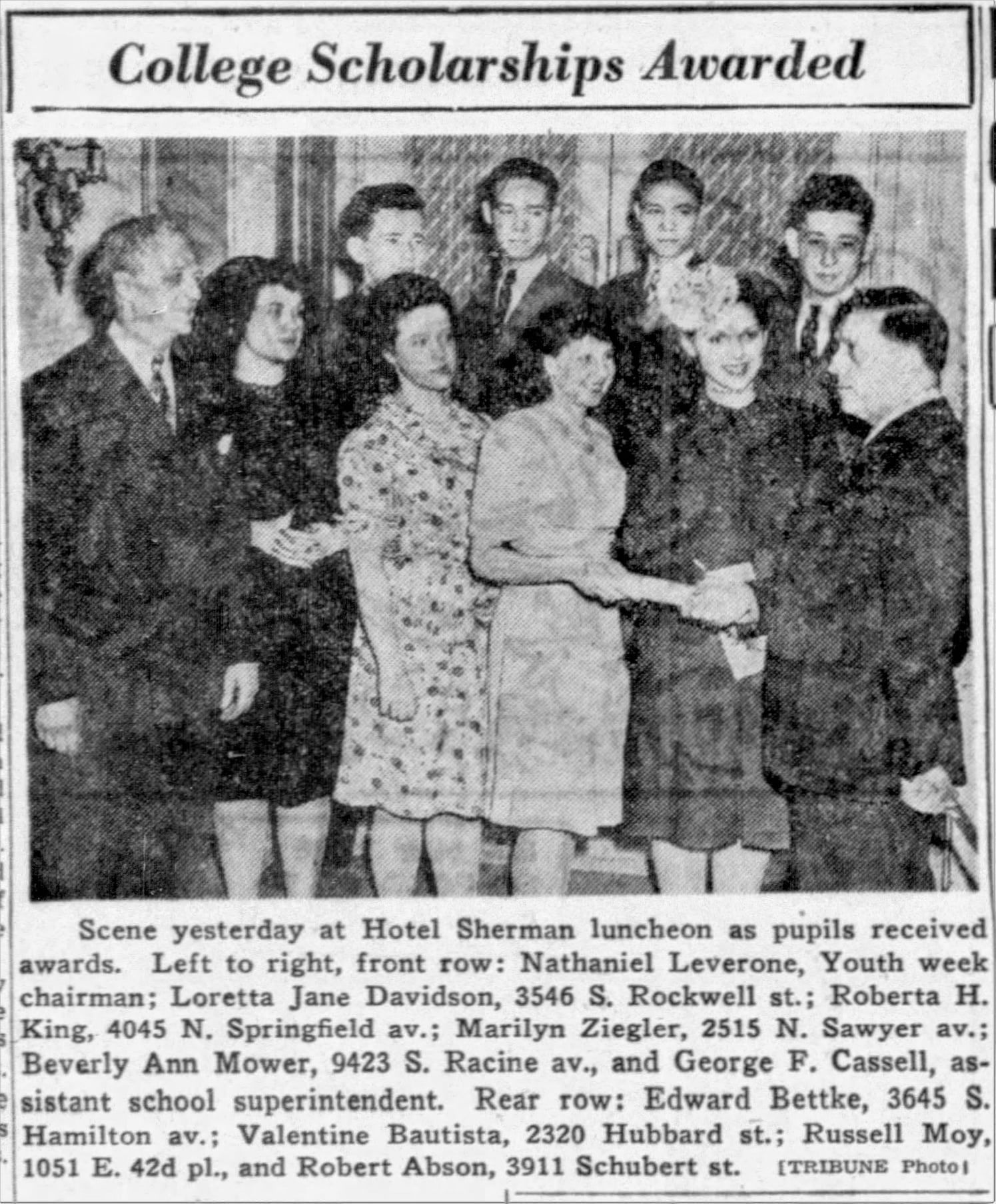
Throughout his career, Cassell gave speeches at commencement exercises and other events to honor students. For many years, Chicago featured a “Youth Week,” and WGN radio had a program “Citizens of Tomorrow” that profiled outstanding honor students from the high schools and junior colleges. At luncheons that were recorded for broadcast on the radio, Cassell gave talks and presented scholarships to students.
After he retired, the Reserved Officer Training Corps (ROTC), at a dinner sponsored by the Chicago Tribune and WGN radio, paid tribute to Cassell for his “enthusiastic backing” of ROTC programs in Chicago high schools. In attendance at the dinner were military officials, Chicago educators, and 200 cadets from eight states who had won awards from the Tribune for their military and naval work. Hunt, the superintendent of Chicago schools, gave the recognition speech for Cassell.
George F. Cassell died of a heart attack while he and his wife were vacationing in Colorado. He was 74. He was buried in Forest Park, Illinois.
In 1960, the George F. Cassell School opened at 113th Street and South Spaulding Avenue in Mount Greenwood.