

The Ridge Historical Society
Native Americans and the Blue Island Ridge – Part 13: Games and Trade
By Carol Flynn
The Potawatomi Indians, the major presence in the Chicago area by the 1830s when European settlers started moving to the Blue Island area, enjoyed games and sports. They were important pastime activities and formed connections within and between tribal communities.
Gambling games were popular and could go on for days. Men played a game known as straws in which the number of straws in bundles was guessed. Women played a game with plum stones marked on one side. The stones were tossed in a small bowl and points were assigned for the stones that landed with the markings face up.
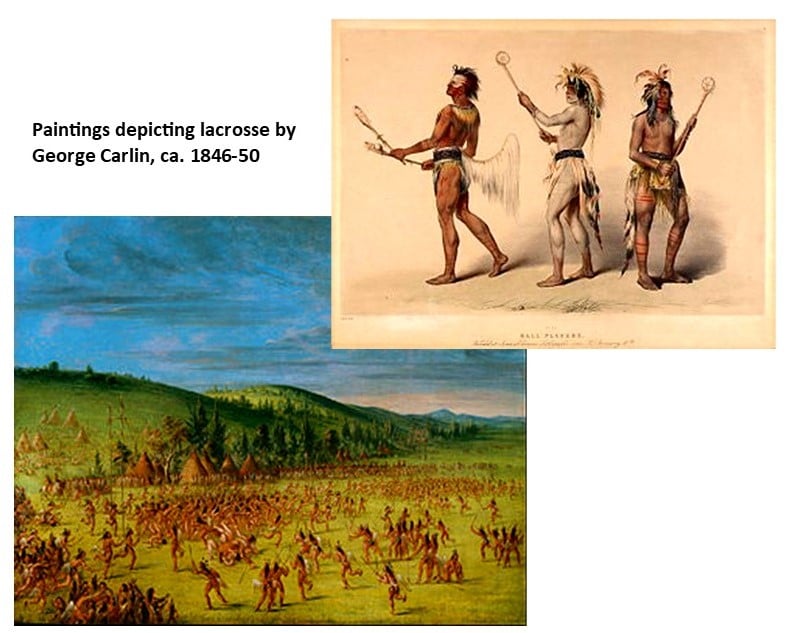
The sport of lacrosse was invented by Native Americans. A wooden tree knot was used as a ball and the object of the game was to score goals by throwing and catching this ball in a small basket made from buffalo sinew that was attached to the end of a three-foot-long wooden pole or racket.
Lacrosse was considered a symbolic warrior game, played for the honor of the tribe. Teams of hundreds of members played on large fields. It was a violent game and players could be severely injured and even killed. Men and women both played the sport.
The Potawatomi were avid traders. Information and technology were traded back then just as they are now.
The Potawatomi were expert canoe builders, making good use of the birch trees found locally. They traded this knowledge and technology with other tribes and European traders for goods, and for information and technology on growing crops.
The canoes also gave the Potawatomi considerable freedom of movement that other tribes did not have. They were able to travel long distances through Midwest waterways to reach trading sites. With the introduction of horses by the Europeans, the Potawatomi became less reliant on travel by water, and were able to expand their trading and hunting opportunities.
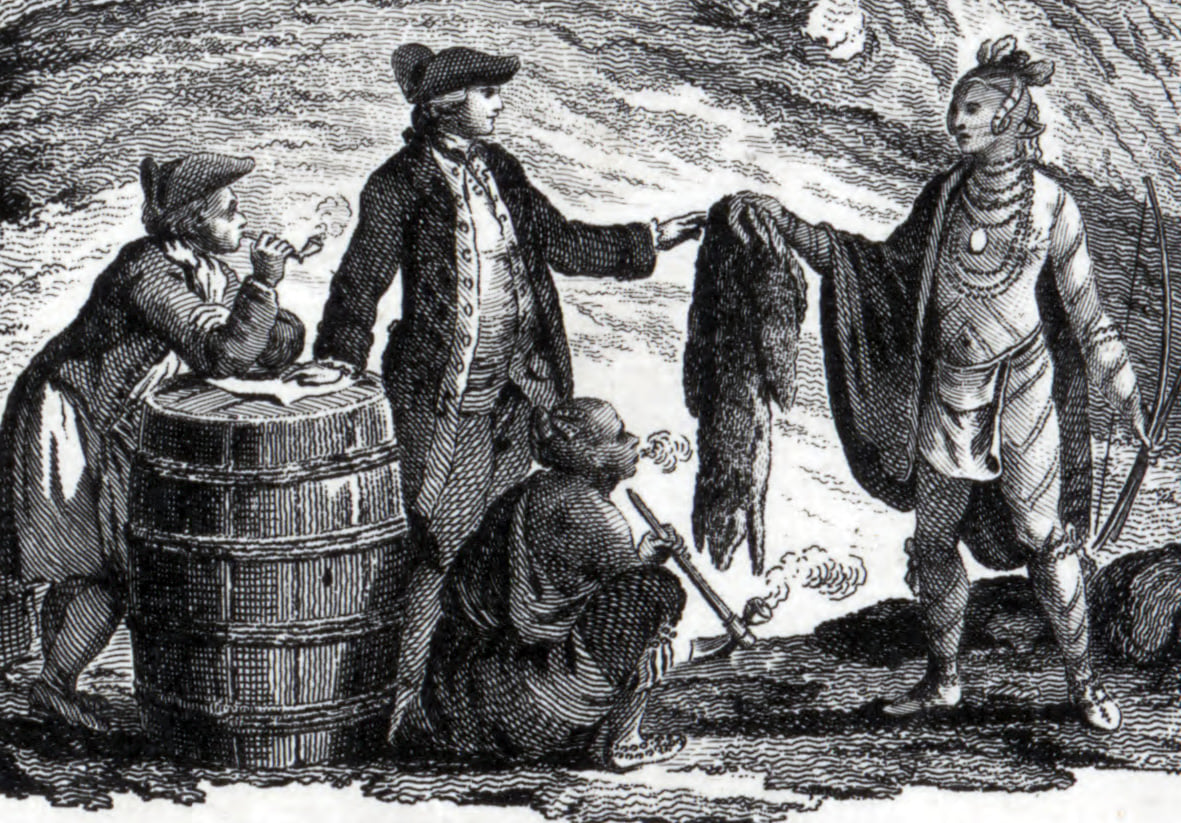
The most important harvested trade items were furs. For several hundred years, fur trading drove the economy in the land that would become the northern United States and Canada. Beaver, especially valued for making hats, were overhunted to the point they became locally extinct. Deer, bear, mink, and skunk were also valuable.
In addition to economic benefits, the fur trade became important for forging alliances between the Europeans and the Native Americans. However, the competition between Native American groups to meet the demand of the Europeans for furs led to considerable inter-tribal conflict.
The Indians traded furs for guns, alcohol, glass beads, silk ribbon, and cloth, items introduced by the Europeans that were novel to the Native Americans.
The interest in beads and ribbons is sometimes trivialized as valuing “trinkets” but in reality, the Indigenous Peoples already had what they needed for subsistence so there was little in that way to get from the Europeans.
Guns were new to the Native Americans and the advantage of this technology over bows and arrows for hunting and warfare quickly became apparent to them. The gun trade became highly competitive for the European colonists and the Indians. Many tribes amassed arsenals superior to those of the settlers.
Perhaps no product was more controversial than alcohol when it came to trade between the Europeans and the Native Americans. Alcohol was not unknown to Indians; various cultures had been making weak beers, wines, and other drinks from plants and grains for thousands of years, but these were generally used for spiritual, medicinal, and ceremonial purposes, not for personal entertainment and intoxication. The Native Americans were totally unprepared for the potent alcoholic beverages like rum, brandy, and whiskey introduced by the European settlers.
Many Native Americans responded with distaste and mistrust as unscrupulous white traders pushed alcohol on them, and many tribal leaders recognized the dangers and called for abstinence. Nonetheless, alcohol became a destabilizing force in Native American communities and created serious health issues both before and after forced relocation. Laws were passed banning the sale of alcohol to Indians, but these laws were ignored and circumvented.
Although much ado has been made historically about alcohol consumption within the Native American communities, in truth, alcohol consumption was extremely prevalent in the white communities also. By 1830, an average of 7.1 gallons of absolute alcohol was consumed annually per individual of drinking age in the white community. Today, that average is about 2.3 gallons per person per year.
It’s often reported that, going back to medieval times, alcoholic beverages were made and consumed because local water supplies were not clean for drinking, but this has been largely disputed and debunked. Even in medieval times, people knew that boiling water got rid of bad odors and tastes, even if they did not realize they were killing harmful organisms.
It’s also reported that alcohol was believed to have medicinal properties and drinking it was “healthy.” This was the case with smoking tobacco for many years, also. Of course, tobacco was first discovered and cultivated by Native Americans and then introduced to the Europeans. Tobacco, which was used by Native Americans in religious ceremonies and for sealing agreements with other tribes, was an early trading item between Native Americans and white settlers until settlers started growing their own tobacco crops.
Next: Documented Native American sites in the Blue Island Ridge area