
The Ridge Historical Society
Native Americans and the Blue Island Ridge – Part 3: Native Americans and the Chicago area
By Carol Flynn
The greater Chicago area includes ancestral lands of 25 to 30 distinct Native American groups. By the time the Native Americans gave up the land via treaty with the U.S. Government and left the area in 1833-35, the predominant group living here were the Potawatomi people.
The Field Museum of Natural History has a vast collection on the Native peoples of North America and, since 2018, has been in the process of transforming the Native North American Hall.
The Field Museum issued a Land Acknowledgement Statement which reads:
We acknowledge that the Field Museum resides within the traditional homelands of many Indigenous nations:
• Hoocąk (Winnebago/Ho’Chunk), Jiwere (Otoe), Nutachi (Missouria), and Baxoje (Iowas)
• Kiash Matchitiwuk (Menominee)
• Meshkwahkîha (Meskwaki)
• Asâkîwaki (Sauk)
• Myaamiaki (Miami), Waayaahtanwaki (Wea), and Peeyankihšiaki (Piankashaw)
• Kiikaapoi (Kickapoo)
• Inoka (Illini Confederacy)
• Anishinaabeg (Ojibwe), Odawak (Odawa), and Bodéwadmik (Potawatomi)
Archeologists divide Native American history into eras or “traditions” and these eras are further broken down into more exact time periods and cultures. Very little is known about the earliest Indigenous Peoples who lived on the land dating back 3,000 years ago and before. Information becomes more available with the Woodland Tradition from 3,000 to 1,100 years ago, and the Mississippian Tradition which began about 1,100 years ago. More on these eras and Native American life during these times will be in future posts.
The term “confederacy” appears for some Native American groups. A confederacy is a union of sovereign groups that come together for common action. The Illini or Illinois Confederacy listed above was made up of a dozen tribes ranging east and south from Lake Michigan. Most of the Illini groups were destroyed by diseases introduced by the Europeans, or through war with other tribes. Their descendants are found today as part of the Peoria Tribe of Miami, Oklahoma.
The last group listed above is the Ojibwe, Odawa, and Potawatomi. These groups make up the Three Fires Confederacy or the Council of Three Fires. This is a long-standing alliance dating back for over a thousand years, that has a complex structure and operating system. The three tribes in this alliance are listed in a specific order – the Ojibwa or Chippewa are the “Older Brother,” the Keepers of Medicine. The Odawa or Ottawa are the “Middle Brother,” the Keepers of Trade. The Potawatomi are the “Younger Brother,” the Keepers of the Fire.
Only the Potawatomi actually lived in the Chicago area in any number, but as an alliance they all signed the treaty that resulted in Native Americans leaving the area in the 1830s. In 1830, there were forty Potawatomi communities in northern Illinois and thirty-six in northeast Indiana, with a total population over 6,000.
Many Land Acknowledgement Statements (LAS) in the Chicago area make reference to the Council of Three Fires. For example, the LAS for the Forest Preserves of Cook County reads: “The Forest Preserves of Cook County acknowledges that we are on the ancestral homelands of the Council of Three Fires—the Ojibwa, Ottawa and Potawatomi tribes—and a place of trade with many other tribes, including the Ho-Chunk, Miami, Menominee, Sauk and Meskwaki.”
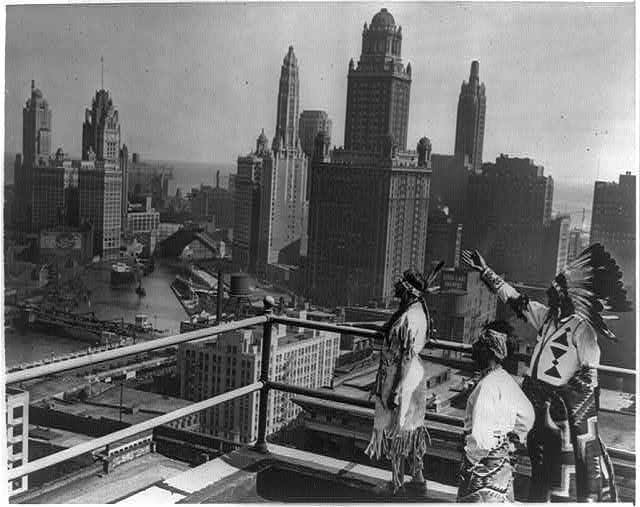
Photo: “Princess O-Me-Me, a Chippewa; Sun Road, A Pueblo; and Chief Whirling Thunder, a Winnebago, looking over Chicago's skyline from the roof of the Hotel Sherman.” October 3, 1929. From the Library of Congress.
The Chippewa and Winnebago tribes had ancestral land in the Chicago area. The Pueblo Indians were mostly in the southwest area, Arizona and New Mexico.
Next: More on Native Americans and the Chicago area – Fort Dearborn, treaties