
Ridge Historical Society
Teacher Appreciation Week – May 3-9, 2021 – Part 5
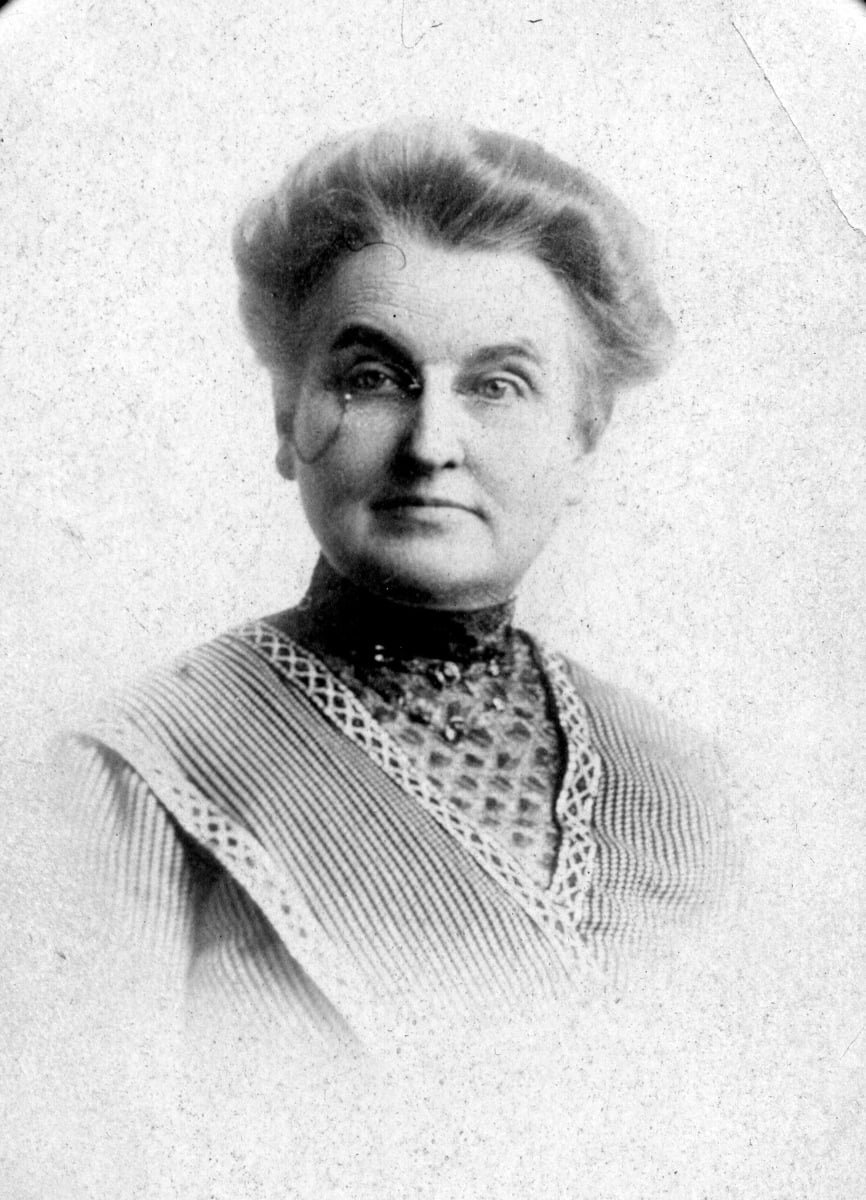
School Series – Profile 11: Kate Starr Kellogg
By Carol Flynn
There was more to Kate Starr Kellogg than her life-long commitment to education, as if that wasn’t enough.
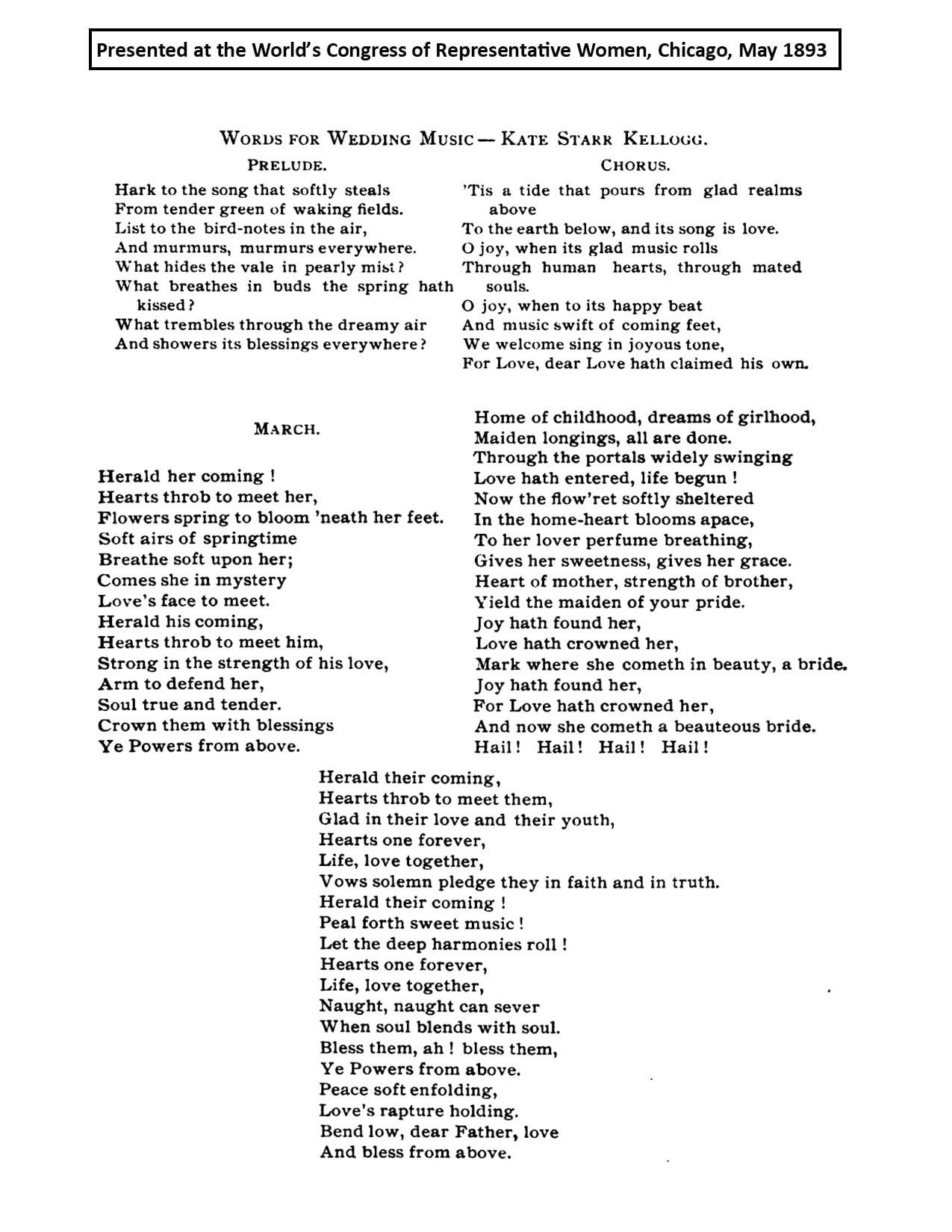
Kate was a poet and song writer. The World’s Congress held a series of events at the time of the Columbian Exposition, the World’s Fair in Chicago. A special World’s Congress of Representative Women of All Lands was formed, and held a week-long meeting in May 1893. The purpose of the event, chaired by Bertha Honore Palmer (Mrs. Potter Palmer), was to present the progress of women in “the great departments of intellectual activity.”
There were talks on education and social reform, but Kate participated in an evening event on music created by women. A song she wrote the lyrics for, “Wedding Music,” with music by Eleanor Smith, was performed by Miss Helen Root and a chorus.
Kate published poetry in other sources, also.
The Kellogg sisters also explored their spiritual sides. Through their father, a holistic physician, they developed interests in metaphysical ideas and practices including spiritualism, the Christian Science writings of Mary Baker Eddy, and the writings of Emanuel Swedenborg.
In 1896, the Cook County Normal School held its annual alumnae reunion and “tree planting exercises.” Following an opening session, the participants marched outside for the planting of a catalpa tree. This was followed by a business meeting, and then a banquet. It was a custom then at most events like this that a series of toasts were made, and each was responded to in kind by someone giving a brief presentation. Kate was one of the responders and her topic was “The Transmigration of Souls.” This concept is related to reincarnation.
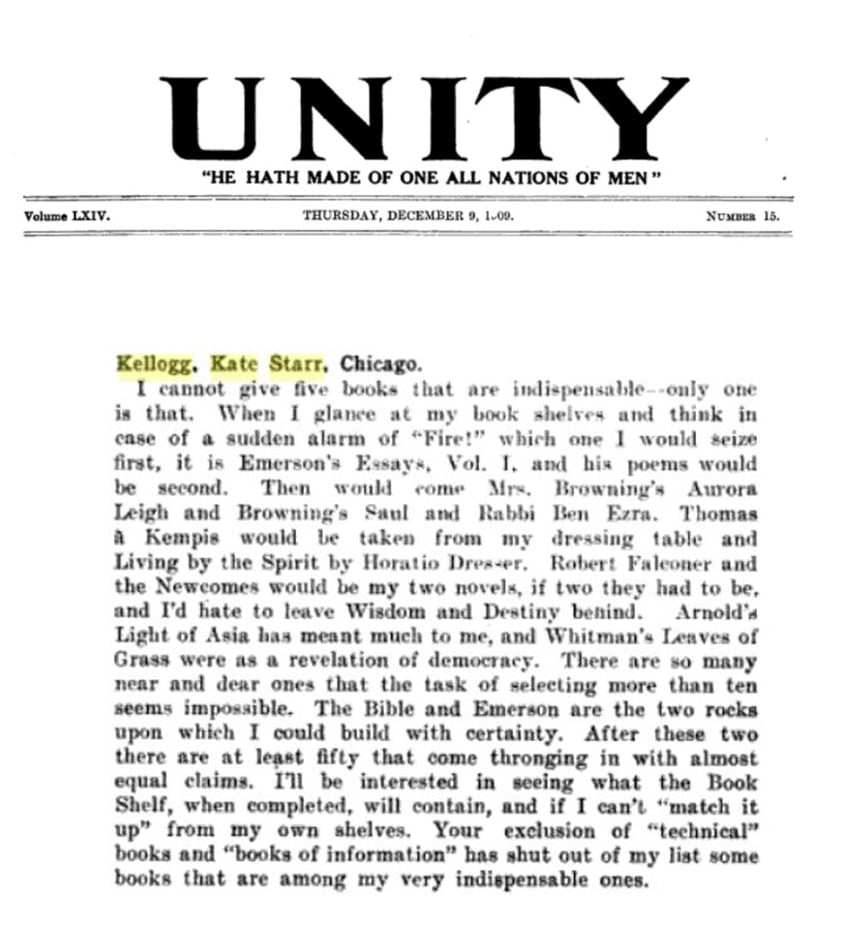
In 1901, Kate and her sister Alice were listed as members of All Souls Church, a Unitarian Church connected to Jenkin Lloyd Jones, a well-known Unitarian minister and writer who produced the Unity newsletter.
Kate along with other people responded to a 1909 request in the Unity newsletter to identify what books of literature they considered indispensable. Her number one book was Emerson’s Essays, Volume 1, followed by his poems.
One interesting story about Kate appeared in the Brooklyn Daily Eagle newspaper on October 1, 1899, in an article titled “Chicago Stories of Ghosts.” In this New York paper, it was reported that Kate often told a story of the “supernatural” to her “intimate friends.”
According to the article, Kate reported that she was taking an overnight journey on a train, and, although not a superstitious person, was distressed with a presentiment of evil. Suddenly, at the foot of her berth, she saw a shadowy white female figure. The figure remained for several hours and finally vanished. Kate noted the time of this event, and later learned that a dear friend had died that night after a very sudden illness of a few hours’ duration, and on her deathbed the friend had said, “Tell Kate.” Kate made no attempt to explain what had happened other than to say how real the experience had been.
Kate died at the family farm in Evergreen Park in 1925 at the age of 71, and was buried in an unmarked grave in Mount Greenwood Cemetery with her family.
One remembrance of Kate stated: “Those who knew Miss Kellogg will long cherish the memory of her human sympathy, her keen sense of humor, her imagination, and her deep understanding of the youthful mind.”
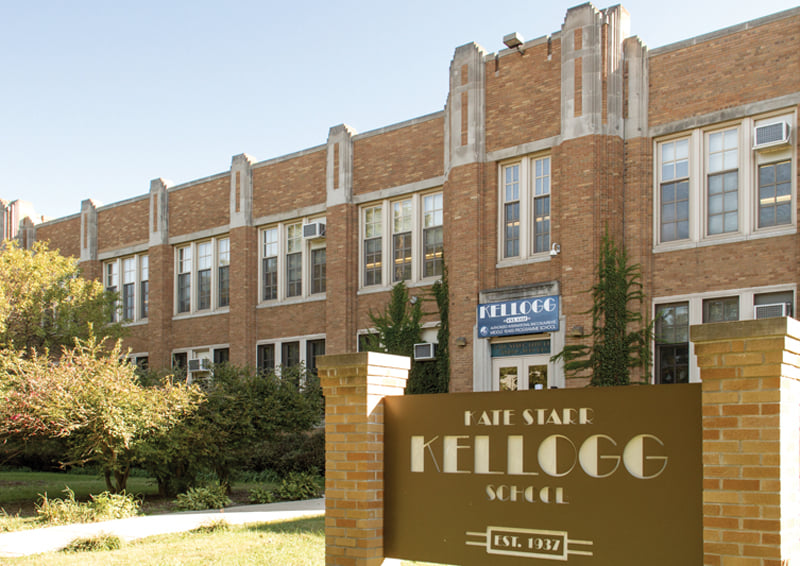
On November 8, 1937, the new Kate Starr Kellogg Elementary School opened its doors at 9241 S. Leavitt Street. The first principal was Jennie S. Jenkinson, who also headed Sutherland School at 10015 S. Leavitt Street. Jennie was notable, too – a local resident, she lived with her parents at 1669 West 104th Place. Her father was Presbyterian minister Rev. Henry S. Jenkinson. Jennie taught at Barnard School before her promotion to principal. She died in 1972 at the age of 91 after a 42-year career as a Chicago educator. Surely Kate Starr Kellogg was a legend and inspiration to her.
This concludes our profile on Kate Starr Kellogg.