
The Ridge Historical Society
March 2021 – Oscar Wilde’s Visit to Chicago – Part 5 – Conclusion
By Carol Flynn
Oscar Wilde left Chicago on February 15, 1882, to take his lectures on aestheticism to other Midwestern cities, including Detroit, Cleveland, Indianapolis, St. Louis, Milwaukee, and Dubuque. In Illinois, he made stops in Springfield, Rockford, Aurora, Joliet, Peoria, and several other small cities before he returned to Chicago on March 11.
He stayed again at the Grand Pacific, and that evening, gave another lecture at the Central Music Hall. The weather was bad, so this time the house was about two-thirds full. The Chicago Tribune described the audience as “cultured.”
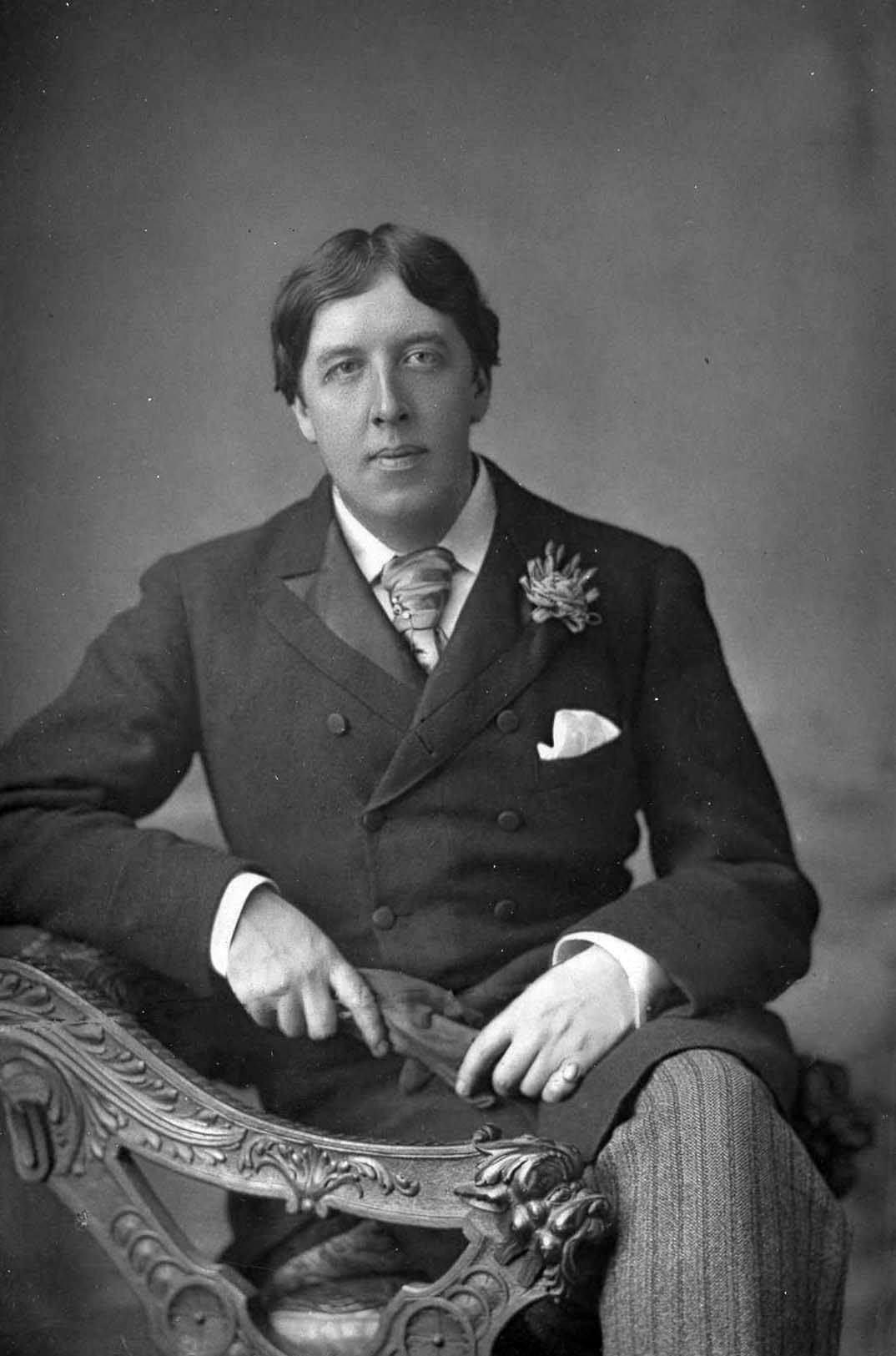
Wilde wore a black velvet suit with knee britches, black silk stockings, a white lace tie, and white kid gloves. His topic was “Interior and Exterior House Decoration.” This was a new lecture he put together to premiere in Chicago, the first city he visited twice, necessitating a second lecture. This lecture would be later called “The House Beautiful.”
In this lecture, Wilde shared his views for proper architectural details. He said yes to terra cotta embellishments; he said no to iron railings. He liked red brick and brass door knockers.
He also discussed home furnishings and decorating. He said keynotes and gradations of colors should appear in rooms like the answering calls in a symphony of music. He said yes to area rugs and no to heavy furniture. He liked plenty of flowers and candlelight. He said china should be used, not kept hidden away in a closet. He said the only thing worse than no art was bad art.
Although this time he did not create the same kind of controversy as he had with his comments about the Water Tower, he was critical of Americans and their home decorations. His opinion was that much of it was “second class.” He was not advocating that people buy expensive items, but rather ones that were handmade, well-made, and pleasing to look at.
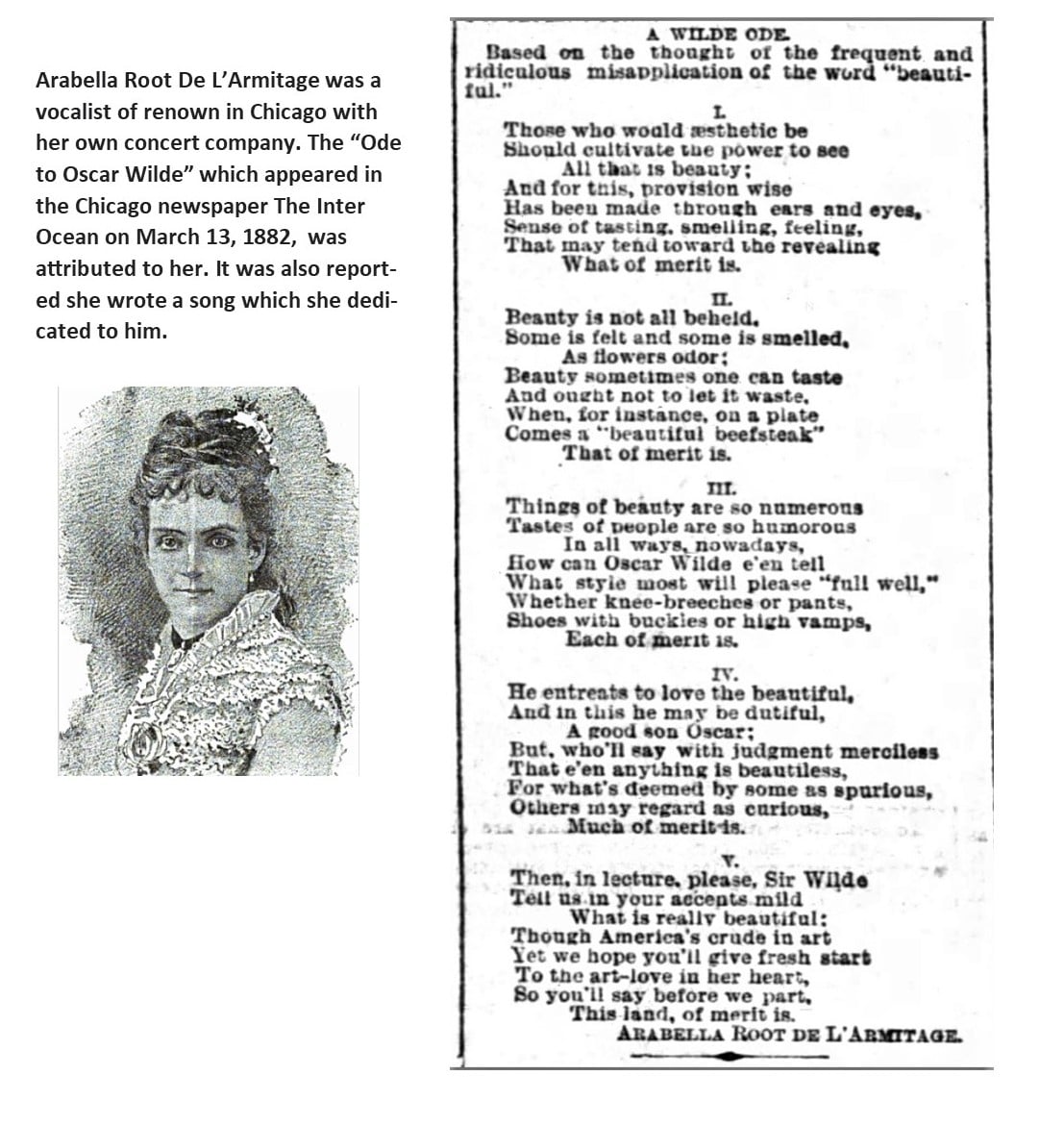
Following the presentation, there were two curious newspaper articles concerning a woman named Arabella Root De L’Armitage. She was a highly regarded vocalist with her own concert company.
The first article appeared in the Inter Ocean newspaper on March 13. It was a letter critical of Wilde’s talk on decoration, followed by a sarcastic poem, all attributed to Mrs. De L’Armitage. She said Wilde’s talk was full of “little nothings, idle visions, and absurd doctrines.” Her poem included lines like, “He entreats to love the beautiful, and in this he may be dutiful, a good son Oscar.”
Yet, the second article, in the Inter Ocean on March 18, reported that during this second stay, Wilde visited the Lyon and Healy piano rooms to hear her perform a new aesthetic piece, “Sunflower Song.” She wished to dedicate the song to Wilde if it pleased him.
Wilde displayed his considerable charm in the letter he wrote to her in response: “Your song, whose dedication is so courteously offered, I accept with rare pleasure, for what could come from a nightingale but what is beautiful.”
The true nature of Mrs. De L’Armitage’s feelings for Wilde are hard to interpret with these conflicting articles. Perhaps the song was a parody of aestheticism.
Scheduled to leave Chicago for his next commitment, Wilde sent a “pleasant letter of regret” to the Irish American Club in response to its invitation to attend a St. Patrick’s Day banquet. He spent that day in St. Paul, Minnesota, where he gave an impromptu speech on Irish patriotism, the only time he is known to have spoken on this topic, although it was a topic very dear to his mother, Lady Jane Wilde.
On March 19, the Chicago Tribune ran a surprising article. After being critical of Wilde for months, it stated: “It is humiliating to confess, but nevertheless true, that when a stranger visits Chicago his host has nothing to show him but that ‘castellated monstrosity’ – the water-tower, a number of high buildings, a labyrinth of dirty streets, hog-killing by machinery at the Stock-Yards…. Oscar Wilde was a personified caricature of the vagaries of art, but his criticisms of Chicago’s deficiencies in the artistic and beautiful were fair and timely…. Chicago should have an opera-house, an art-gallery, a museum, a great library, and schools of music, painting, architecture, and polytechnics ….”
Of course, Chicago would get all of these things with time – and they are among the best cultural institutions in the world.
Wilde spent the next eight months touring Canada and the western and southern sections of the U.S., then returning to New York. Of all places, he was a big hit with the rugged miners in western camps. In one escipade, he was challenged to a drinking contest by several of them. He left them passed out on the floor while he exited on his own two feet.
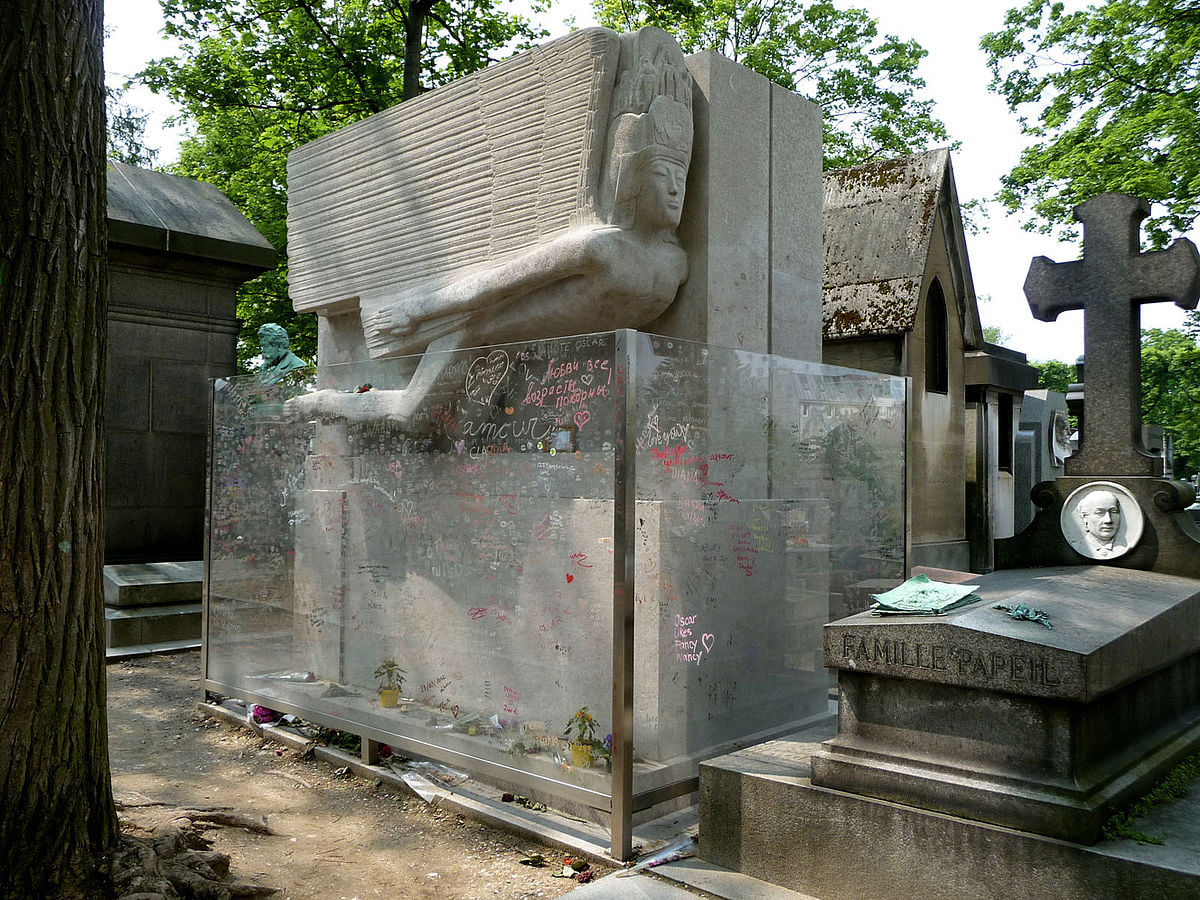
Returning to England, Wilde wrote his famous works. He married Constance Lloyd and they had two sons. But his career came to an end when he served two years in prison for homosexual acts. After that, he went into exile in France, where he died in November 1900 of meningitis at the age of 46. His gravesite with its modernistic sculpture had to be enclosed in glass to protect it from a constant stream of visitors.
In 2017, he was among approximately 50,000 men pardoned for homosexual “crimes” that no longer exist in British law.
The aesthetic movement tapered off with Wilde’s death in 1900. It did leave the world some “beautiful” art, literature, and decorative items. Many of the influences and leaders of this movement continued into the Arts and Crafts and the City Beautiful Movements of the early 20th century.
Preservation movements to save historical and cultural structures were also influenced by aesthetic principles. The irony that he inadvertently helped Chicago’s “castellated monstrosity” survive to today would have been appreciated by Oscar Wilde.
In conclusion, Oscar Wilde said about himself: “Yes, I am a dreamer. For a dreamer is one who can only find his way by moonlight, and his punishment is that he sees the dawn before the rest of the world.”