The Ridge Historical Society
The Month of March – Part 6, Conclusion with Frank and Kate Egan
By Carol Flynn
This post will bring to a conclusion our stories about the Frank and Kate Egan family, an Irish American Catholic family that lived on the Ridge one hundred years ago. Their frequent mention in the local newspapers gave us a glimpse into their lives that we don’t often find.
Through Ancestry, we connected with a great-granddaughter who shared some wonderful family pictures and history with us. Another distant relative supplied information via comments on one of the posts. We love connecting with family members of the historical people we profile, and we thank them for their contributions.
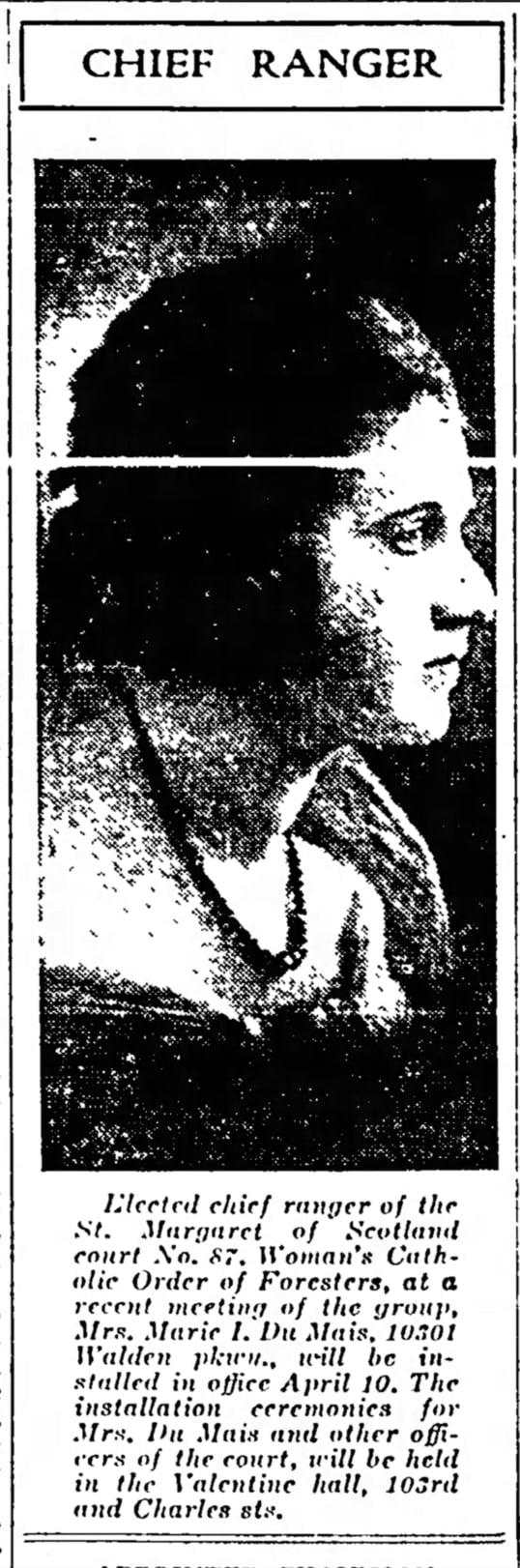
We’ll start out with one addendum to Part 5 on the Egan daughters. We found a newspaper picture of Marie Egan DuMais from 1931 that we are including here. She was installed as the chief ranger of the St. Margaret’s chapter of the Women’s Catholic Order of the Foresters. Her sister Florence was named treasurer.
March is National Women’s History Month, National Irish American Heritage Month, National Nutrition Month, and National Craft Month, and the Egans brought all four themes together for us.
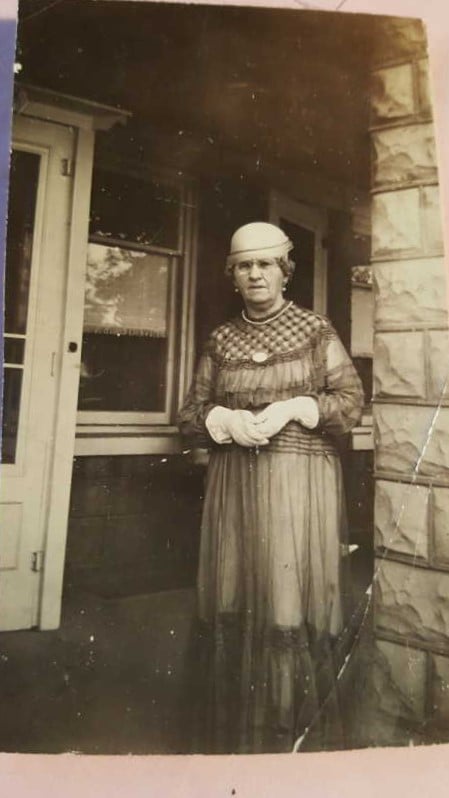
The cement block house that the Egan family built at 1414 West 95th Street has to be the ultimate craft project. Mother Kate Egan was much of the creative force behind the project. The house became the center for family activities. There were many newspaper mentions of them entertaining there. Kate came from a large family and out-of-town relatives – from Denver, Austin, Seattle, Los Angeles, New Mexico – stayed at Kate’s house.
At one time, assuming during the Great Depression and World War II years in the 1930s – 40s, when families looked for new ways to bring in income, the Egan family ran the house as a “tourist lodge,” and advertised permanent rooms for men. This was the time that “motels” were beginning – “MO-tor” and “ho-TEL” combined – indoor rooms to stay in conveniently located along major autoroutes, replacing earlier motor camps.
It was mentioned in the papers several times that Kate suffered from severe flare-ups of “rheumatism,” which back then encompassed osteoarthritis, rheumatoid arthritis, gout, and any other illnesses that affected the joints. Rheumatology was just coming into its own as a medical specialty.
Kate stayed active with her grandchildren. One article had her going to two First Communions, the Lane Tech High School prom at the Medinah Temple, and graduation for the grandson who had the prom, all in a space of two weeks. Her grandchildren, and nieces and nephews, were frequent guests at the big house.
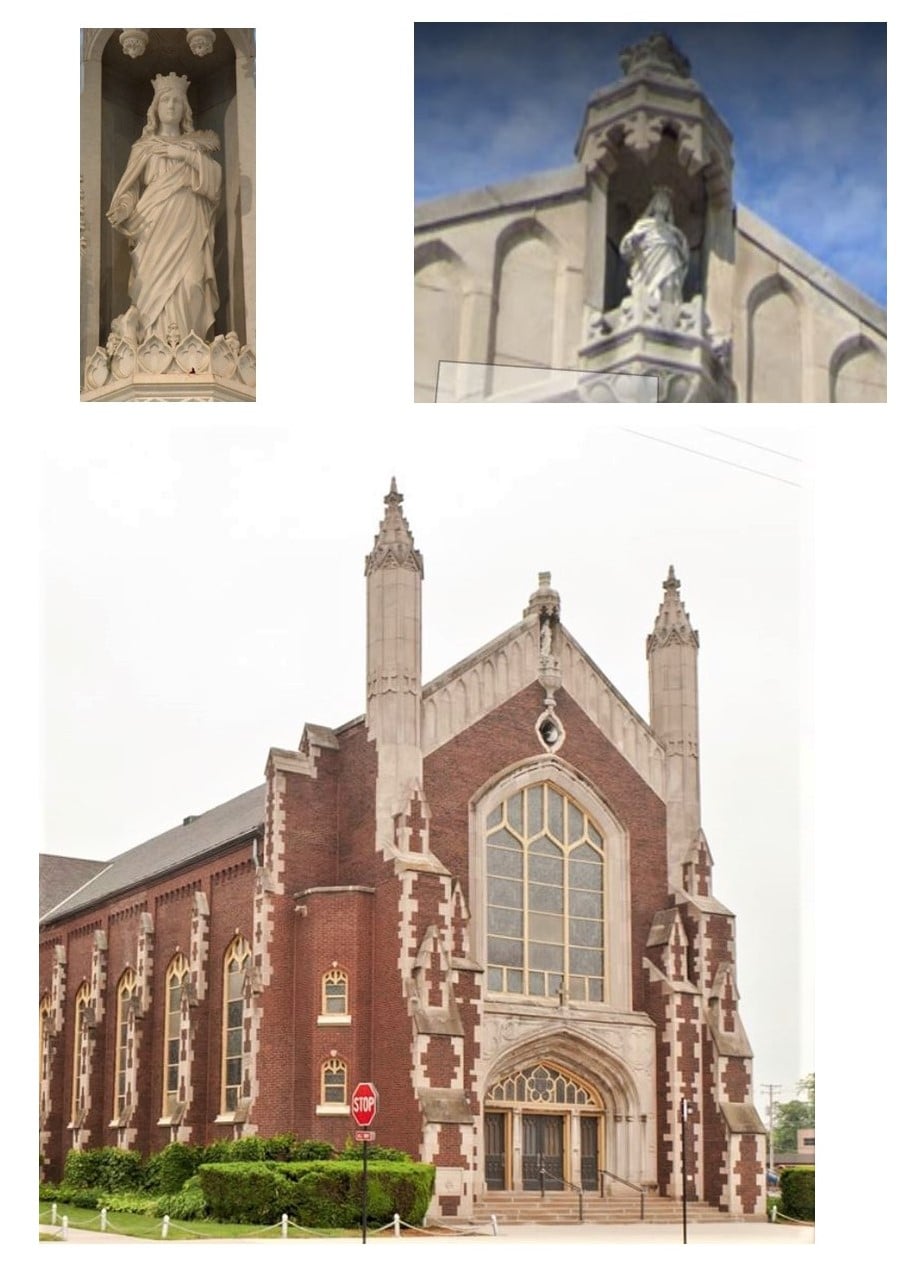
In 1927, Frank and Kate Egan and Phillip DuMais donated the statue of St. Margaret of Scotland for the new church the parish was constructing. The statue was in memory of Bernard Egan, the son who died of influenza in the army during WWI, and George DuMais, the husband of Marie Egan, killed in an accident at the Blue Island train yard. The statue can be seen in a niche high above the outside front doors of the church, right below the roofline.
Frank and Kate celebrated their golden wedding anniversary in 1933 with a Mass at St. Margaret of Scotland Church, a breakfast, and an open house for friends during the day. One article brought up some reminiscences by the couple.
During the Great Chicago Fire, when he would have been just 14 years old, Frank hitched up his father’s express team to help people rescue their household goods. Apparently, the frightened horses ran away and there was an accident; the chaos and danger in the streets at the time can only be imagined.
Their 50th anniversary coincided with the beginning of the Century of Progress, and Frank recollected he managed an exhibit in the Machinery Hall during the 1893 World’s Fair. It could have related to sewing machines, as his expertise was in that area.
Frank died on December 1, 1939, at the age of 82, and was waked at their home, then buried from St. Margaret of Scotland in Mt. Olivet Cemetery.
In 1941, daughter Marie held a surprise 77th birthday party for her mother Kate.
Kate died on January 22, 1947, at the age of 82. Her last story involves her funeral procession from St. Margaret of Scotland Church and burial in Mount Olivet Cemetery.
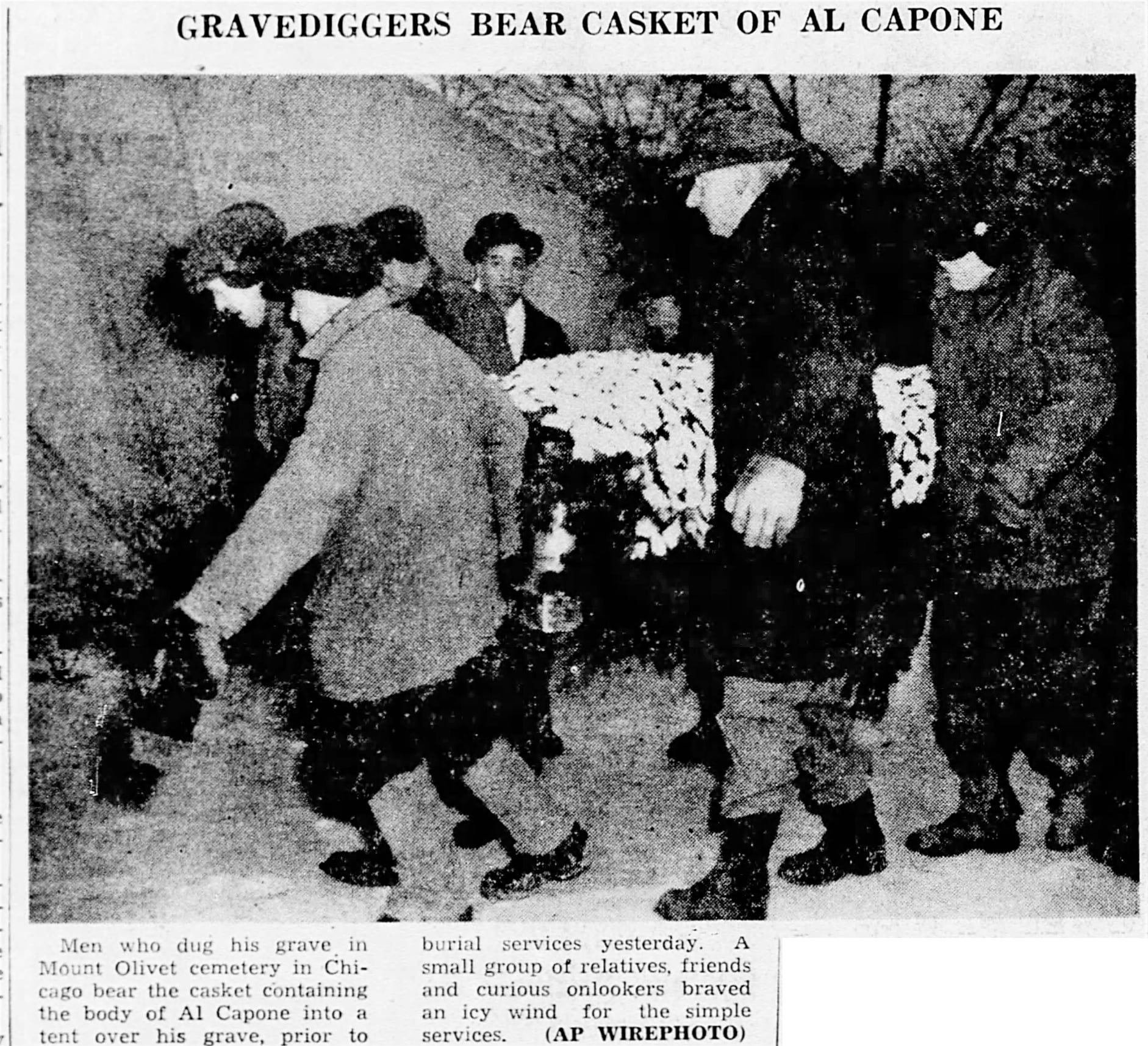
Kate was buried the same day in the same cemetery as was Al Capone, the infamous bootlegger from the days of Prohibition. Capone, aged 48, died in his home in Florida, and his remains were brought up to Chicago for burial. At that time, Capone’s father and one brother were already buried in Mount Olivet Cemetery.
It was a freezing cold, windy day, February 5, 1947, when the funeral cortege for Capone arrived at the cemetery at the same time as that of Kate Egan and her family. Fifteen limousines conveyed Capone’s mother, wife and son, brothers, and other family members and friends. A few “gawkers” and media people braved the cold to watch. There were about forty people in attendance, very small by standards set during the 1920s for gangsters. The service was said by Monsignor William Gorman, the chaplain of the Chicago Fire Department, who had been Capone’s mother’s parish priest at one time. The ceremony was brief, and the family did not linger.
According to Egan family folklore, the family was scandalized that famous people turned out for Capone’s funeral and it was conducted by Monsignor Gorman, while a good Catholic mother like Kate got only a small cortege and a local priest.
Of course, a good Catholic mother like Kate was the expected norm, and Kate couldn’t possibly have competed for public attention with a notorious bootlegger and alleged murderer who dominated Chicago and the newspapers for over a decade.
One paper reported that Msgr. Gorman did say at Capone’s gravesite that the ceremony was “to recognize his penitence and the fact he died fortified by the sacraments of the church. The church never condones evil, nor the evil in any man’s life.”
The Capone graves were later relocated to Mount Carmel Cemetery, but the Capone gravestone still stands in Mount Olivet Cemetery.
However, this was not a story about Al Capone. This was a story about a typical Irish American Catholic family who lived on the Ridge one hundred years ago and contributed to the rich history of the community.
This concludes the series on the George F. Egan family.