The Ridge Historical Society
February – Black History Month –#3
By Carol Flynn
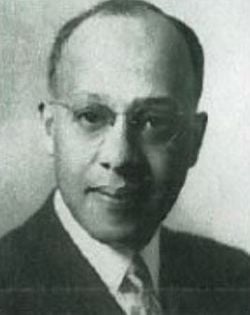
Our third person of distinction with a school on the Ridge named for him to be profiled for Black History Month is Judge Wendell Green.
Wendell Elbert Green (1887-1959) was a lawyer and judge who had a distinguished career in Cook County, Illinois. He was considered a brilliant defense attorney, with a “forceful expression.” As a judge, he was known for his “clarity of judgment” and professional decorum.
Born in Kansas, Green was the son of an Episcopalian minister and a social worker. He yearned to become a lawyer, but others convinced him that the opportunities for Black men were limited in this field. He earned a degree in pharmacy from the University of Kansas in 1908. He worked as a pharmacist for a few years, but he still dreamt of practicing law.
In 1913, Green married Loraine Richardson, who would also become well-known in Chicago as the first Black woman to serve on the Chicago Board of Education. He took a civil service job as a postal clerk in order to transfer to Chicago in 1916 so Lorraine and he could attend the University of Chicago. Green worked his full-time postal job, went to school at night, and took a second job serving meals on campus to pay their tuition. He was told by the dean of the school he would never be able to complete the law program.
He graduated in 1920.
Establishing a private practice, he built his reputation as a defense attorney who rarely lost a case. The Chicago Defender newspaper carried many stories about Green’s appearances in court. One pivotal event happened in 1924.
Green was defending a Black man against the charge of intoxication. One white police officer said the man had been intoxicated at an event; nine Black witnesses said this was not the case. Green asked for the charges to be dropped but the judge replied that in his opinion the nine witnesses were lying.
The judge said, “It has been my experience in this court that colored people lie on the slightest provocation. They will lie when there is no need to lie. That is why I believe one white witness against your nine.”
Green was speechless for a moment, then he addressed the court, “his voice charged with anger, re-sounding through the courtroom.” He berated the judge for not being fair and impartial; by law, color should not be the test for credibility. He said that veracity and perjury belonged to no particular race, that the lying and perjured testimony of white witnesses had done great wrong, and that the judge had no right to decide the case based on the color of the witnesses.
Green then withdrew from the case and, taking up his hat and coat, left the courtroom.
The courtroom sat in an “electrified” silence. Then the judge, with “a flushed countenance,” dismissed the defendant. Attendees of both races rushed into the corridor to congratulate Green.
Green served as a public defender, then as a Civil Service Commissioner appointed by Mayor Edward Kelly. In 1942, he was elected as a judge to the Municipal Court of Chicago.
Governor Adlai Stevenson appointed Green to fill a vacancy on the Cook County Circuit Court in 1951, and he won re-election to this position the following year. Green was the first Black person to reach this judicial level. During his time on the Municipal and Circuit Courts, Green tried cases ranging from a landlord accused of overcharging a tenant $1.25 on his rent, to a sensational case of a police officer charged with the murder of two young men following an off-duty altercation in a bar.
From 1956 to 1958, Green was assigned by his fellow Circuit Court justices to head Juvenile Court. He was the first Black judge to oversee associate judges hearing cases for runaways, truancies, and delinquencies. He helped set up a facility focused on psychological services and training for the juveniles who came before the bench. His effort to help young people is considered by many to be Green’s greatest legacy left to the city and the people.
Because Blacks were not allowed to join white legal associations, they started their own groups. Green was active in the Cook County Bar Association (CCBA), the oldest association for Black lawyers and judges in the country. In 1925, he was one of the thirteen founders of the National Bar Association (originally the Negro Bar Association). When the Chicago Bar Association finally accepted Black members beginning in the 1940s, Green joined. The Chicago Bar Association always gave the highest ratings to Green for his performance as a judge.
Green served as president of the board of Provident Hospital, the first Black-owned and operated hospital in the country, established in Chicago in 1891 to provide medical services and training to Blacks denied access at other institutions. Green was also a board member of the National Conference of Christians and Jews.
In 1973, the Chicago Board of Education voted unanimously to name the new school at 1150 W. 96th Street in Wendell E. Green’s honor.