
Martin Luther King, Jr., stated: “We are not makers of history. We are made by history.”
One point he was trying to make is that to understand the present, we need to study the past.
Today, Martin Luther King Jr. Day, is an appropriate day to announce that beginning in February, Black History Month, the Ridge Historical Society will explore the history of race relations and integration in the Ridge communities. This fits in well with the 2021 theme of “The Black Family: Representation, Identity and Diversity.”
Introduction: Martin Luther King, Jr.’s Visit to the South Side of Chicago
Excerpted from a Time Magazine article by Olivia B. Waxman, updated January 16, 2020
Martin Luther King, Jr., is usually associated with civil rights activities in the southern states, but in 1966, he spent time in Chicago.
In January of 1966, he moved into an apartment on Chicago’s west side to call attention to the poor living conditions of people of color in many of the northern cities. The slogan for the Chicago campaign was simply “End Slums.”
On August 5, 1966, he planned to lead a march in Marquette Park – centered around 69th Street and South Kedzie Avenue – to a realtor’s office to call attention to discrimination in the housing market.
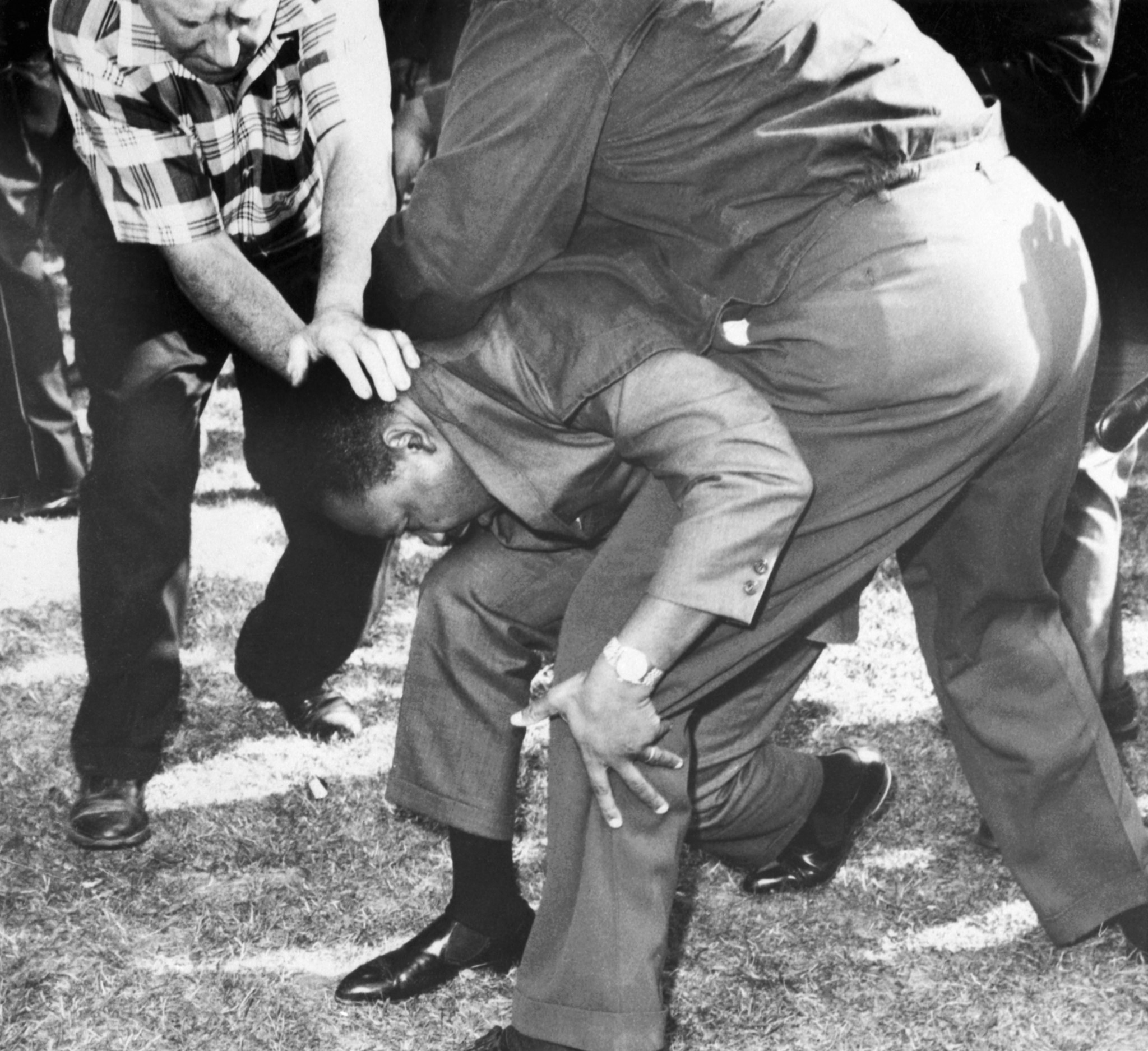
He was attacked by a swarm of about 700 white protesters hurling bricks, bottles, and rocks. One rock hit King and knocked him to one knee. His aides rushed to shield him, and he remained in a kneeling position for a few moments until his head cleared. That is the picture included here.
Afterward, King told reporters, “I’ve been in many demonstrations all across the South, but I can say that I have never seen, even in Mississippi and Alabama, mobs as hostile and as hate-filled as I’m seeing in Chicago.”
President Lyndon B. Johnson signed the Fair Housing Act into law on April 11, 1968, one week after Dr. King’s assassination. It was an important step in equalizing opportunities, but it was just a beginning step.
Follow RHS for the series in February.
Photo from the Chicago Tribune.