
What Didn’t Happen Today 100 Years Ago
By Carol Flynn
In November of 1920, the voters of Chicago approved a proposition to divide the city into 50 wards, each with about the same population based on the 1910 U.S. Census. Each ward would have one alderman, elected every two years. This replaced the old system of 35 wards of widely varying populations, each with two aldermen serving staggered two-year terms. There was an annual election in which half the aldermen were elected.
The proposition was to become effective with the February 1921 election. It was envisioned there would be 50 wards by then and 50 aldermen would be elected. Those in the middle of a term, if not elected as one of the new 50, would be phased out the next year – there would be no election in 1922. Henceforth, all 50 aldermen would be elected every two years on the odd-numbered years.
The map redistributing the population into 50 wards still needed to be finalized and approved. The proposition gave the city council, made up of the current 70 aldermen, authority for 90 days to do this.
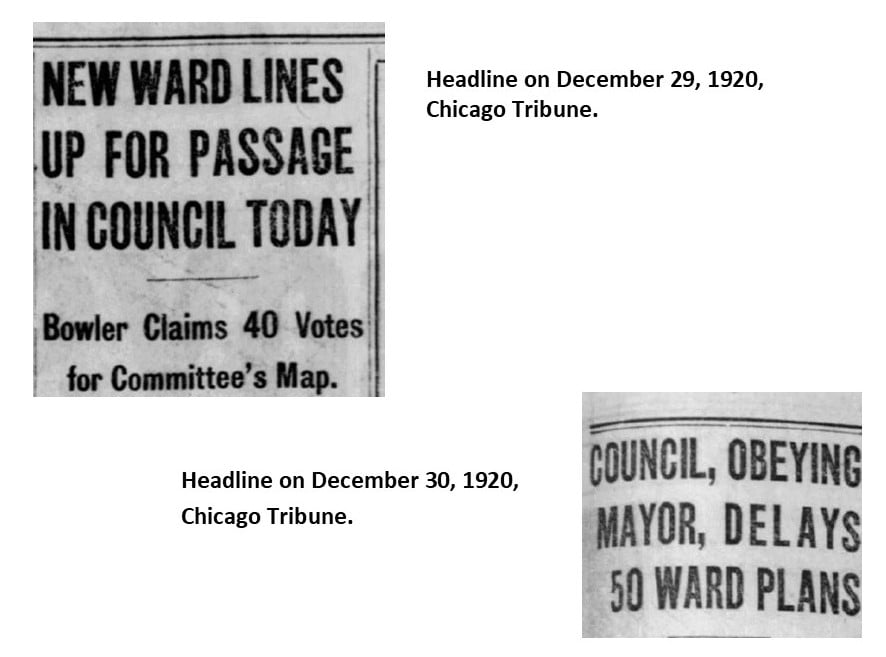
A subcommittee on redistricting under the elections committee of the city council, chaired by James B. Bowler, alderman from the “old” 19th ward, was charged with developing the new map. The committee worked as long as 18 hours per day to get a map finalized for vote by the city council, dealing with numerous “minor disputes,” including a fistfight, between aldermen.
They came up with the plan to renumber the wards. It was decided the wards would be divided into north, south, and west geographical territories, then numbered in order. They started with the loop and south wards. The 1st ward that included the loop retained its old number, then working down the map they ended with the 19th ward for Beverly and Morgan Park on the far southwest border of the city.
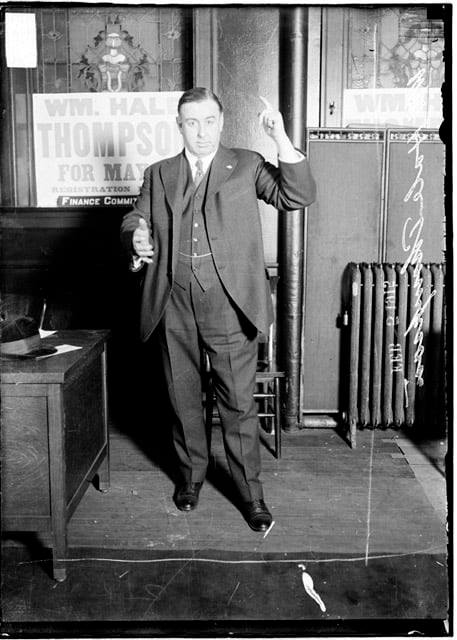
The committee was finally ready to submit its plan to the city council, and had secured 50 votes for approval (36 out of 70 were needed), when it was blindsided by Mayor William Hale “Big Bill” Thompson. Thompson announced he was forming his own committee, not headed by an alderman, to develop a redistricting plan which he approved. Some of his “friends” lost out in north side wards with the city council remapping.
This would likely result in two plans, one approved by the mayor, and one approved by the city council, that would go to the public in February to be voted upon.
The city council committee delayed its vote on a plan for weeks, trying to reach a compromise with the mayor’s committee. Many aldermen withdrew their support of the city council plan so as not to antagonize the mayor. Both sides accused the other of gerrymandering and favoritism.
Then the mayor’s office announced it was delaying the election of aldermen under the 50-ward plan until the 1923 election. This meant that 35 aldermen would be elected in 1921, and the other 35 would be phased out in 1922, so the city council would be reduced to 35 members – until the 50-ward plan was implemented or overturned. This would be a preferable model for the mayor – less aldermen to share decision-making authority. But many of the aldermen objected to this.
The city council committee announced it was going ahead with a plan, and that they had the necessary votes to pass it. The mayor’s supporters said that they were not interested in defeating the plan; if the plan passed, it simply meant that voters might have to choose between two plans in February 1921. It wouldn’t affect the election.
The vote was held in the city council on December 29, 1920. The support for the plan totally evaporated, and it was sent back to the elections committee. The power of the mayor was too strong to overcome.
Only 18 aldermen approved the city council plan, and two of these were Lyle and Fisher from the 32nd ward, representing Beverly.
At one point during debates, the cry of “Fire!” went up – it was Alderman Bowler burning the pledges of those who promised support for his plan.
The mayor announced his intention to have the state legislature repeal the 50-ward bill. The city entered the New Year, 1921, with no plan to implement the will of the people.
Of course, Chicago did eventually implement the 50-ward plan. Next year, 2021, is an aldermanic election year, and RHS will continue the story of the 19th ward.