
The Ridge Historical Society
The Nineteenth Amendment
By Carol Flynn
It will be a while yet before they can give final results for today’s election, so this seems like a good time to share a story about the Nineteenth Amendment to the U.S. Constitution, which was ratified 100 years ago.
The Nineteenth Amendment states: “The right of citizens of the United States to vote shall not be denied or abridged by the United States or by any State on account of sex.”
The U.S. Congress passed the legislation on June 4, 1919. It took Illinois less than a week to be the first state to ratify the amendment, on June 10, 1919. Thirty-six states were needed to ratify the amendment, and this was reached with Tennessee on August 18, 1920, allowing the country to certify the Nineteenth Amendment as adopted on August 26, 1920. [The last state to ratify the amendment was Mississippi, in 1984. Yes, 1984.]
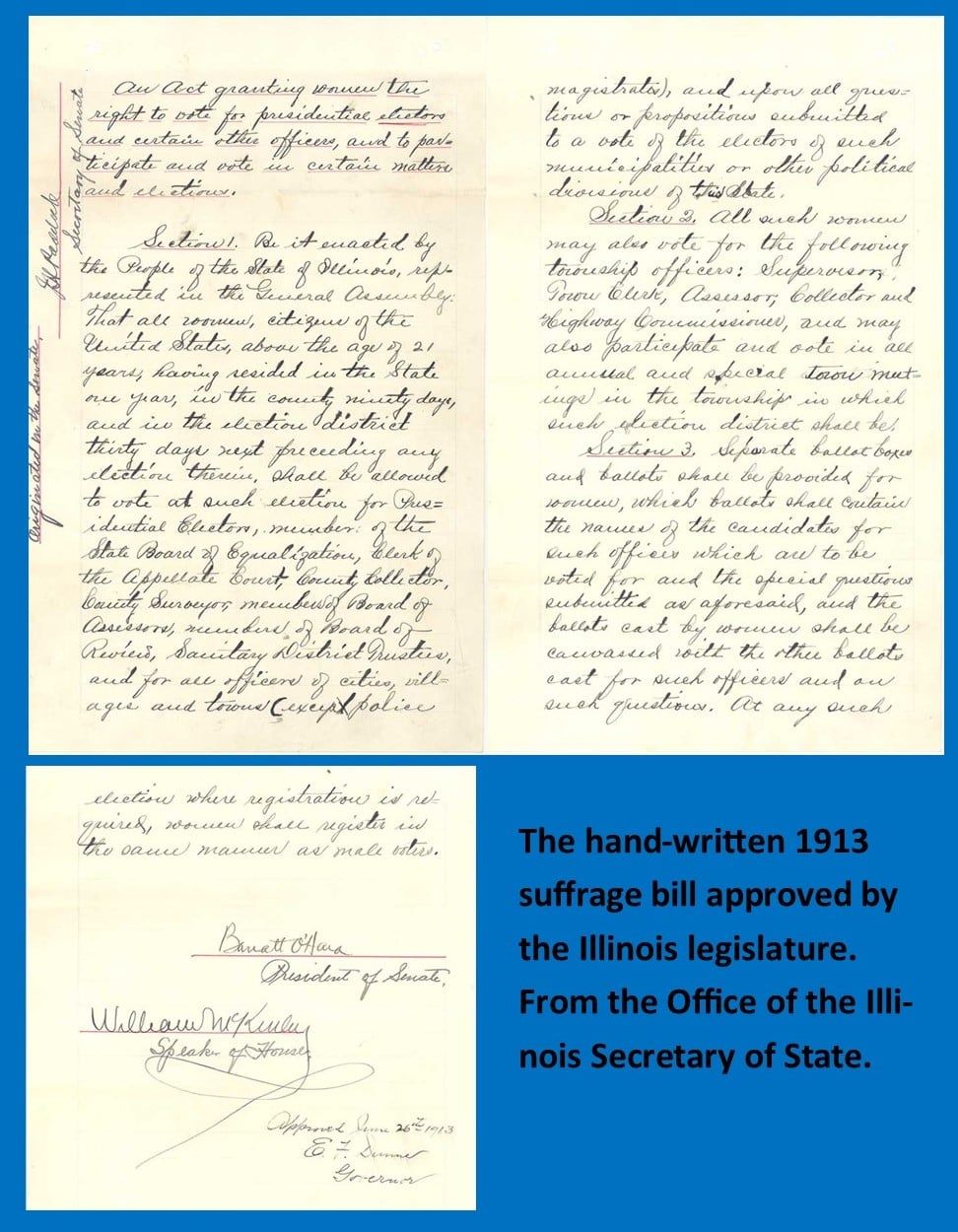
It was not surprising that Illinois was the first state to ratify the amendment, as it was legislation passed in Illinois in 1913 that was a major turning point in the women’s suffrage movement. In fact, the women of Illinois took the passage of the Nineteenth Amendment somewhat in stride because they had had the right to vote in the U.S. Presidential selection process for years.
Although the issue of women having the right to vote went back to the founding days of the country – the second First Lady Abigail Adams was all for it – the formal beginning of the women’s suffrage movement is considered to be an 1848 women’s rights convention held in Seneca Falls, New York. The group came up with a list of resolutions and the one concerning the right to vote was hotly debated.
It was one of the few men at the meeting, Frederick Douglass, former slave turned statesman, who convinced the women to leave suffrage in their platform.
Douglass wrote, “All that distinguishes man as an intelligent and accountable being, is equally true of woman; and if that government is only just which governs by the free consent of the governed, there can be no reason in the world for denying to woman the exercise of the elective franchise. Our doctrine is
that ‘Right is of no sex.’”
The resistance to women voting was widespread and strong, not just among men but for many women, also. The arguments against it generally related to the “proper” or “natural” role of women in society. The debate continued for seventy years.
But changes occurred in society. There was increased industrialization and urbanization. A fast growth in wealth led to the “Gilded Age,” a veneer which covered a wide range of corruption and social ills. Reform-minded groups called for change, and an atmosphere conducive to women’s suffrage finally emerged.
The period from 1890 to 1920 became known as the Progressive Era. Reforms in government, education, business, even churches and religion, took place. Leadership cut across party lines, and Theodore Roosevelt, Herbert Hoover, and Woodrow Wilson were all progressive.
By 1913 in Illinois, the Progressive Party held the balance of power in the state legislature. Women lawyers of the state’s suffrage association had figured out a way to get limited but significant voting rights for women.
The Electoral College is the process that the Founding Fathers established as a compromise between Congress or the public electing the President. Individuals known as “electors” are chosen by each state and it is the electors who actually choose the President. Each state has the authority to decide how its electors are chosen.
In Illinois, a bill allowing women to vote for the state’s electors was drawn up and introduced to the state legislature.
Every conceivable parliamentary maneuver was used by the opposition to keep the bill from coming up for a vote. Hundreds of men went to Springfield to entreat the Speaker to prevent entry of the bill. The Speaker asked the pro-suffrage lobby for a show of support, and he was immediately flooded with letters, telegrams, and telephone calls. Satisfied that there was public support for the bill, he let it go to vote.
When the time came for the vote, women “captains” went so far as to fetch needed male voters from their homes, and stayed on guard duty at the chamber doors to urge members in favor not to leave before the vote, and to prevent opposition lobbyists from being illegally allowed on the floor.
The bill passed. Illinois women became the first in the country with the right to vote in the process to select the U.S. President.
The opposition brought forth more than fifty legal challenges to have the new law declared unconstitutional, but none were successful. Pro-suffrage sentiment across the nation swelled. At the annual suffrage convention in 1916, a plan was developed state by state to procure voting rights in the presidential election process. Delegates went home and put their plans into motion and had successful results. By 1919, the country finally accepted that women were going to find a way to vote.
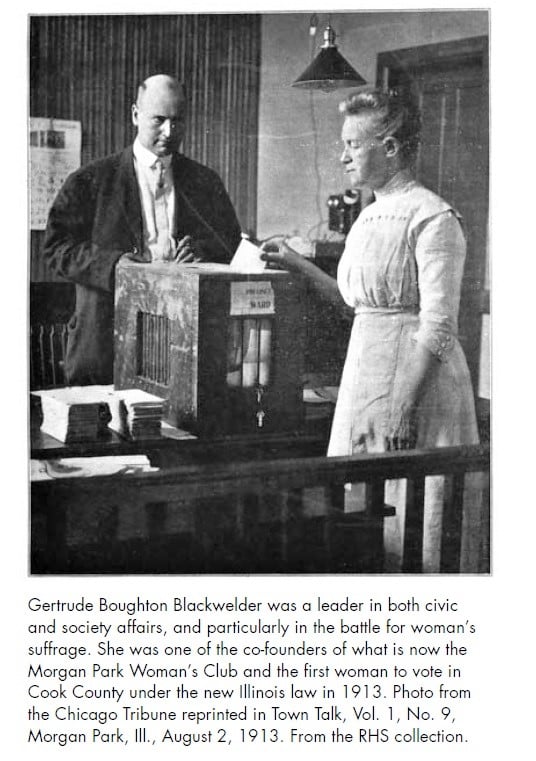
The women of the Ridge were not idle observers of these events, and many were ardent suffragists. They lost no time exercising their new, hard-won right. The other part of the 1913 Illinois bill covered certain aspects of municipal voting. The Illinois bill was passed on June 26, 1913, and on July 26, 1913, the women of Morgan Park voted for a bond issue to fund a high school. They were the first women in Cook County to vote, and the first woman to cast her ballot was Gertrude Blackwelder, former President of the Chicago Woman’s Club and the Chicago Political Equality League.
The InterOcean newspaper carried an article on the event. Many husbands and wives went to vote together for the first time ever. Even progressive David Herriott, the Morgan Park Postmaster and editor/publisher of the Morgan Park Post, was surprised when the women voted in their own names. His wife told him, “Mrs. David Herriott looks well on calling cards, but Janet Herriott has more political significance.” Janet Herriott cast the second female vote.
The event took on the aura of a garden party, according to the newspaper, with the summer frocks and parasols. It turned into a pleasant social afternoon with no problems. The policeman on duty said it was the most civil election he had ever witnessed. The women’s votes were kept separate from the men’s in case they were challenged legally. The only “bribe” in sight were packets of peanuts provided by the school superintendent, John H. Heil.
Just at closing time, a 65-year old woman rushed in still wearing her apron. She had biscuits in the oven at home and was in a hurry. The process was explained to her – she had to select a slip for or against the high school, fold it, and place it in the ballot box.
“For land’s sake,” she said, “it’s that easy and I’ve always respected a man because he knew enough to vote.”
World War I came in 1917, and women took on many non-traditional roles, both as volunteers and as paid employment. They showed they could keep their homes running and also participate in civic affairs. After years of opposing women’s suffrage, President Woodrow Wilson became an advocate. When the Nineteenth Amendment was finally ratified, the Illinois papers took little notice of it. They had been covering women voting for seven years.