
The Ridge Historical Society
The Paranormal Ridge: Part 13 – Odds and Ends on Castle Ghost Stories
By Carol Flynn
Here are two more pieces of interesting trivia about the Givins Beverly Castle that relate to the paranormal. The first is the Transylvania connection, and the second is Bob Givins’ own experience with a ghost.
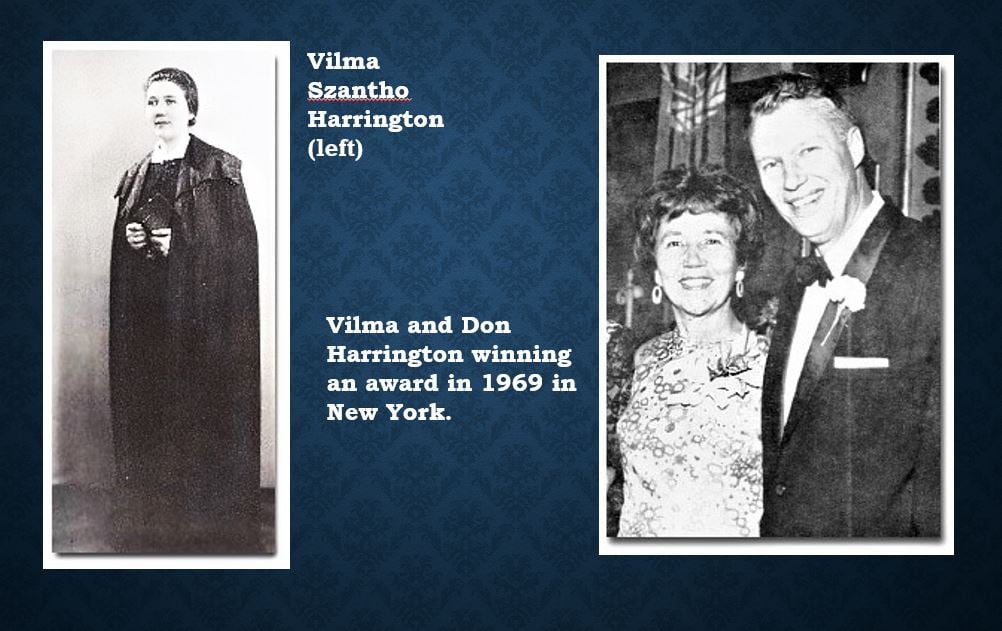
If the rumor that there was once a woman from Transylvania, Romania, the home of Dracula, in the neighborhood and she was connected to the Castle is ever heard, well, that is true. Her name was Vilma Szantho Harrington, and she was instrumental in starting the Beverly Unitarian Church. She was the first woman to be ordained a Unitarian minister.
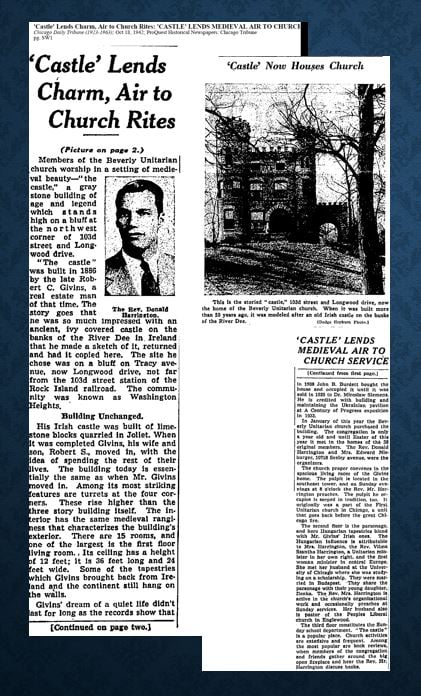
Vilma was born and raised in Transylvania, which, along with Poland, was a starting place for the Unitarian Church. She came to Chicago to attend the University of Chicago. There she met Donald Harrington, a fellow seminary student, and they married in 1939. The Harringtons started the Unitarian Church in the Castle. They moved on to New York, where Donald became a leader in the Church there.
The history of the Unitarian Church is very interesting. By all of the many accounts about the Harringtons, they were wonderful people, devoted to social justice causes. Vilma died in 1982. Her husband wrote a tribute to her that can be found online at https://www.harvardsquarelibrary.org/biographies/vilma-szantho-harrington/. Donald died in 2005 in Transylvania.
The Unitarian Church connected with Harvard University has mentioned Dracula humorously in some of its web posts, but there is, of course, no connection at all between the Church and Dracula.
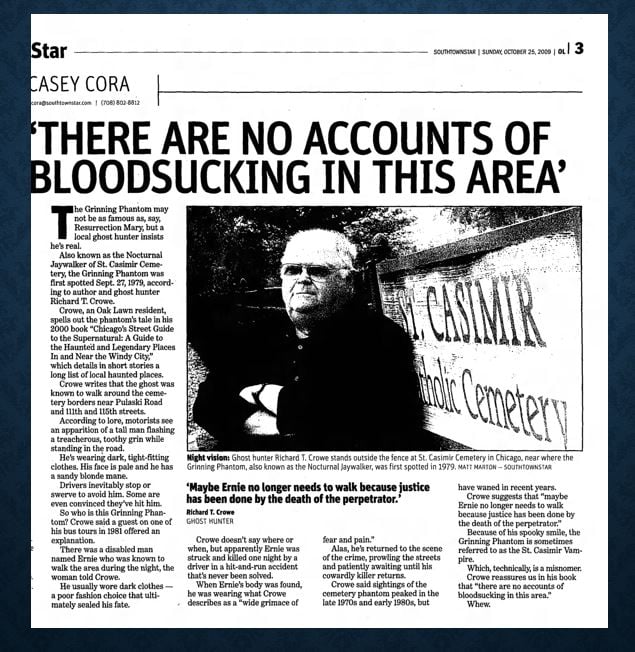
There has been an occasional vampire story on the South Side but these never came to anything. There were occasional sightings of a phantom by 111th and Pulaski Road at St. Casimir Cemetery, on the western edge of Mt. Greenwood. Richard Crowe, Chicago’s legendary ghost lore expert and tour director, assured the public this was not a vampire.
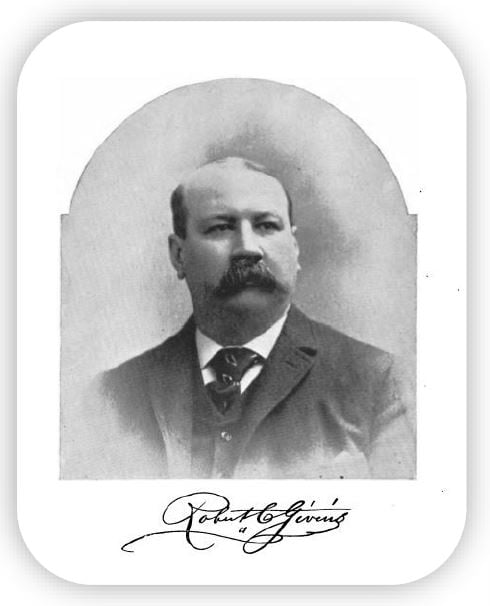
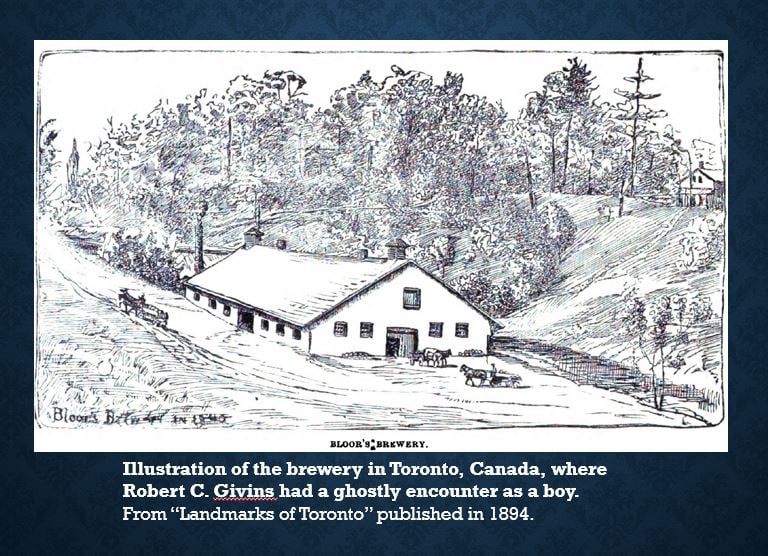
These posts have covered ghost stories at the Castle that Robert C. Givins built. As it turns out, Givins himself was no stranger to ghost experiences. One experience is covered in a book titled Robertson’s Landmarks of Toronto, published in 1894.
Givins’ ancestors came from Northern Ireland to Canada. Around 1800, Colonel James Givins, Robert’s grandfather, built a home in Toronto. At the time, Toronto was called York, and this was one of the first homes established, a landmark for many years until it was demolished in the late 1800s.
Robert C. Givins was born in Canada in 1846. In an adjacent village, Yorkville, which became part of Toronto in 1883, was an old brewery built at the bottom of a ravine. The building was described as “a low, red brick building one hundred feet long and fifty or sixty feet wide.” It was in a very picturesque setting, surrounded by thick woods with a pond from a stream that had been damned up to create water power for grinding. A water wheel was at one end of the building. A road ran down to the brewery from the street above.
By 1860, the brewery was no longer in operation. The building was used by local boys for a meeting place and shelter. In the wintertime, the road leading down into the ravine was used for sledding.
Givins shared the following story with a Canadian newspaper reporter:
“I remember one dark night one of the boys [dared] a party of us to go through the old [brewery]. A superstition existed among many in the village that this old building was haunted, and notwithstanding our frequent visits there in the day time, there was not a boy in the neighborhood who could be hired at any price to go through it at night, and I have no doubt many believed that it was actually haunted, because I remember a story in circulation at the time that one night an old watchman had occasion to go down there after an escaped burglar, claiming that as he entered the old building, he saw four ghosts playing whist on the top of one of the vats. He did not wait to catch the burglar, who either escaped or was annihilated by the ghostly occupants of the old building.
“We followed the nervy youth who originated this hazardous proposition. It was the blackest night he could have selected; thunder clouds hung over the pond, and an occasional flash indicated an approaching storm, and added no little terror to the occasion. To many of us this day seemed our last. Whew! – going through the old brewery at night. We groped our way down the hill, and after stumbling about over the rough ground and through shrubbery we finally got to the entrance to the old sluice. [This opening was where the water once ran to power the wheel for grinding.] It was 200 feet through into the big water wheel, which was located at one end of the brewery. The passage way was large enough for us to go two abreast, but was very low; we had to creep on our hands and knees. [No one] experienced a more breathless journey than we did.
“We got along, however, all right until we came to the big wheel, and after we all climbed through we stood inside the wheel to get a rest before we explored other portions of the brewery. In the corner of the room we thought we saw what first appeared to be a ray of light peeping through a crack in the wall. We all looked intently upon the corner where we saw two big bright eyes glaring at us like two coals of fire. We were paralyzed for a minute, not one of us mustering up courage enough to speak. At last the leader whispered, “Let’s get,” which we did and the way we scrambled out through that sluice to the entrance and got up the hill can never be properly expressed. Upon reaching the street, we walked hand in hand home.”
Tomorrow: Halloween and a final post on Castle ghosts