
The Ridge Historical Society
The Paranormal Ridge: Part 6 –Questionable Folklore about the Givins Beverly Castle
By Carol Flynn
Ghost stories are by nature subjective – the person having the experience is really the only one who can say what happened. For that reason, it is hard to say a ghost story is not true. However, a ghost story that is attributed to incorrect historical information can be challenged for its likelihood. And that is the biggest issue with the stories about the Givins Beverly Castle that have been printed over and over for decades in books and on websites – they are not supported by historical facts.
The ghost stories most often related for the Castle involve some variation of a young woman or girl ghost. She pops up in various ways, from appearing in the living room/church sanctuary, to walking the grounds, to knocking on the door in the middle of a blizzard, to making an appearance at social events, to following people up and down stairs.
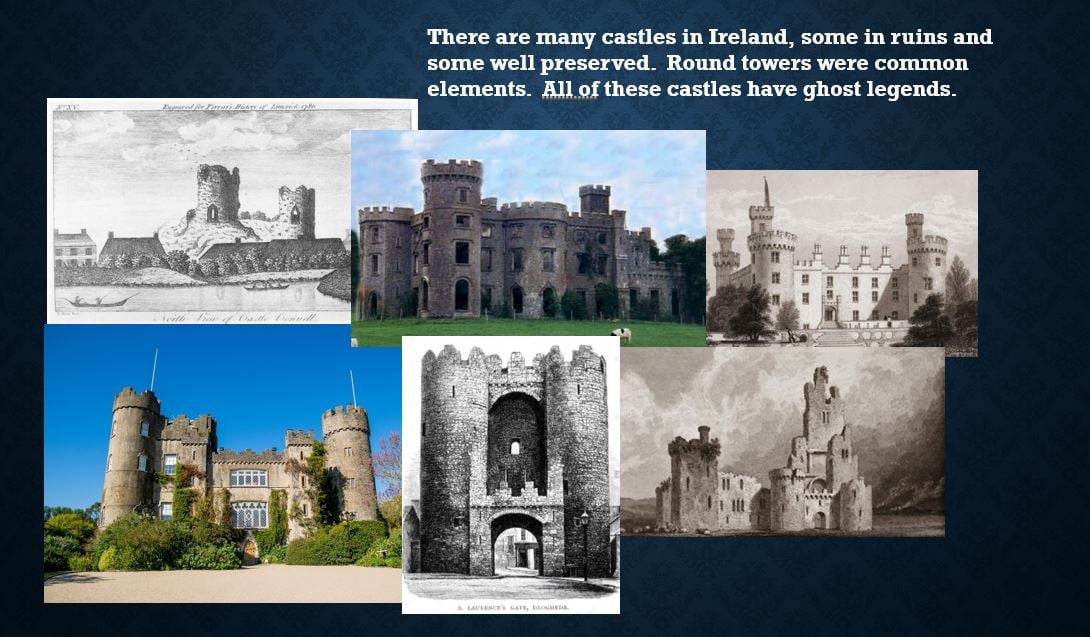
The most common story is that caretakers and others have encountered a young woman with an Irish brogue said to be the ghost of Robert Givins’ Irish fiancé. This is based on the folklore about the “Irish” origins of the Castle. The usual story is that Givins visited Ireland and came across a castle along the River Dee. He so liked the Castle that he sketched it, and when he returned to Chicago, he built his Castle as a replica. Some stories say the limestone used to build the Castle was brought over piece by piece from Ireland.
The ghost legend part is that Givins built the Castle for his fiancé, who remained back in Ireland. She died before she could come to America to live in the Castle, and it is her ghost that haunts the house.
The truth is that none of this information can be verified – in fact, more than likely the Castle is not “Irish” at all.
The Castle was built by Robert Givins in 1886-87 from limestone quarried in and transported from Joliet, Illinois; this is verified by the family of the stonemason who did the work. Research so far shows that the Castle was never referred to as an Irish Castle until it was about 50 years old, and then the Ireland story was mentioned in a newspaper article that had many facts wrong about Givins and the Castle. His name was not even spelled correctly in the article. No record of Givins taking a trip to Ireland can be found. Travel to Ireland was not the norm in the 1800s due to the living standards and political strife there. In fact, this was the period in history when hundreds of thousands of people were emigrating from the country.
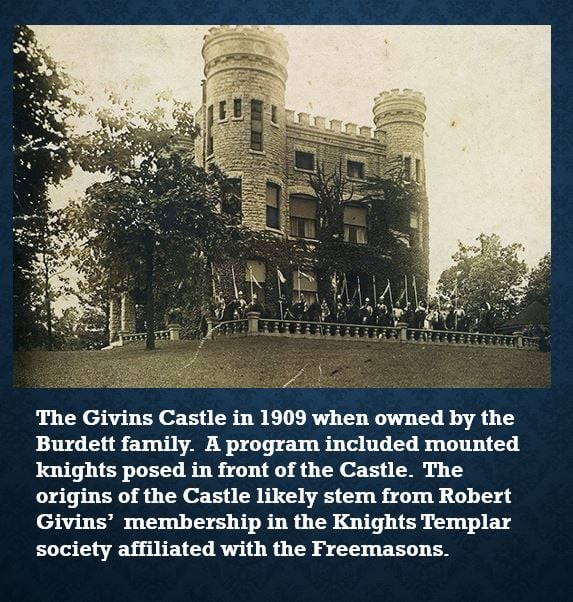
Givins sold the Castle in 1909 to the Burdett family. Decades later, in the 1940s, the Beverly Unitarian Church (BUC) bought the Castle. A member of BUC contacted the Burdetts for information on the building and Mrs. Burdett had never heard the Irish story before. The Castle was not known as “Irish” in its early years.
It is always possible that Givins did get over to Ireland and the evidence of the trip – a ship’s passenger list, etc. – just has not turned up yet. Or it is possible Givins saw a print or painting of a castle in Ireland and modeled it on that. The architect for the Castle has not been identified. The structure is typical of what many castles were like – a box with towers.
But even if Givins did get over to Ireland, the ghost story about a deceased fiancé is highly unlikely. Givins married Emma Steen, his second wife, in 1884, and she was very much alive when the Castle was built two years later. She was a Chicago schoolteacher of Norwegian descent, and her family was from Minnesota. They lived in the Castle for many years.
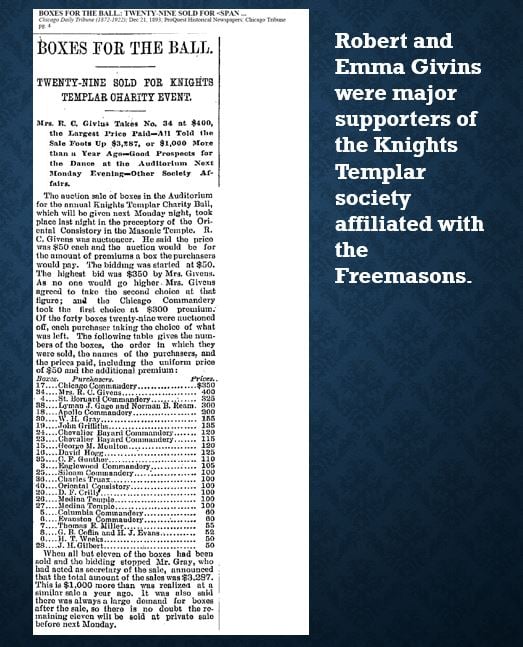
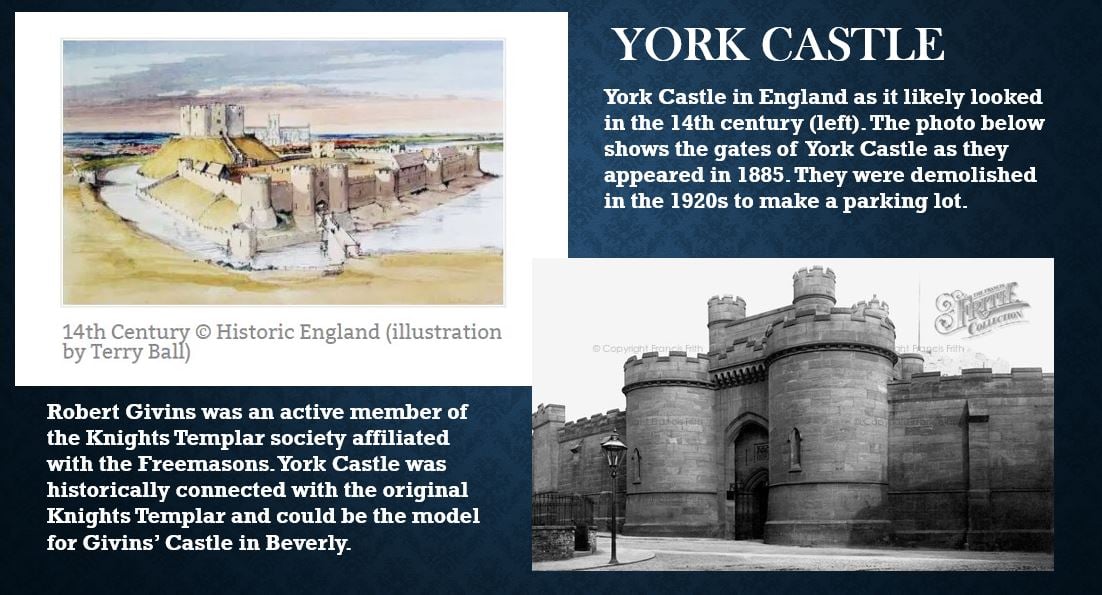
An alternative, and more likely, theory is that the Castle is based on York Castle in England. Givins was an active member of the Knights Templar fraternal organization affiliated with the Freemasons, as were numerous other prominent men of his day. Emma and he participated in many events with this group, which had no historic connection with the medieval Crusaders other than borrowing their name. However, there was much interest in the original Knights Templar.
The Knights Templars had a strong historic connection to York Castle. In 1308, twenty-five knights were held prisoner there while they were tried for heresy. They were found innocent, but the order was disbanded and stripped of its possessions. In France, Templars were burned at the stake.
Givins was a romantic at heart – he even wrote romance novels – and certainly would have been familiar with York Castle. The York structure with its round towers looks very similar to the building Givins constructed in Beverly.
The second most common story is that the young woman whose ghost haunts the Castle died of influenza while she was a student at the female academy in the 1930s.
The problem with this story is that the Chicago Female College was in the Castle in 1895-97, and long gone by the 1930s.
The house was owned by Dr. Miroslaw Siemens in the 1930s and he saw patients there. A young woman could have died during that time or could have died during the 1890s when the school really was there. Neither of those time periods had widespread influenza outbreaks, but the flu certainly could have been around. The major influenza outbreak was in 1918-19. More research could be done to try to identify a female influenza victim from any time period that somehow had connections to the Castle.
The origins of the “Irish fiancé” and the “female academy student” stories are not known but they are likely just urban folklore.
There are other stories about a young woman or girl ghost at the Castle. These will be explored in the next sections which will look at unusual experiences people have actually reported at the Castle.