
The Paranormal Ridge: Part 1 – The History of Ghost Stories
By Carol Flynn
Ghost and paranormal stories have been around forever. Every culture and every nationality and every religion have their versions of ghost folklore. Every one, from the Vikings to Tibetan Buddhists.
The intent of this series, as was stated in the previous post, is to share information on the ghost stories connected to Givins Beverly Castle at 103rd and Longwood, which were covered last year in a presentation at the Castle. Some general information on the history of paranormal stories will help put those surrounding the Givins Beverly Castle into perspective.
In Egypt, archaeologists discovered 4,000-year-old pottery fragments with a ghost story recorded on them. In this story, a high priest encountered a restless spirit whose tomb had collapsed.
A tomb was considered not just the final resting place for a person’s physical remains, but the home of his spirit as well, and therefore tombs needed to be maintained like any house would be. While interactions with ghosts were not considered horrifying supernatural occurrences, the living still wanted the dead to stay content so they would not become a nuisance.
In the story, the priest promised to build a new tomb, but the ghost was skeptical because others had promised but failed to do so. Some pieces of the story are missing, but then the priest sent out three men to find a good location for a new tomb. They found one and reported back to the priest. The last shard states the priest declared his intent to build the tomb. No further parts of the story have been discovered but it is assumed the priest kept his promise.
Religious people like saints often reported paranormal experiences – apparitions, dreams, messages from the supernatural.
A personal favorite story is a little piece about St. Paul of the Cross who was born in 1694 in Italy. A series of visions led him to establish the religious order called the Passionists.
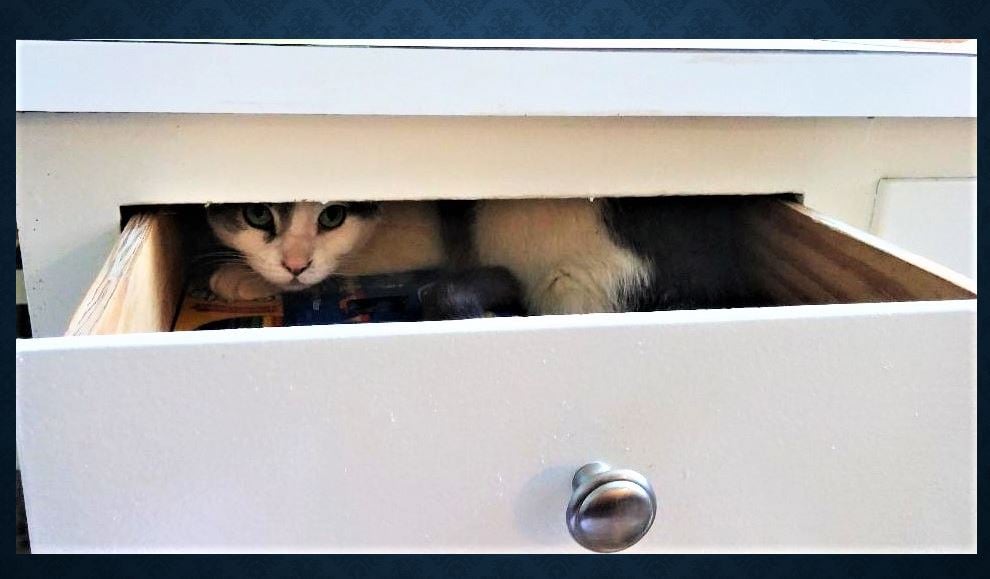
Paul claimed that demons in the form of cats often walked across his bed while he was trying to sleep, keeping him awake. Anyone who has cats knows this is the kind of thing cats indeed do.
One cat owner asked a member of the clergy, “My cats walk across the bed all the time when I’m trying to sleep. How did Paul know these weren’t just regular cats?”
The clergyman replied, “How do you know your cats aren’t demons?”
This might off a new perspective for some cat owners.
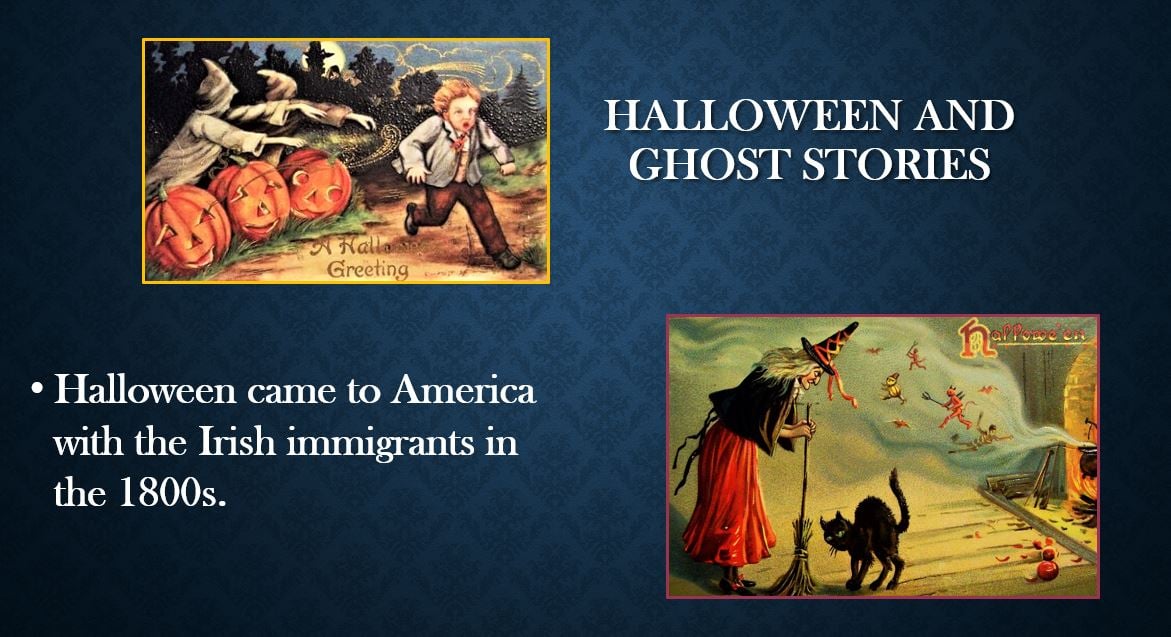
This is the time of the year, Halloween, when imagination turns to ghosts. Halloween is an old Celtic tradition, and it came over to America with the Irish and Scots in the 1800s. Its origins are likely in the Gaelic pagan harvest festival Samhain, Old Irish for “summer’s end.” It was believed this was one of the times of the year, in between the harvest and the coming of winter, when the barrier between the physical and spiritual worlds was thinnest, and it was easier for the spirits of the dead as well as non-human entities like demons and fairies to cross over into the living human world. With time, many of the pagan holidays were adapted to Christianity, and Samhain apparently evolved into All Souls’ Day and All Saints’ Day.
The Celts welcomed the spirits of their deceased loved ones into their homes; they even set places at the dinner table for them.
But the non-human spirits, the demons and the fairies, were another matter. The Celts did things to keep these beings at bay and these became some of our American Halloween traditions.
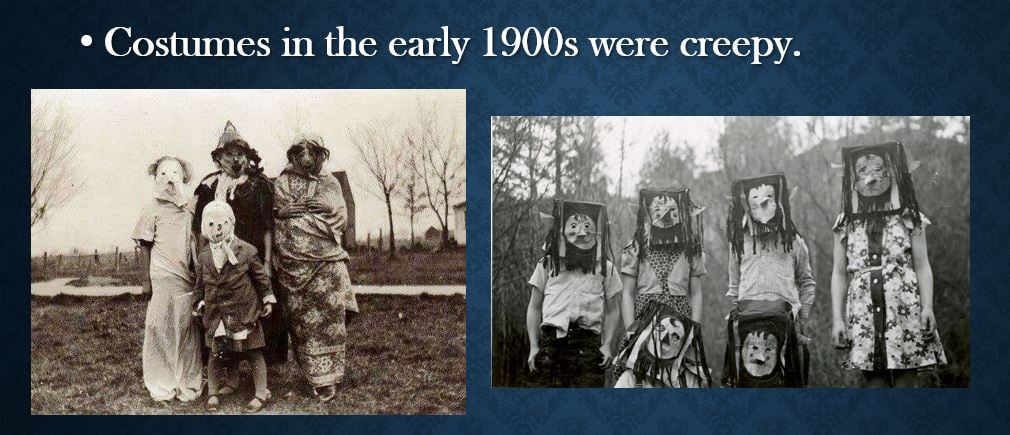
First, the Celts dressed up like frightful demons so the real spirits would be confused and leave them alone. This is where costumes came from. Starting in the 16th century, “mumming” became popular – dressing in costumes and going door to door reciting verses or singing, in exchange for food or offerings on behalf of the spirits. Costumes in the U.S. around 1900 were homemade and “creepy” by today’s standards. They had to be creepy to represent or drive off the spirits. It would be decades before princess and superhero costumes became the norm.
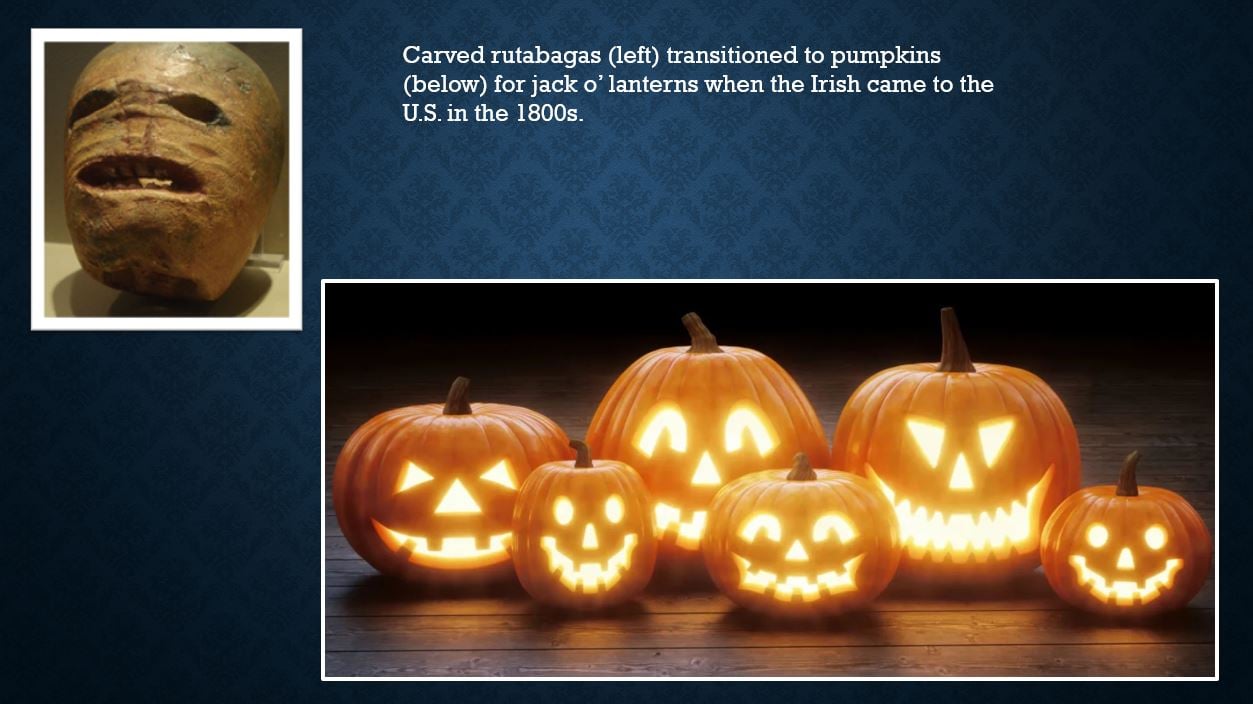
The Celts carved gruesome faces in rutabagas (yellow turnips) and lit them from inside with candles and put them on their stoops or in their windows to scare away spirits. When they got to America, they switched over to pumpkins, a native vegetable that was very plentiful. These are jack o’ lanterns, of course. One Irishman recently new to the U.S. said that he was happy to find that pumpkins are much easier to carve than rutabagas.
The Irish also left out treats of food and beverages so the fairies would not play tricks on them but would instead help them and their farm animals survive through winter. This, plus mumming, led to trick or treating.
A few years ago, a ghost explorer from Chicago was invited to a farm in another state that reportedly is a portal where fairies cross over from their world. As an experiment, they left out a variety of food items to see what the fairies preferred. The favorites were chocolate brownies and Starbucks Frappuccinos. Fairies apparently like sweets.
Fairies are much more common in Ireland and England but sometimes they pop up over here. There is evidence we have visits from the fairy folk here on the Ridge.
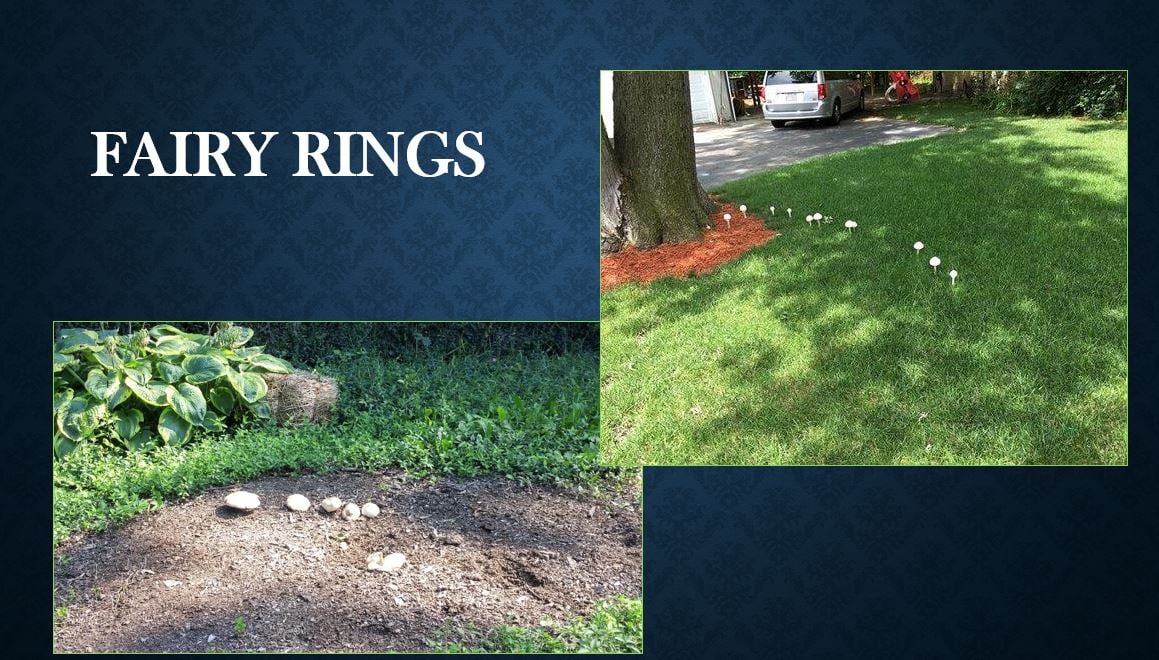
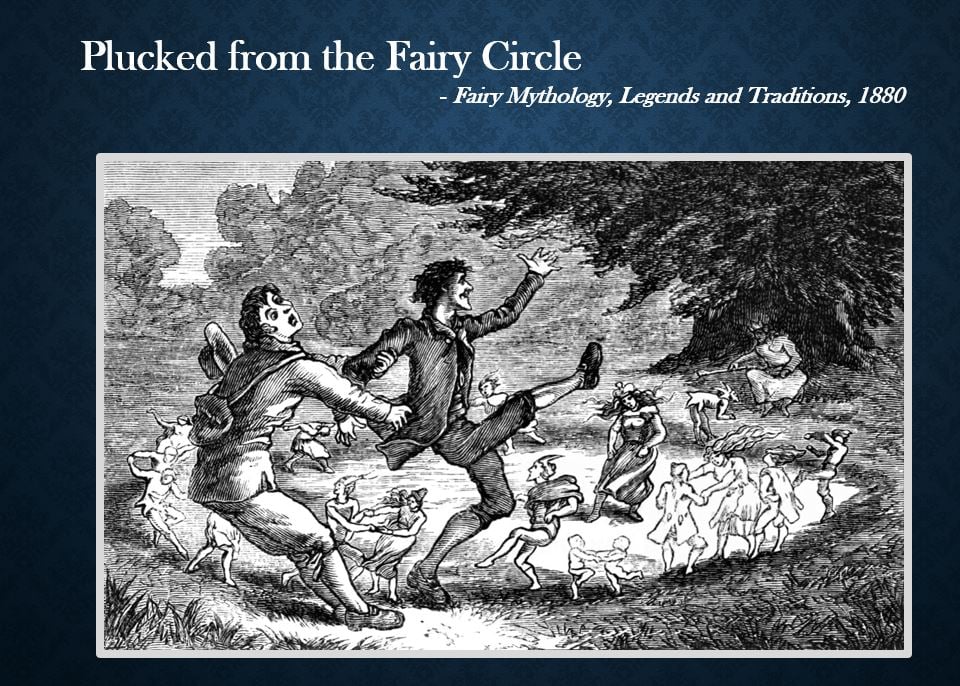
Sightings of “fairy rings” on lawns in the Ridge area are not uncommon. These are mushrooms that grow in an arc or a circle. Sometimes the fungus is underground and displays as a circle of thick or tall grass. There are a lot of superstitions about fairy rings. Folklore says these are made by fairies dancing. Fairies use these rings to trap humans. If a human steps in a fairy ring, he or she may be stuck in the fairy world forever dancing. It is considered bad luck to destroy a fairy ring.
Part 2 will look at the Victorian love for ghost stories.