Although never as widely favored as Tudor or Georgian, Norman style houses are found all over Beverly/Morgan Park, with examples ranging from simple cottages with two wings joining at a central tower all the way up to high-style examples on or just off Longwood Drive. Norman was the preferred style of distinguished local architect Harry Hale Waterman, when he began his own practice here in the 1890s, but most examples date to after World War I, when returning doughboys carried with them visions of rural manors they had seen in France. Such a house is the residence built in 1929 or Dr. Ralph L. Harris at 10415 S. Bell Ave.
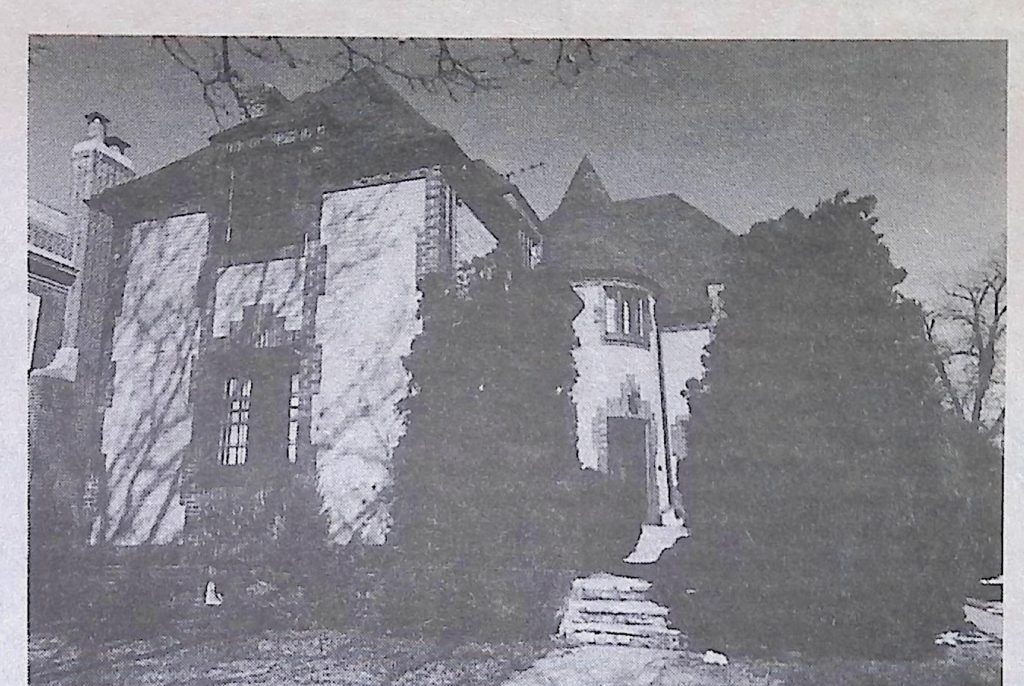
The Harris House, designed by architect William B. Betts of Park Ridge, is comprised of front and side wings with steep roofs of different heights, which is often seen in this style, joined on the corner of intersection by a round tower with a steep conical roof.
The entrance is at the base of the tower and is approached from two directions by sidewalks which cross a shrub-enclosed terrace about three steps higher than the parkway. On the north side another formal door opens onto a little uncovered raised porch with steps descending in two directions to the driveway.
The windows of the house are grouped in vertical tiers, usually composed of a large window cluster on the first floor beneath a smaller window on the second. The smaller window usually projects through the eaves and is capped by a hipped dormer, the latter being a fairly common feature of Norman manors.
All of the windows and doors have very elaborate surrounds, with quoins that run between the stories as part of the connections between the windows.
Quoins were originally blocks of stone placed up and down the corners of brick houses to anchor the brickwork. When they became decorative features, they were often imitated in light-colored brick. In the French originals the wall is usually of red brick, while the quoins, including those at their more usual position on the corners of the house, are of light stone. But in this house, the walls are of yellow brick, while the quoins are of red brick. The chimney on the north side of the house has a similar quoin pattern on its broad side, but the narrow sides are all red brick. Between the windows of the two floors on the south wing there are panels of checkerboard pattern, composed of alternating squares of red bricks and yellow stone. This again recalls the manors of Normandy, where sometimes whole walls are laid out in checkerboard brick and stone patterns. Beneath some of the first floor windows are panels composed entirely of red brick headers (bricks laid with their short side out).
Atop the ground floor windows and doors are stepped patterns of upright red bricks for which I can find no precedent in the Norman originals, though they are somewhat reminiscent of art deco decorations of the late 1920s. Incidentally, the windows themselves are casements, which are similar in external appearance to the small-paned windows of the manors in France, and both they and the gutters are painted red to enhance the effect of the brickwork.