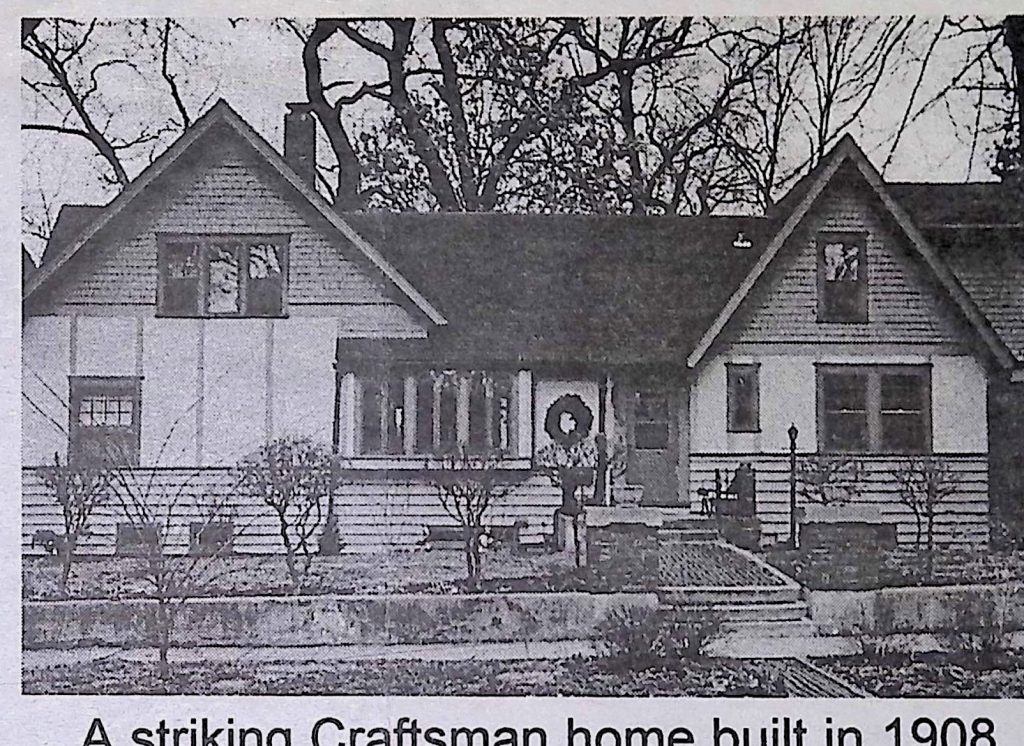
What is in an architect's mind when he builds a house for himself and his family and names his wife as the client in his press release? Possibly he just wants it to seem like he has a client for the project. Or he may want to credit his mate with some role in the funding, conceptual program, or even design details. All of these may have been factors in the house designed for Alla Ripley Bannister by her husband George Steele Bannister and built at 1620 W. 102nd St. in 1908.
George Bannister was born in western New York State in July 1860, the first of three sons. His father, Thaddeus O. Bannister was a physician who served as a surgeon in the Civil War and was imprisoned at the notorious camp at Andersonville, Georgia, until freed near the end of the war.
After the war, Thaddeus Bannister moved to Odell, Illinois, probably at the behest of his wife's parents, who were his neighbors there. He was among the founding trustees of the village of Odell in 1867.
About the Architect
George attended the University of Illinois from 1882 to 1886, graduating with a degree in engineering. Upon completion of his studies he moved to Chicago. Rather than take a position with an established firm to learn the practical aspects of architecture, Bannister simply hung out his shingle as a draftsman, presumably to be taken on by any firm with a need for extra hands. He made contacts through participation in the Chicago Club of the University of Illinois and the Illinois Society of Architects. Apparently he gained the necessary experience, and began to advertise himself as an architect in 1893, launching into the profession just as the depression of 1893 was breaking over the country. Bannister was able to remain in independent practice, and even to marry his first wife, C. Jeanette Price, who died in 1896.
Bannister perhaps felt the need for more steady employment for distraction, and so in 1896 he went to work for the architectural firm of Raeder & Coffin as a “superintendent,” which probably means he supervised construction at building sites. After a year he returned to his own practice, but in 1903 joined the architectural firm Patton & Miller, apparently again supervising construction. In 1909 Bannister resumed his own practice, though he seems also to have experimented with other ventures. In the 1920s, he opened an employment agency for other architects in the Loop.
In 1902, Bannister married Alla Ripley Bannister, a widow who was a successful dressmaker. Her establishment in the Loop served some of Chicago's most fashionable women. As the president of the Fashion Art League of America, she lectured frequently on topics relating to dress and costume, and was involved in frequent exhibits and style shows of fashionable gowns. In 1916 she had a show of “the unique adaptations of the old masters to modern costuming.” In 1917, she provided the costumes for the “Men Who Have Made Love to Me,” a silent film based on an article by Mary MacLane of the same title published in 1910. The author agreed to star in the film herself, but when she refused to return gowns, hats, and furs borrowed for the film, Mme. Ripley had her tossed in the clink, probably precluding further invitations to design clothes for the film world.
Following their marriage, the Bannisters lived in Beverly/Morgan Park, first on 100th Street and Wood. In 1908 they built their striking Craftsman home at 1620 W. 102nd St., where Alla's parents and sometimes her sister and brother-in-law also lived. The Bannisters seemed to have continued their respective occupations, even into the Depression, until George S. Bannister's death on June 3, 1938.
Architectural Details
The house that George Bannister designed to house his extended family is a striking composition. Balanced rather than symmetrical, it has two front-facing gables joined by a lower cross-gable. Although one might suppose that the two front gables delineate separate living quarters for Bannister and his wife on the one hand and his inlaws on the other, in fact the separation is functional, with the bedrooms occupying the west end of the house and the cross-gable above, and the entertainment areas and kitchen located in the center and east end of the first floor. These rooms were arranged around a porch, which is now enclosed.
This house, beautifully painted in mustard yellow, khaki green, and cranberry red, won the current owners a Chicago's Finest Painted Ladies prize in 2000. Vertically the composition is tripartite, with clapboards at the base of the house, a cummerbund of stucco around the middle, and shingles in the gables. The windows, some of which are sashed and others casement, are colored green; the box bay with casement windows provides ventilation for the central living room. The rafter tails are picked out in red, and their prominence is a hallmark of the Craftsman style.