The arts and crafts movement, begun in England by William Morris in the 1880's in reaction to a century of mass production, sought a revival of the handcrafting of objects of lasting beauty and utility. The movement quickly gained many adherents in America, particularly through the evangelizing of CR Ashbee on behalf of the (British) National Trust for Historic Preservation, of which Frank Lloyd Wright was for a time a corresponding secretary.
Although originally devoted to the production of decorative objects, the trend came to embrace architecture as well, if for no other reason than the need to produce a harmonious setting for the handcrafted objects and patterned wallpapers for which the movement became famous.
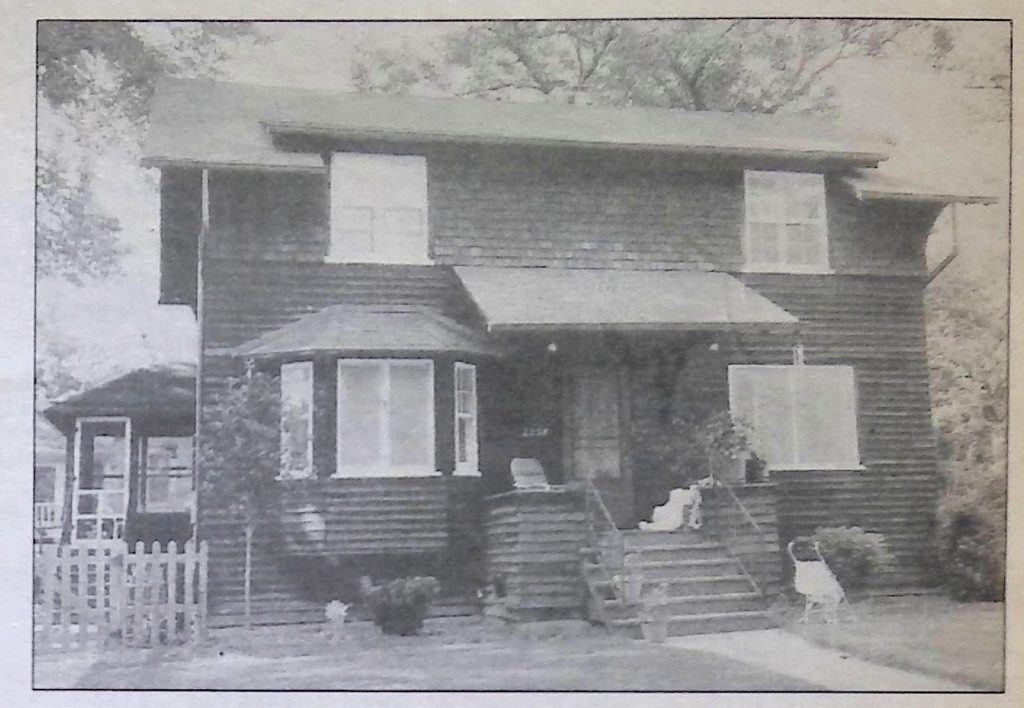
From stained cedar exterior to hardwood-paneled interior, the house at 2238 West 107th Place is a case in point. Its plans were drawn late in 1905 and it was built in 1906 for Fred E. Young, president and treasurer of Brown, Anderson and Young, an insurance agency.
The house was designed by Charles Robert Ayars (1861-1934), an Evanston-based architect who had himself spent most of the first decade of his adult life in partnership with his brother James in an insurance agency. A yearning to be an architectural designer slowly seems to have overmastered him. In 1885 and 1886 he took a job as a draftsman for Holabird & Roche. By 1891 he was serving as the architectural firm's bookkeeper, and in 1892 is listed in the city directory as a superintendent, though whether he superintended draftsman or construction we do not know. In that year he left the firm to become an independent draftsman, and the following year formally launched his career as an architect.
Ayars' career was based in Evanston, though he maintained an office in the Loop until 1899. He specialized in the design of residences and small commercial structures. Probably his best-known buildings are Annie May Swift Hall at Northwestern University and the small two-story edifice behind Frances Willard's "rest cottage" which houses the headquarters of the Woman's Christian Temperance Union.
The Fred E. Young House on 107th Place is a two-story residence sheathed with stained cedar siding on the first floor and cedar shingles above. The facade of the house is dominated by vizor roofs which reach out to cover the front entrance on the first floor, and again on the second floor to shield the windows and the wall connecting them. Beneath the roof over the second floor, the shingled outer walls curve upward and outward to make their junction with the gable. Under the roof, the rafter ends are exposed.
There is a great variation of window types throughout, a hallmark of the arts and crafts house intended to emphasize the individuality of the craftsmanship. One cluster of first-floor windows is grouped in a projecting bay, while the other is flat with the surface. The second-floor windows, though few, are large, and make the three corner bedrooms very sunny.
The placement of the house on its lot seems to have been intended to contribute to the illumination of the rooms. It is set well back on the property, with an extensive side yard to the east but almost no back yard at all. The park across the street also contributes to the feeling of openness and spaciousness.
Inside, the principal rooms on the first floor are trimmed with hardwoods, which the present owner is painstakingly restoring. The largest room has a beamed ceiling and a brick fireplace which is a model of arts and crafts simplicity and charm.
The arts and crafts movement primarily found its expression in Craftsman-style houses. The great majority of these were bungalows, but there are many examples of larger houses as well, and these display a much greater range of individuality. The Fred E. Young House, with its unique vizor roofs, achieves a distinction of its own, while remaining firmly anchored in the arts and crafts movement.