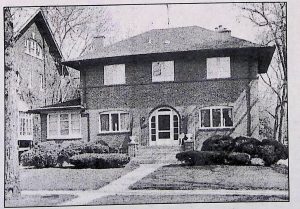
From the mid-1890’s to the end of the 1920’s, the American Foursquare was among the most popular types of houses built from one end of the country to the other. With a depth almost as wide as its front and capped by a four-sided pyramid (the hipped roof), this house could be built in many styles, from Queen Anne to Colonial Revival to Prairie.
Typically built of frame, sometimes covered with stucco, these residences could be ordered by mail from Sears Roebuck, and were turned out by the hundreds by local contractors (including the Wolff Lumber Company of Wayland, New York, a firm composed of my grandfather and his brothers). Very few of them, however, could compete in grandeur with the house at 9850 S. Prospect Ave., built in 1913.
The client who commissioned this house, Fred P. Garrity, was the secretary of the National Plumbing and Heating Supply Company, a wholesale plumbing business. Edmund C. Garrity, the president of the company and obviously a relative of the client for this house, had set off the construction of the Walter Burley Griffin-designed houses on 104th Place (now Walter Burley Griffin Place) by making an offer for the house Russell L. Blount had built at 1712 W. 104th Pl. in 1909. But, whereas the president of the firm was content with a modest bungalow for his residence, the firm’s secretary made a far more imposing choice, both as to location and size.
Prospect Avenue follows the contour of the first rise of land above the plain and at this point the property on the west side of the avenue is at a level about six feet above that of the street. Moreover, the house, which by no means crowds its lot, measures 34 by 44 feet and has wings spreading from it on all four sides.
The architect of the Fred P. Garrity house was John Todd Hetherington (1858-1936), founder of a local dynasty of architects. Born in Canada and educated in Scotland, Hetherington then came to Chicago and began his career as a draftsman in the office of Treat & Foltz. He was active with the Chicago Architectural Sketch Club, an association of draftsmen with many members with Scotish connections. His first firm, Kleinpell, Borst & Hetherington, produced houses in Hyde Park and other locales.
Hetherington moved to Beverly/Morgan Park in 1906 and began practice on his own in 1907. He designed many houses here, as well as the Ridge Park and Graver Park fieldhouses. In the 1920’s he associated his son Murray with him in his practice, and as the son took on more and more responsibilities the firm became simply “Hetherington Designers and Builders.”
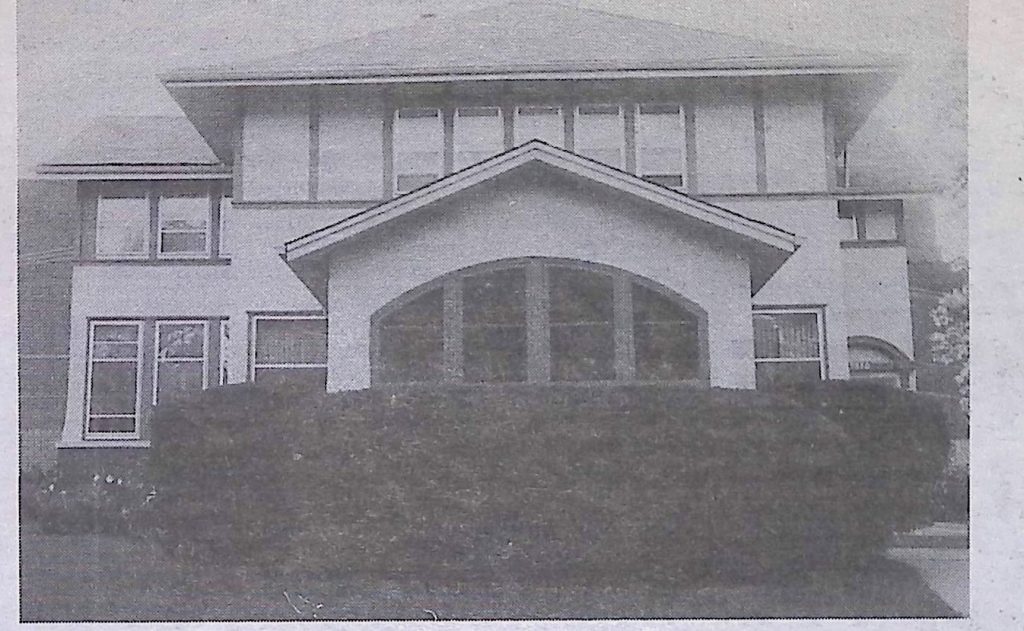
The house that John Todd Hetherington designed for Fred P. Garrity can best be described as a stucco-clad foursquare with wings. The core of the house, under the hipped roof, has a band of half-timber defined rectangles at the second-floor level, often seen in the work of contemporary Prairie-style architects. Many of these rectangles frame windows.
Extending out from the front of the house is a morning room with sets of windows under a segmental arch on three sides, windows probably having been inspired by the Prairie School architect George W. Maher, who used them frequently. To the north, a short two-story wing contains the principal entrance, thus keeping to the Prairie School principle of the indirect approach to the house. On the south side, a wing twice as long as the opposite extension contains bands of windows framed by timbers on both the upper and lower floors. To the rear, another wing extends back from the northwest corner of the house. All of the wings have gabled roofs extending from the main roof, and the half-timbering extends up under the gables on the north and south sides.
All around the base of the house there is a brick dado, which is separated from the stucco wall treatment above by a band of bricks lying on their long sides, with their short sides out. This dado reaches higher up the wall of the south wing than it does on the rest of the building. The house has a single central chimney, of which Frank Lloyd Wright would certainly have approved. And in keeping with Wright’s views, there are no dormers on the roof.
The Fred P. Garrity House achieves its striking appearance largely through massing, with the wings carefully scaled to defer to the core of the house, under the hipped roof. The wings are not an attempt by Hetherington to “break the box,” as Frank Lloyd Wright sought, but rather surround the core with interesting adjuncts. The dado of brick preserves the stucco facades from monotony and the morning room on the front catches the eye immediately. Thus, what Hetherington sought to achieve is an amalgam of the popular foursquare house type with detailing from the most up-to-date Prairie School architectural vocabulary.