
Ridge Historical Society
By Carol Flynn
School Series – Profile 6: John D. Shoop (1857- 1918)
This is sixth in our series on people for whom schools on the Ridge are named.
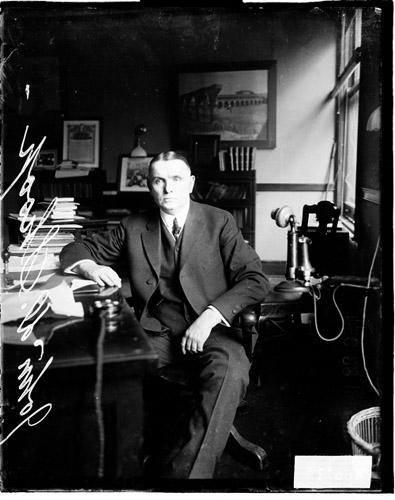
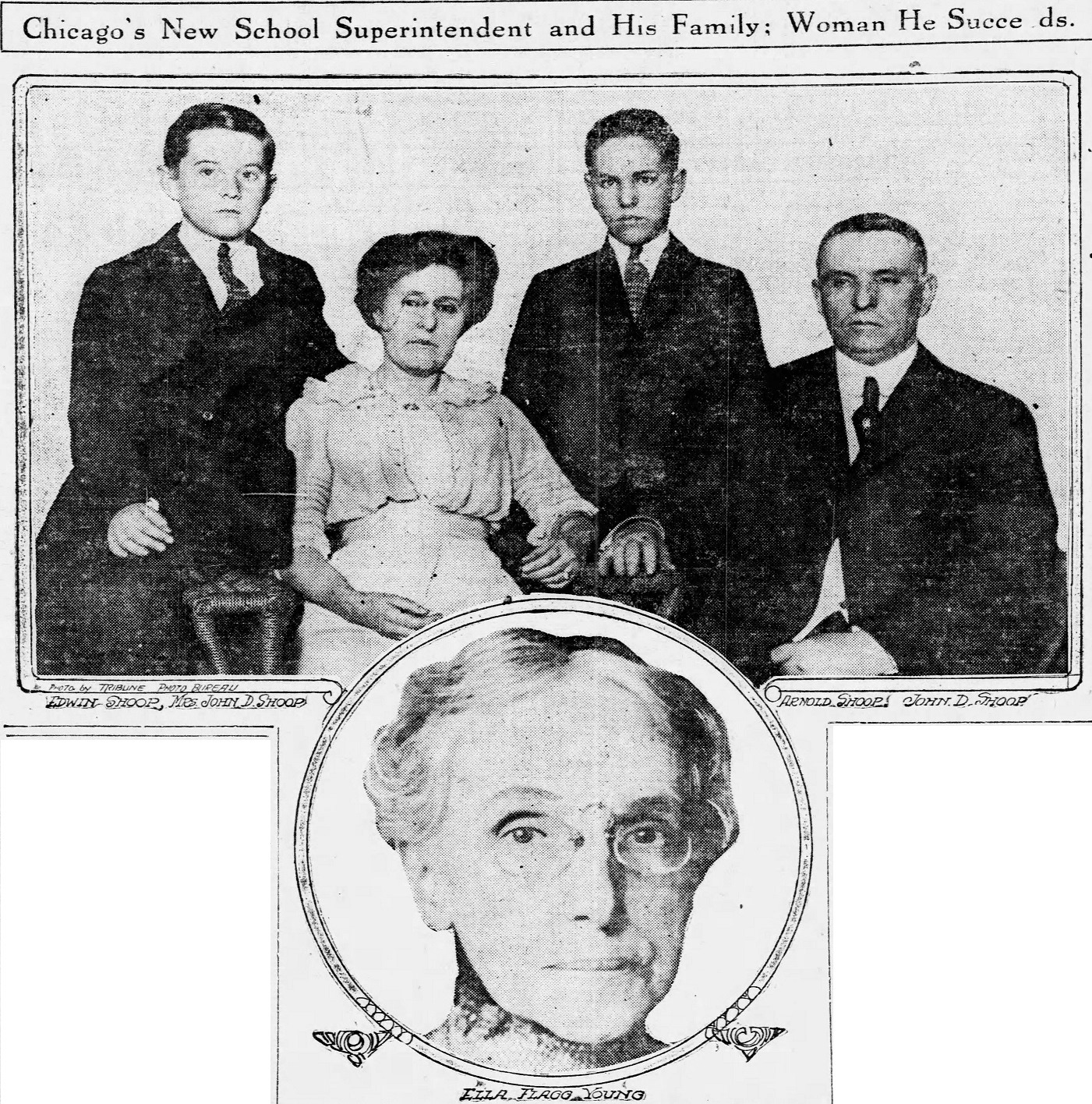
John Daniel Shoop was Superintendent of the Chicago Public Schools from 1915 to 1918. He was a highly regarded educator and administrator. His history is closely linked to that of Ella Flagg Young (1845-1918), the first woman elected as Superintendent of Chicago schools.
Shoop was born on a farm in Ohio. He attended the Indiana Normal University (“normal” schools trained teachers in the “norms” or standards for how to educate children) and the University of Chicago. He served as superintendent of schools in Gibson City, IL, from 1890 to 1896, and then in Paris, IL. In 1901, he moved to Chicago with his wife Jennie and their two sons to become the principal of a public school.
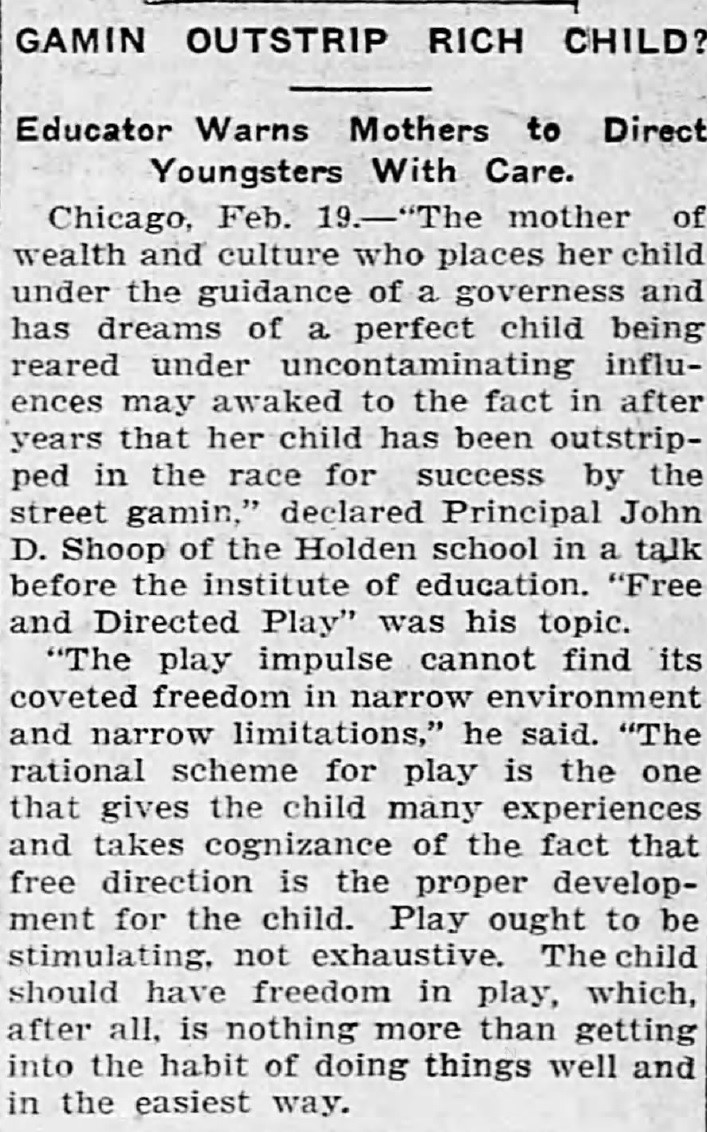
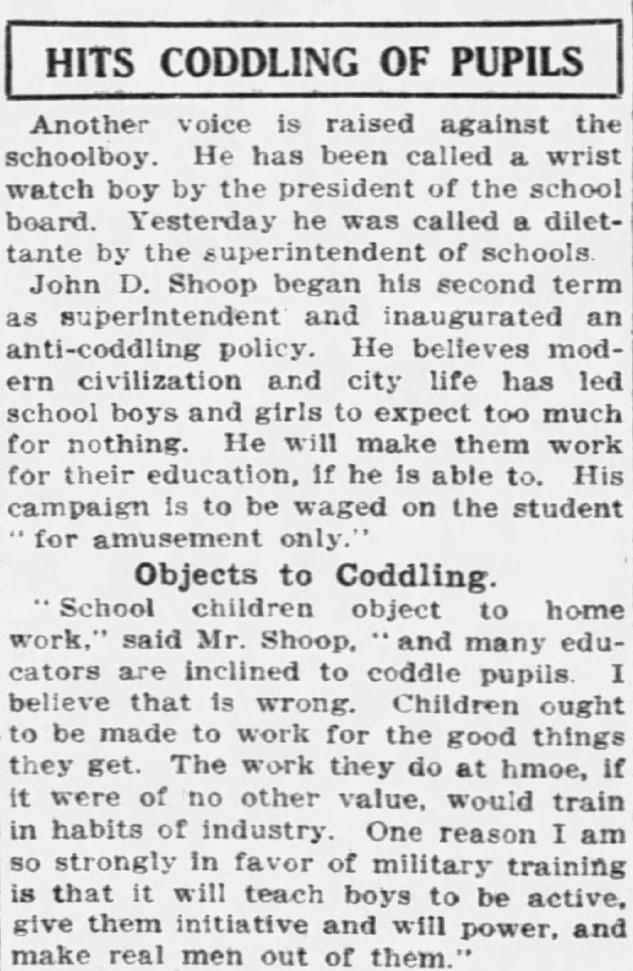
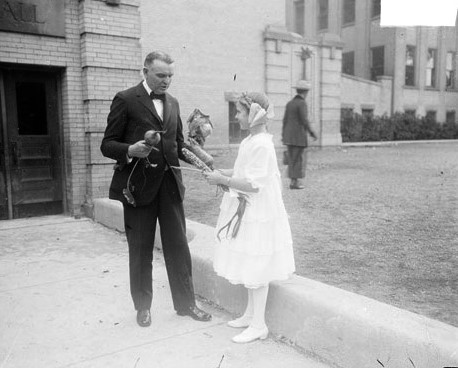
Shoop established himself quickly in Chicago. He had excellent public speaking skills and loved to recite poetry. He was a frequent and popular guest speaker, often quoted in the newspapers. Two examples of his views are attached to this post. He was made chief of “vacation schools” in 1908. These were summer programs, mainly for poorer inner-city children, designed to provide educational and recreational activities during the summer months.
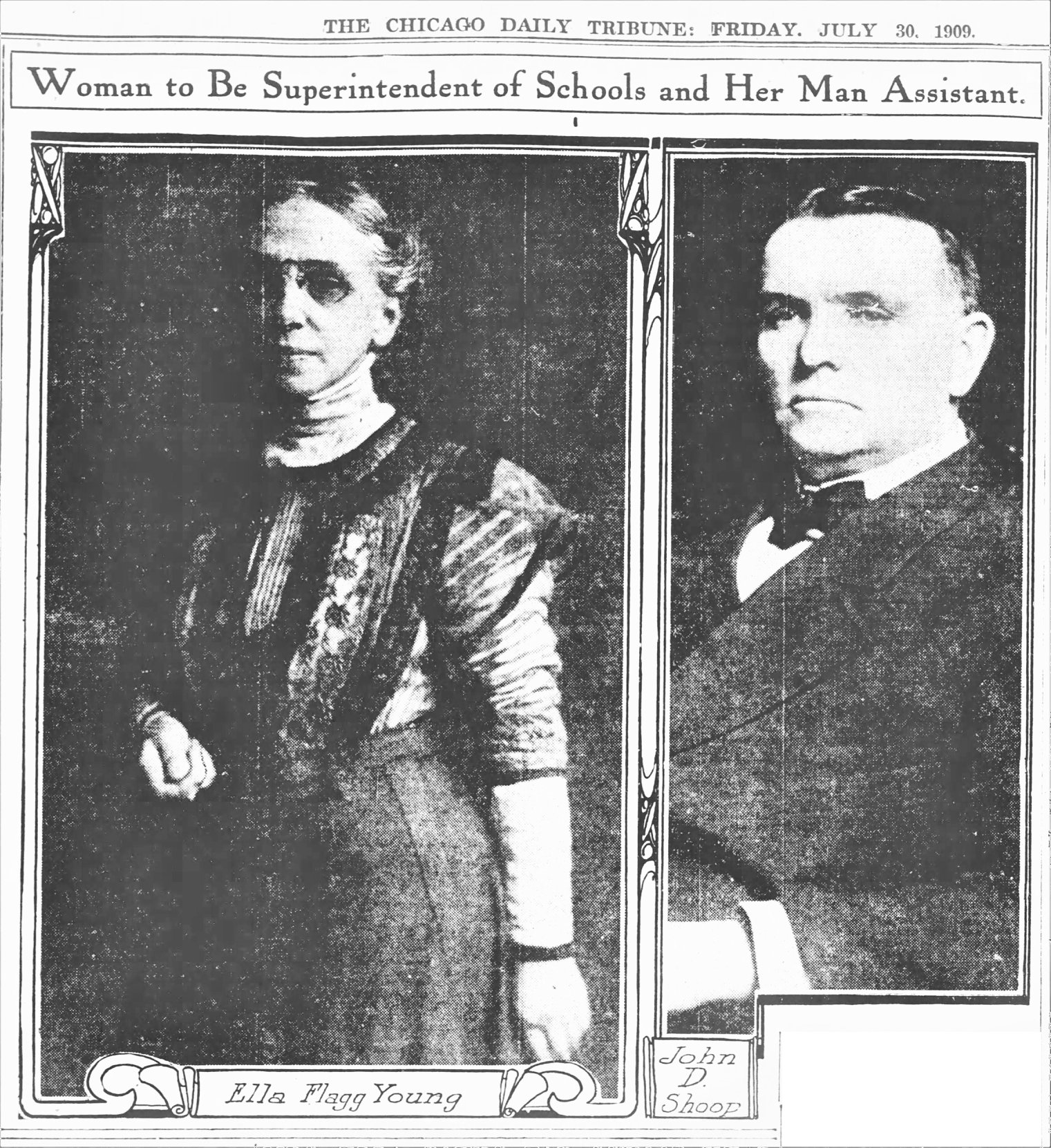
In 1909, the Chicago Board of Education (CBOE) was tasked with electing a new Superintendent of schools. Candidates included Shoop and several other men, and Ella Flagg Young. Shoop was considered by many as the front runner. Then the Board made a surprising and historic decision; they elected Young as the Superintendent, the first woman to advance to this position. Shoop was elected as the Assistant Superintendent.
If any woman was going to break through the “glass ceiling” of the CBOE, Ella Flagg Young had the qualifications. She was recognized as a brilliant and progressive educator and had many supporters in the public arena as well as the education field. She had a Ph.D. from the University of Chicago and was now a professor there. She had been a district superintendent and she was currently principal of the Chicago Normal School.
Shoop embraced his duties as Assistant Superintendent. He dealt with many of the everyday issues of running the schools. He was an advocate of industrial/vocational training. He worked with city businesses to develop paid work/school programs for children forced by economic necessity to quit school to go to work. (Note: The U.S. Census showed that between 1890 and 1910, at least 18% of children in the U.S. ages 10 to 15 worked. There were cases of children as young as 5 years old working in factories or in “street trades” like selling newspapers.)
Shoop helped bring the new Boy Scouts of America organization to Chicago. And he was no stranger to the Ridge. In 1912, he spoke at the graduation exercises at Morgan Park Academy.
For three years, Young and Shoop were unanimously re-elected to their positions. Then in 1913, without warning, school board directors who were against Young managed to gather enough votes to remove her from the Superintendent position. They accused her of mismanagement of funds and making the school system inefficient. They called into question her integrity and competence. Realizing she did not have the support to continue, Young resigned. The Board elected Shoop to the Superintendent position. Stating publicly that he was surprised and had no knowledge of the plans leading up to this, Shoop accepted the promotion.
Young’s numerous supporters, largely concentrated in the powerful women’s clubs of the day, were outraged by the Board’s decision and treatment of Young. Their call for Shoop’s resignation and Young’s reinstatement was supported by the legendary Jane Addams of Hull House and many other leaders. The teachers of the city strongly supported Young and “hinted” they would strike if she were not reinstated.
Witnesses came forward stating that Shoop had been informed of what the Board planned before it happened, but he continued to deny this. He had his supporters also, making for intense debates.
Mayor Carter Harrison Jr. had appointed five of the directors who led the campaign against Young. He declared himself “betrayed” by their actions. When he appointed them two years previously, he had them all write letters of resignation he could invoke at any time. When they refused to voluntarily step down, he used those letters to declare them “resigned.” He then appointed new directors who supported Young.
Young was asked if she was willing to return if voted back in. She replied she would return if Shoop resigned. Shoop refused to do so.
On Christmas Eve, 1913, the Board voted Young back in as Superintendent and Shoop back in as Assistant. Shoop and the ousted directors said they would seek legal advice. They all took Christmas Day off from political maneuvering, then after Christmas, Shoop surprised everyone by announcing he would accept the new Board decision. He said the good of the school system was more important than his position.
Young and Shoop, both dedicated professionals, met a few days later, resolved their differences, and went back to work. The next year they were once again re-elected unanimously to their positions.
In 1915, Young announced she would not seek re-election as Superintendent, allowing Shoop to finally move into the position. The night of Shoop’s election, Young quietly boarded a train for California. She died in the 1918 influenza epidemic.
As Superintendent, Shoop dealt with many issues, but his term was largely dominated by World War I. He strongly supported establishing military training programs for boys in the schools. He had the “household science” teachers become certified in dietetics (nutrition therapy) by the Red Cross so they could teach the subject to high-school girls. He allocated funds to establish “victory gardens” at any school with a patch of land for the students to farm.
He continued to work closely with business and industry to find training and employment opportunities for high school students. One example was downtown stores training and paying girls to learn sales skills. A number of schools advertised work/study programs for boys.
Shoop was seriously injured in an automobile accident in August 1916 while visiting friends in Paris, IL. He was thrown from the car and knocked unconscious, breaking his collar bone and seven ribs. He had a long, painful recovery.
During his recovery, he had to deal with a scandal on the Ridge. Morgan Park was annexed to the city in 1914 so all the schools were now under his supervision. The principal of Morgan Park High School, John Henry Heil, was accused of sending “poison pen” letters to a woman. Shoop really had little choice but to fire Heil and appoint a new principal. Heil was eventually exonerated but by then his career was ruined. (Note: This is a story we will cover in detail another day.)
In early August 1918, the Illinois Assistant State’s Attorney began investigating irregularities in the school census conducted in 1916 under Shoop’s direction. Allegations included padding the census to receive more money from the state, and filling the census taker positions, paid for by the CBOE, with campaign workers for Mayor “Big Bill” Thompson. Shoop was ordered to turn over all files from the Superintendent’s office that related to the census. He agreed to do so but dragged his feet.
Shoop was in Indiana for a public speaking engagement on August 9 when two policemen set up camp in his office. It was assumed by Shoop’s staff they were waiting for Shoop to return and produce the files.
And then on that same day, while waiting for his ride in the hotel lobby in Indiana, John Shoop died of a heart attack at the age 61.
Shock waves went through the communities that knew Shoop. His remains were brought back to Chicago. He lay in state in the Chicago Normal School rotunda, then followed a funeral service attended by thousands of people. His family took him back to Ohio for burial.
The Assistant State’s Attorney Office declared it would continue investigating the census but that Shoop himself had not been involved in any wrongdoing.
Shoop was remembered for “giving to every boy and girl the maximum of opportunity.” He was remembered for “never losing sight that the children were the chief factor” in the education system.
The new John D. Shoop school at 11140 S. Bishop Street opened in 1926.