An architect ambitious to make a lasting impact in his profession almost always has to undergo a period of experimentation, seeking to create a style which is both distinctive and attracts clients. Typically, she or he will begin with established forms and work slowly towards something which is novel and yet expresses the lifestyle of the generation.
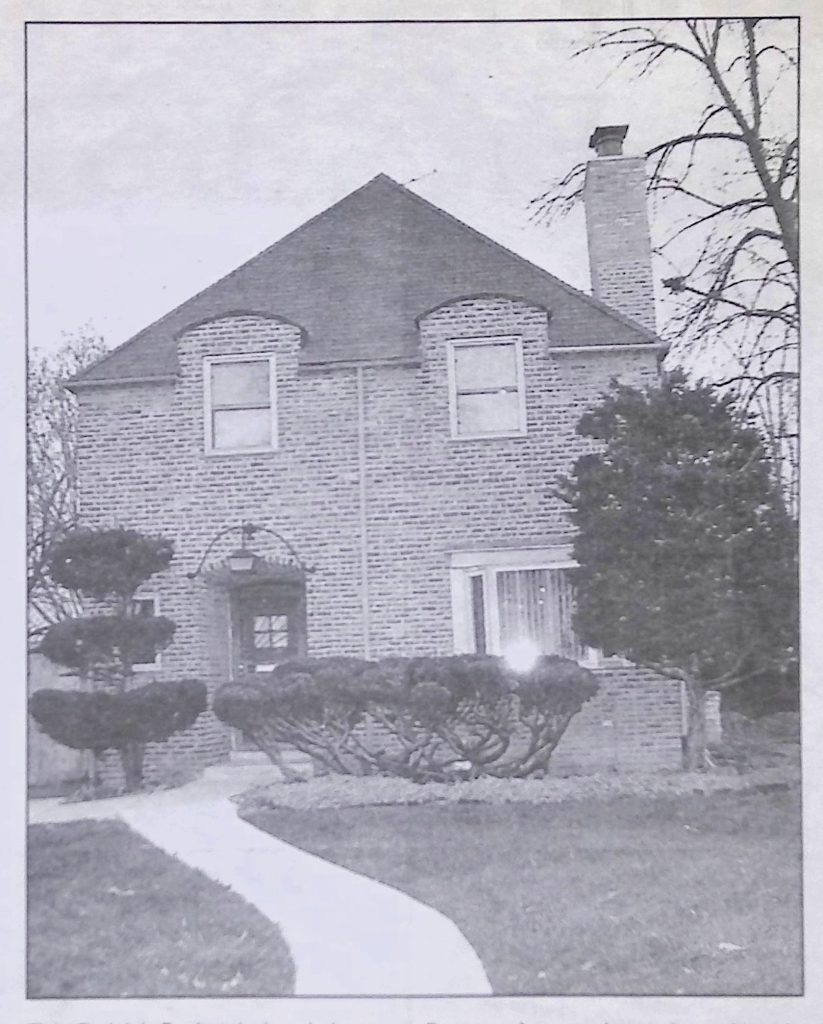
The house at 9767 S. Prospect Ave., built in 1930 and 1931 for J. W. Stevens, is part of the series of experiments through which the work of local architect Rudolph Boehm progressed.
It is a tribute to the talent of Rudolph Boehm (1897-1959) that he was able to rapidly adapt to American residential preferences. Born in Brieg, (then in Germany but now in Poland), he was educated in Breslau before serving in the German army in World War I. After the war, he came to the United States, worked as an apprentice to an architect for five years, obtained his license, and began his own practice in 1926. The quality of his designs was soon recognized, and his submittal to a house-design competition sponsored by the Chicago Tribune was published in the newspaper in 1928.
More of Rudolph Boehm's early designs are in the variety of Tudor Revival design called English Manor. With the onset of the Depression, he adapted his work to his clients' demands for economy and efficiency, while providing designs which stand out from their neighbors, as does the Stevens House.
Boehm's work after World War II sought to combine the practicality of ranch-style homes with design features from the prairie school.
The Stevens House stands at a critical juncture in Boehm's career. The large Tudor mansions of his first years were, for the time being, out of favor. Yet Boehm still had to work from concepts familiar to his potential clients or risk scaring them away. In the Stevens House he achieves this by basing his design loosely on colonial American models.
Aside from the overall massing of the building, however, Boehm's design owes little to colonial precedents. The deeply recessed front entrance, which makes the walls look far thicker than they are, is sometimes seen in pre-Revolutionary houses, but here the opening is so narrow that it almost becomes a tunnel. Boehm's post-World War II houses are famous for having over-hanging roofs to protect the owner from the rain while opening the front door; here the deep door opening provides the same protection.
The large window on the first floor is in a protruding bay, but the bay is supported by a corbel table — that is, a shelf formed by extending succeeding courses of bricks a little further out from the wall — which is a decidedly uncolonial way of doing things. The windows at the front on the second floor achieve their prominence by rising through the roofline in rounded inset dormers. These dormers, which become something of a trademark of Boehm-designed houses, feature bricks that are not arched, but are simply laid flat, the metal-covered crescent top being sliced through the bricks.
The windows of the most important rooms on the sides also are in rounded inset dormers, but the treatment of most other windows is very simple. The chimney on the south wall, although carefully centered between the rounded inset dormers, is otherwise more functional than decorative.
During the Depression, a number of simple house types came into vogue, including Regency designs, Cape Cods, and very simple brick foursquares. It is a mark of the ingenuity of Rudolph Boehm that his solution to the requirements of the time was something all its own.