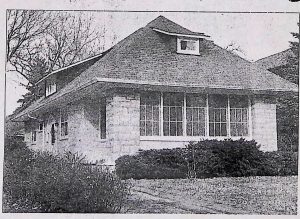
Perhaps because it seemed a contradiction in terms, the generation that erected for themselves the great thickets of bungalows we are so familiar with never quite came to terms with the thought of a two-story bungalow. After all, could that sense of intimacy, that simplicity of maintenance despite dispensing with servants, that curious reliance on every new appliance that appeared while renouncing bureau tops covered with bric-a-brac — could all the novelty of residing in a bungalow survive in a two-story house?
For countless Americans of the period from 1904 to 1930, whose love for big families or willingness to take in an older relative impelled them to seek more room than a standard bungalow could provide, the answer was the semi-bungalow.
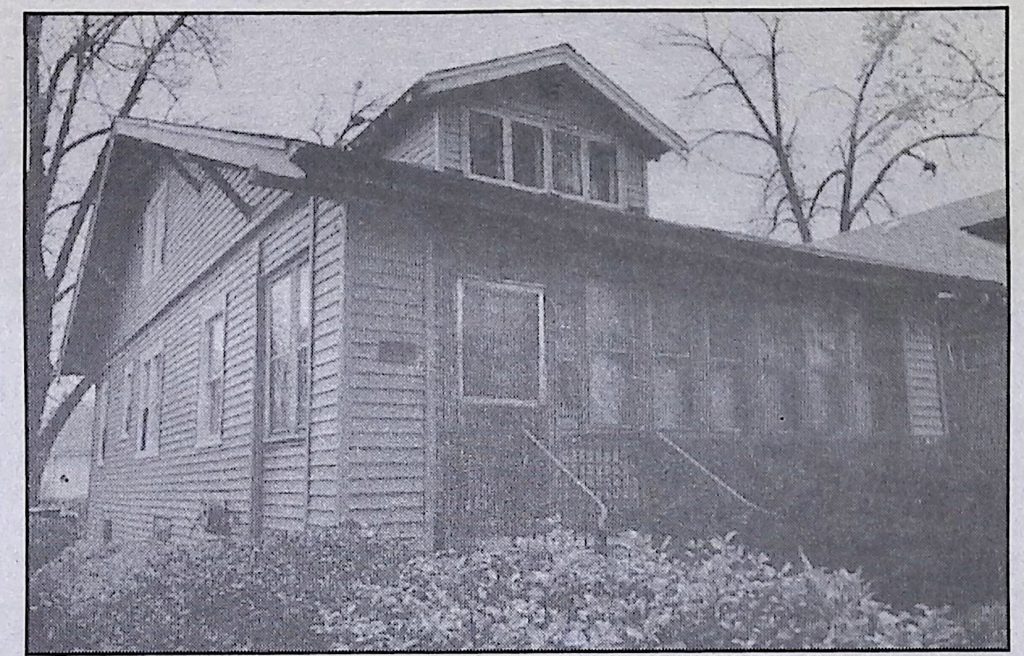
Such a semi-bungalow is the house at 10453 S. Prospect Ave. The term “semi-bungalow” was originated by the Lewis Manufacturing Company of Bay City, Mich. early in the 20th Century and ratified by Clay Lancaster in his study, The American Bungalow 1880-1930.
The man for whom the house was built, Headley W. Wiley (1860-1946), was one of the principals of the Wiley Brothers contracting firm, and the house was built speculatively, for sale to any interested purchaser rather than the intended residence of Wiley. Wiley was the uncle of the architect Russell W. Wiley (1896-1981) and the builder Edward W. Wiley (1891-1975), whose joint work appears in local home tours from time to time The notice of this house appearing in Construction News specifies that the architect was to provide “plans only.” Wiley was superintending the construction himself.
The architect was George O. Garnsey (1840-1923), one of the longest practicing of Chicago’s early architects. Born in Rock Island in 1840, he was educated at a private academy in New York and brought to Chicago by his parents in 1852. In 1856, at the age of 16, he entered the office of J. C. Rankin as a draftsman, remaining with that architect until 1861.
After brief work and partnerships with other firms, Garnsey went into sole practice in 1868, and continued alone the rest of his life. In 1868 he published his American Glossary of Architectural Terms. In 1869 he was involved in the design of the present Illinois State Capitol at Springfield. After the great Chicago fire of 1871, Garnsey was heavily involved in the rebuilding of Chicago, and also established a nationwide reputation for theater and opera house design.
Between 1885 and 1893, Garnsey was the editor of the National Builder, which he used as a sounding board for his ideas on residential taste. His forte was complicated, heavily ornamented Queen Anne houses crammed with picturesque details.
But, as tastes changed, Garnsey adjusted to the times and when, in 1916, he built the house on Prospect Avenue for H. W. Wiley, his domestic work largely consisted of bungalows.
A bungalow can be defined as a house which has one or one and a half stories; some sort of interpenetration of inner and outer space, typically on a porch or verandah; and a roof sweeping down over this porch or verandah. A semi-bungalow adds to this concept a second floor disguised by some such device as a roofline breaking through, and usually containing most of the bedrooms.
In the case of the Wiley house, the second floor masquerades as a large gabled dormer on the front and a long shed dormer on the back. The house once had a full porch for the roof to sweep down on, but, as with so many bungalows in northern climates, this has been walled in, though the original corner pillars can be made out.
The house is basically side-gabled, and its great roof has exposed rafters and is supported by triangle brackets of squared-off wooden beams, all in the fashionable Craftsman style of the day. The bargeboards under the great roof on both sides and also under the gable of the front dormer end in a notched design which resembles the grasping talons of eagles. The windows follow no particular pattern, and are mostly of the sash type, with a prominent board lintel bordering them on top. The front door is of elegant wood-paneled construction.
The Wiley semi-bungalow is but one example of the adaptability of the bungalow movement as it evolved to fill as many niches in the housing market as possible. Simple to maintain and as devoid as possible of wasted space, the bungalow and its offshoots have endured and, indeed, come to characterize many Chicago neighborhoods.