
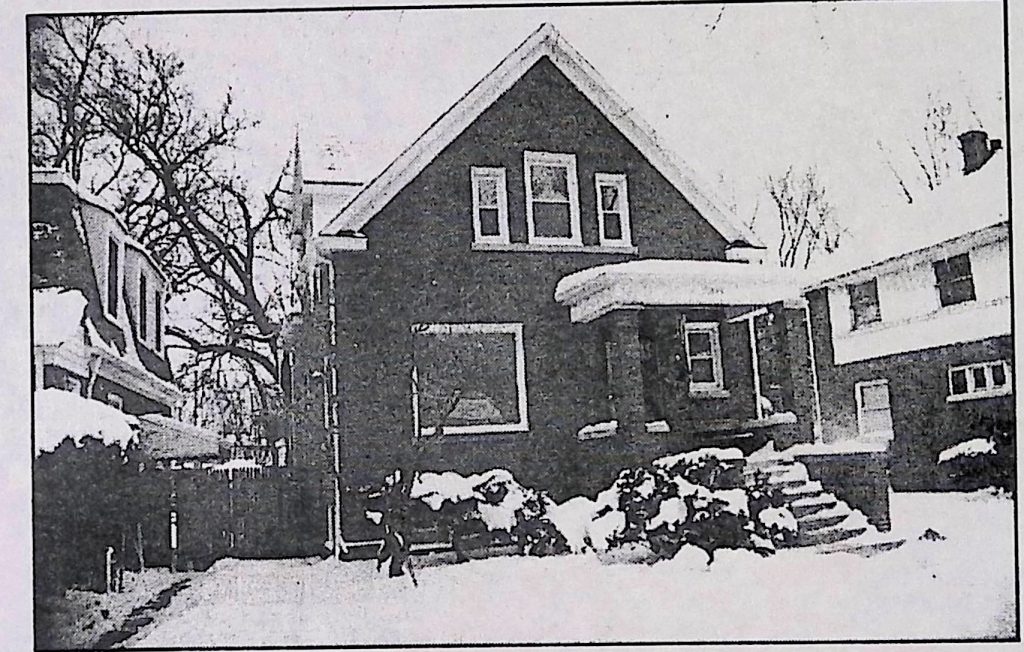
A residence with as attractive a street front as the house at 10849 S. Prospect Ave. seems as though it must belong to some recognizable style, and yet this building contains almost none of the decorative features that would allow it to be conveniently pigeon-holed among the fashionable modes of architecture of its day.
This house was designed in 1907 for Robert Winkley, a house painter, his wife Rose, and their two daughters Edna and Mabel, who were telephone operators. The Ridge Historical Society’s longtime member Alberta Killie recalls Robert Winkley riding through Morgan Park on his wagon drawn by a pony named Bob, which used to graze in the then-empty lots across the street from the Winkley residence.
The architect of this house and of many others on the South Side was Anders G. Lund, who was born in 1857 in Vermland, Sweden. He completed his architectural studies at the Technical School in Stockholm, then came to Chicago in 1882.
After ten years in the employ of others, Lund opened his own architect’s office on 63rd Street in Englewood.
Anders G. Lund, like other immigrant Swedish architects, obtained his first commissions from among his fellow Swedish expatriates, whose needs were to grow from modest residences to include commercial buildings and then more substantial residences as well, all of which Lund was fully capable of designing.
The Winkley house, although recently renovated and added to at the rear, is not much different from its original condition. The secret of the house’s cozy appearance lies in its massing, for it presents itself as a story and a half high, and almost square in floor plan. At the same time, a large dormer on the second floor generates a cross-gable on the roof, and a solidly built front porch gives depth to the whole front of the house; these two elements create enough complexity to command the attention of the passerby.
The decorative details, though few, contribute to the unity of the composition. All of the windows have sills of limestone or concrete, in contrast to the rest of their framing, which is wood painted white. These stone sills are repeated by the coping on the balustrades of the porch and of the front steps, as well as in the simple capitals at the tops of the front porch columns. These columns rise straight out of the sides of the porch and support a simple hipped roof barely steep enough to shed snow.
Curiously, the brick sides of the second-story dormer are sheathed in wooden siding, which may have been intended to protect its masonry from the freezing and thawing of winter runoff.
The north side of the house originally had a little balcony off the first floor, so small that there would hardly have been room for someone to sit on it. Alberta Killie recalls that when her mother saw it, she remarked, “How convenient to just step out and shake a mop or dustcloth!”
The south side had an entry at ground level covered by a simple Craftsman-style porch with cross-beamed brackets, virtually the only stylistic feature on the building. Otherwise, the design stresses privacy, with most of the windows to the rear small and located high up on the walls to prevent prying. The front window, now replaced, originally had a cut-glass decorative panel running across its top.
So many houses confront us with instant stylistic signals that tell us what the owners envision themselves to be—lords of the manor, welcoming hosts of the wayside inn, heralds of the dawn of the avant-garde. Only a few architects dare to dispense with these characterizing devices and get away with it. The Winkley house radiates cozy comfort and doesn’t try to suggest anything else.