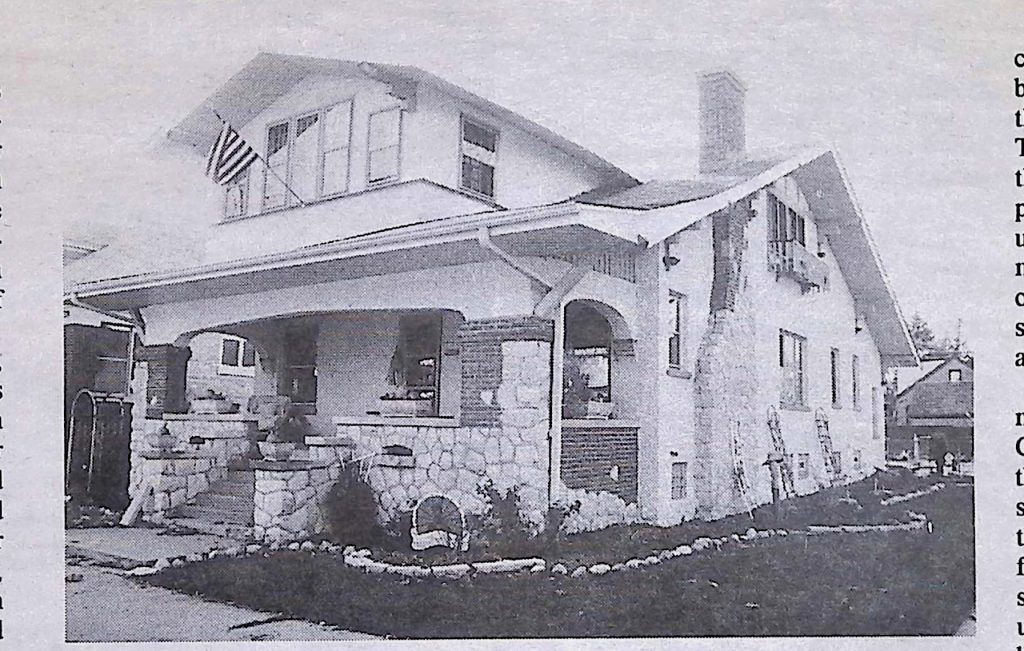
To a certain extent, the City of Chicago's new-found interest in celebrating and preserving its bungalow heritage has caused our local architectural and historic preservation agencies — and, indeed, commentators like myself — to take a second look at this widely-varied type of house. And the effort is often well worth the time spent, as in the case of the house at 9600 S. Seeley Ave.
This house is a semi-bungalow because, although possessing many of the features of a bungalow, it has two stories rather than a story and a half. It was built in 1915 for Charles N. Bowen, a commercial artist and a principal in the firm of Bowen and Warmington. Its architect was H. Peter Henschien (1881-1959), a native of Oslo, Norway, who came to the United States in 1902 to work as a designer for Swift and Company, the meatpackers. Shortly afterward, he set up his own firm, which specialized in the design of packinghouses. Over half a century, he designed more than 300 such plants, including one in Moscow and one in Siberia. He also authored one of the first books on his specialty, “Packing-house and Cold Storage Construction.”
Although larger than a true bungalow, the house at 9600 S. Seeley Ave. nevertheless provides excellent examples of the distinguishing features of one of the California styles of bungalow, starting with the materials of which it is constructed, a cheerful mix of stucco, brick and stone, with the occasional detail of wood. Like nearly all California bungalows, it has a porch across the front with a roof supported by a wide arch. The front of the porch is of roughly shaped stone, and seems to arise out of the lawn. Note how drains of stone are provided to drain the porch floor on each side.
The stonework gives way to brickwork in the porch columns, and the brackets that support the side arches on which the porch roof rests are also of brick. Given the relatively short flight of steps between the ground and the porch, and the natural materials of the porch, it is as if the lawn extends up to the front entrance, and heaps of toys and bicycles running up to the front door seem the most natural thing.
The bulk of the house has a stucco wall covering, although the stonework of the base makes its way well up the chimney on the north side, where it gives way to brick. The chimney rises picturesquely through the roof. Even the front dormer above the porch is stuccoed, except for a wooden strip under the windows, which are composed of many small panes. But the many windows on the sides of the house break up the stucco surfaces and prevent the walls from appearing drab.
A house that employs so many natural materials of course arises from the Arts and Crafts tradition (also called Craftsman), and this house has traditional features of the style. These include the wide overhang of the roof, and its supporting brackets. The front brackets on each side are short beams supported by diagonal braces that extend up from the porch corner pillars. The other brackets, five on each side, are very distinctive. They are composed of three successively longer lengths of beam, the lowest and shortest resting on a short vertical beam that stands on a red tray with outward-slanted side, which in turn rests on a complex joist extending from the wall. Brackets are also employed to support the roof of the front dormer.
Although the current bungalow initiative has focused long overdue attention on the varieties of the Chicago bungalow, one of the joys of living on the Ridge is having available for inspection some examples of the many other styles of bungalow from around the country, and the Bowen bungalow is one of the most delightful.