
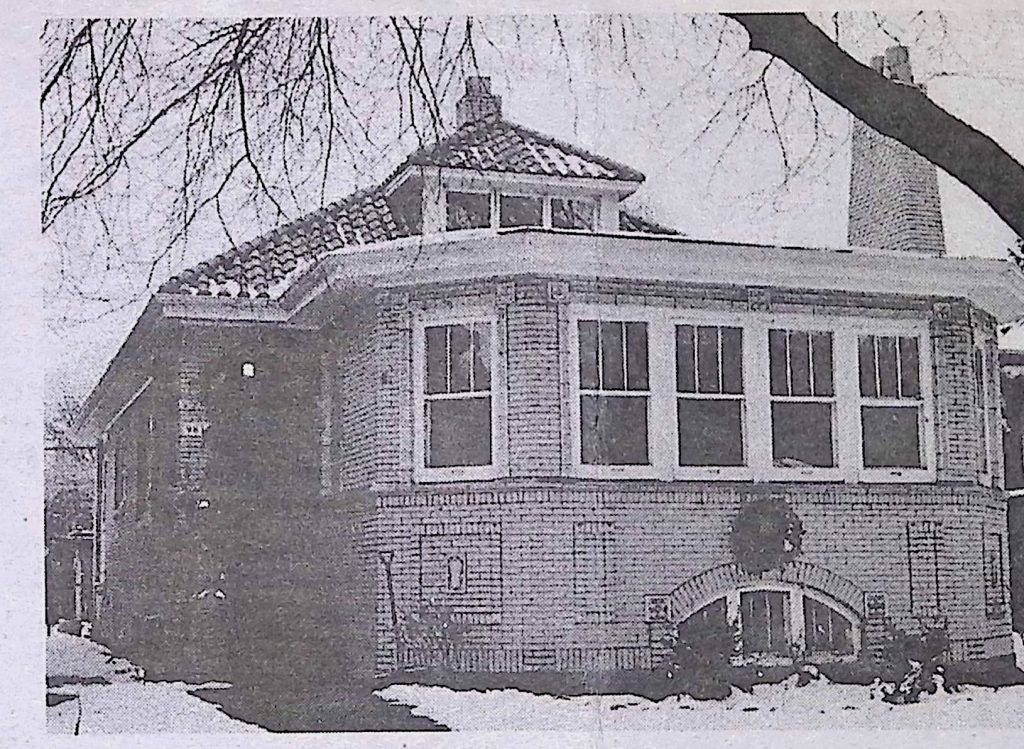
The Historic Chicago Bungalow initiative has brought new awareness of the great variety of styles to be found-in houses of this type, even those that are members of the broad group known as the “Chicago bungalow.” Chicago bungalows are 1½ stories high, of brick construction, with generous windows, an enclosed front room or porch, and an off-center front or side entrance. They usually also have a dormer above the front room, and perhaps a rear dormer as well.
This building type allowed for a considerable range of styles, including Craftsman, Colonial Revival, Spanish Eclectic, or, as was the case with the bungalow at 9812 S. Damen Ave., Italian Renaissance.
The bungalow at 9812 S. Damen Ave. was built in 1928 for Captain Michael P. Evans of the Chicago Police Department, “the man who never forgot a face.” Beverly/Morgan Park has been the home of many distinguished members of the police force, but probably none more remarkable than Capt. Evans.
Born in Ireland in 1846, he was brought to the United States at age 12, but later returned to his native land where, participating in revolutionary movements, he was arrested by the British authorities who gave him the choice of Mount Joy Prison or emigration. Choosing the latter, he arrived in Chicago at age 21, and lived here for the rest of his life.
In 1881 Evans joined the Chicago Police Department, and by 1884 he had advanced to the post of desk sergeant. A course in photography led him to the formation of the Bureau of Identification, which at first only took photographs of criminals. In 1888, the Bureau adopted the identification methods of Louis-Adolphe Bertillion of the Paris Police, which focused on body measurements. Capt. Evans developed cards and albums to record the measurements, and patented them.
The complex Bertillion system was eventually discarded in favor of fingerprints, and Capt. Evans installed this system in Chicago.
the experts who testified in the Jennings case in Chicago, which was the first test of the validity of fingerprint evidence in an American high court.
Capt. Evans worked until he died at the age of 84.
Capt. Evans’ house was built from plans by Roy W. Stott, who designed a number of houses in Beverly/Morgan Park. This bungalow is in the Italian Renaissance style, constructed of yellow brick with a green tile roof. The house has a central chimney behind the front dormer and a side chimney, which tapers to two chimney pots. Because of its octagonal front room, it could also be classified as an octagon bungalow.
The decorative elements are intended to enhance the overall Renaissance motif. The windows of the front room have elaborate terracotta frames and detailing, including corners with quatrefoil flowers. Below the windows, which rest on a limestone sill, are decorative frames in the brickwork; these are outlined with bricks and have terracotta squared nails at the corners, and sometimes enclose ornamental shields with details from heraldry such as fleurs-de-lis and chevrons. The entrance porch has similar terracotta decoration on its arches and around an adjacent blind window opening on the exterior wall of the front room. The decoration of this house earned it a photograph by Mati Maldre in Dominic Pacyga and Charles Shanabruch’s book, “The Chicago Bungalow.”
The Evans House is thus an elegant example of how Italian Renaissance detailing can be employed to enliven the facade of even simple houses and to enhance their appeal from the street.