
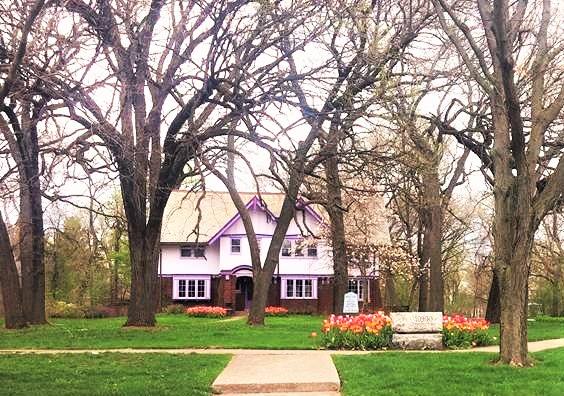

Pretty spring tulips are on view at one of Morgan Park’s historic homes, the Luther S. Dickey, Jr. House, at 10900 S. Prospect Ave.
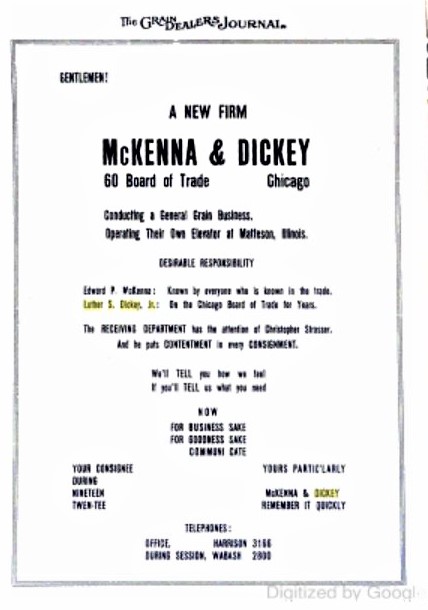
Luther Samuel Dickey, Jr., was a well-known stock broker and grain trader. He was a member of the Chicago Board of Trade and the New York Stock Exchange. He had his own company for years, McKenna and Dickey.
Dickey’s parents were Luther S. and Charlotte Dickey. Dickey, Sr., came to Chicago from Pennsylvania and was a veteran of the U.S. Civil War. He was involved with the Chicago Inter-Ocean newspaper, and upon retirement, authored publications on the history of Pennsylvania regiments in the war. He was also an elected officer with the Calumet-Morgan Park park district. He was active with social and political causes such as labor issues and the rights of the working class.
In 1889, the family made news when Charlotte and the children became “poisoned from eating fermented raspberries.” One daughter, Alice, 9, died. The rest survived.
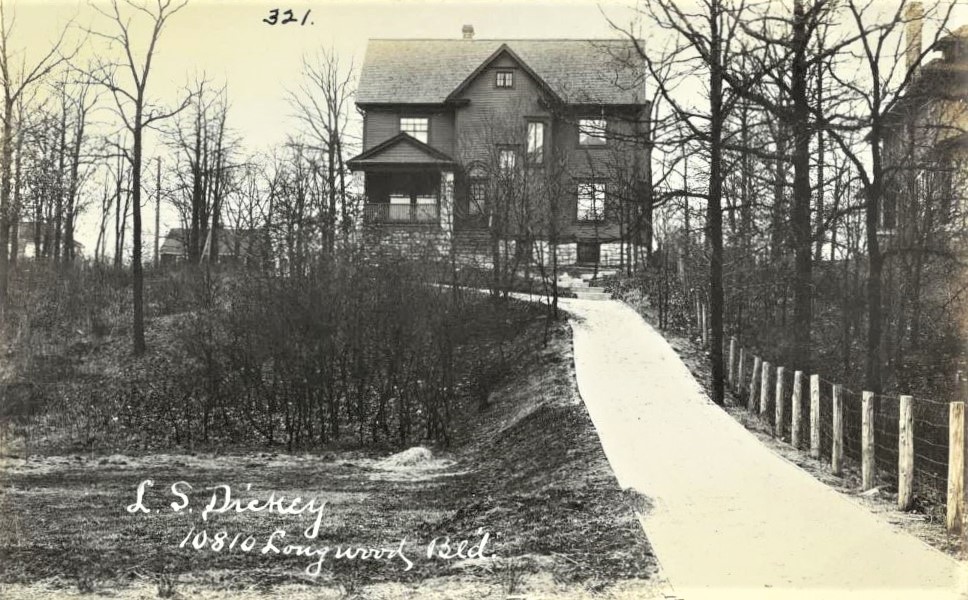
Dickey, Jr., had a first home built by architect George Bannister in 1905 at what is now 10856 S. Longwood Drive. Bannister was the husband of Madame Alla Ripley, the fashion designer and business woman featured in RHS’s exhibit last year, Threads of Imagination. In 1912, that home was sold to Paul Harris, the founder of Rotary International. The house is being restored as a Rotary museum and meeting place.
Dickey, Jr., had the house at 10900 S. Prospect designed by Chatten and Hammond in 1912. The picturesque Arts and Crafts-styled house is set on a lot of several acres of beautiful old oak trees. Design elements include a half-timbered double gable, sloping brick buttresses, and a flanged segmental entry arch. Dickey, his wife Bessie Adele (Robinson) Dickey, and their daughter and two sons made their home there.
Their neighbors were socially and politically prominent Isaac and Gertrude Blackwelder. On July 26, 1913, Bessie Dickey joined Gertrude as one of the first women to vote in Cook County. Her husband, Luther, was president of the annexation association. Annexation of Morgan Park to Chicago was finally approved in 1914. The major issue in the 1913 election was funding for a new high school. The funding was approved, leading to the establishment of Morgan Park High School.
Dickey, Jr., was on the board of the South Shore Country Club and involved in putting on the annual horse show. He was an avid horseman and his steeds won many prizes in competitions.
The Dickeys were members of the Morgan Park Congregational Church. He was also a member of the Union League Club, and active in the Boy Scouts with his sons.
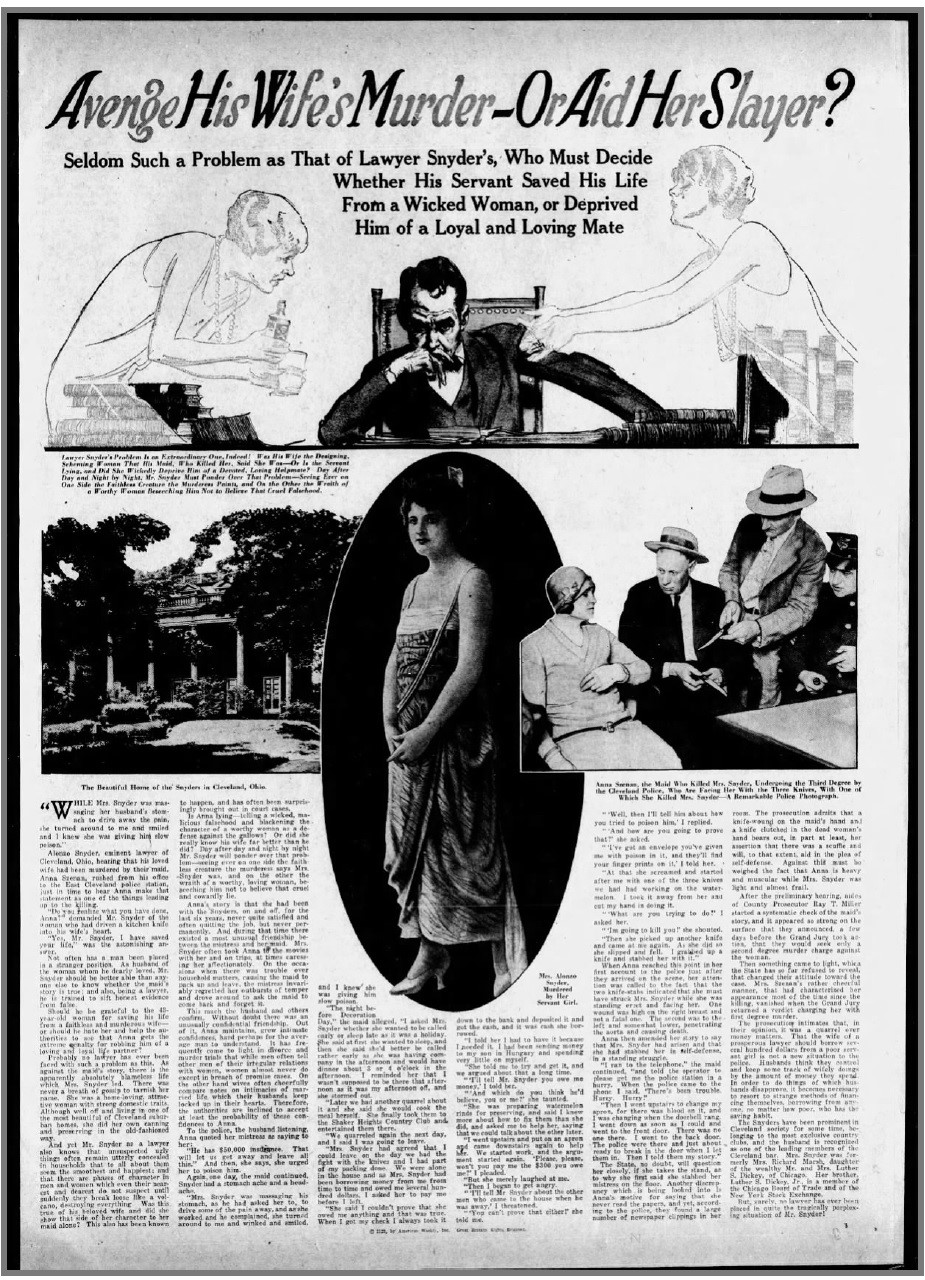
In May of 1929, the Dickey family fell victim to tragedy and scandal when Luther, Jr.’s sister, Maude Dora (Dorothy) Snyder, was killed by her maid, Anna Szenan, at the Snyder home in Cleveland. Dorothy, the wife of prominent attorney Alonzo Snyder, was stabbed to death in an altercation over unpaid wages. Dickey, Jr., rushed to Cleveland as soon as he received the news.
Anna Szenan claimed self-defense. The crime and trial received sensational news coverage. Szenan was found guilty of second-degree murder and received a life sentence. She died at the age of 100 still in jail, refusing parole for years because she had nowhere else to go. She had made the prison her home, cleaning the matrons’ quarters, cultivating a petunia garden and keeping a cat.
Tragedy struck again just a few months later. Luther S. Dickey, Jr., contracted diphtheria, an infectious and contagious bacterial disease spread by coughing and sneezing. He died at his home at 10900 S. Prospect on September 15, 1929, at the age of 48. He was buried in Mount Hope Cemetery.
Diphtheria was a major public health issue and homes with diphtheria patients were quarantined. A safe vaccine was developed in 1926 but was not widely used until after 1930.
Bessie remarried to Walter H. Jacobs, a lawyer, in 1935. He died in 1945. Bessie continued living at the Prospect Ave. house until her death at the age of 94 in 1974. She was also buried in Mount Hope Cemetery.