
Part 6: What happened to the Spanish flu, and some things never change
The “Spanish Flu” infected the world’s population from 1917-1920. Then it pretty much just disappeared.
At the time, no one really knew what viruses were. They knew there was something smaller than bacteria that could not be seen even with microscopes. They knew these pathogens could infect, be transmitted between, and cause grave illnesses in humans. They knew viruses needed living cells as hosts unlike bacteria that could be cultured in a nutrient medium. Some illnesses they knew resulted from viruses included rabies, polio and influenza.
1931 saw big breakthroughs. The electron microscope was invented allowing ever smaller sub-microscopic matter to be viewed. Influenza and other viruses were grown in fertilized chicken eggs. This led to the “golden age of virus discovery” which has resulted in where we are now in identifying viruses and treating the illnesses they cause.
In the 1990s, the strain of influenza that caused the 1918 pandemic was extracted from old tissue samples. The virus, kept in secure laboratories with top level clearance for admittance, is used for research. One conjecture as to why the virus “disappeared” from humans is that the structure of the virus mutated, or changed, into a less lethal form.
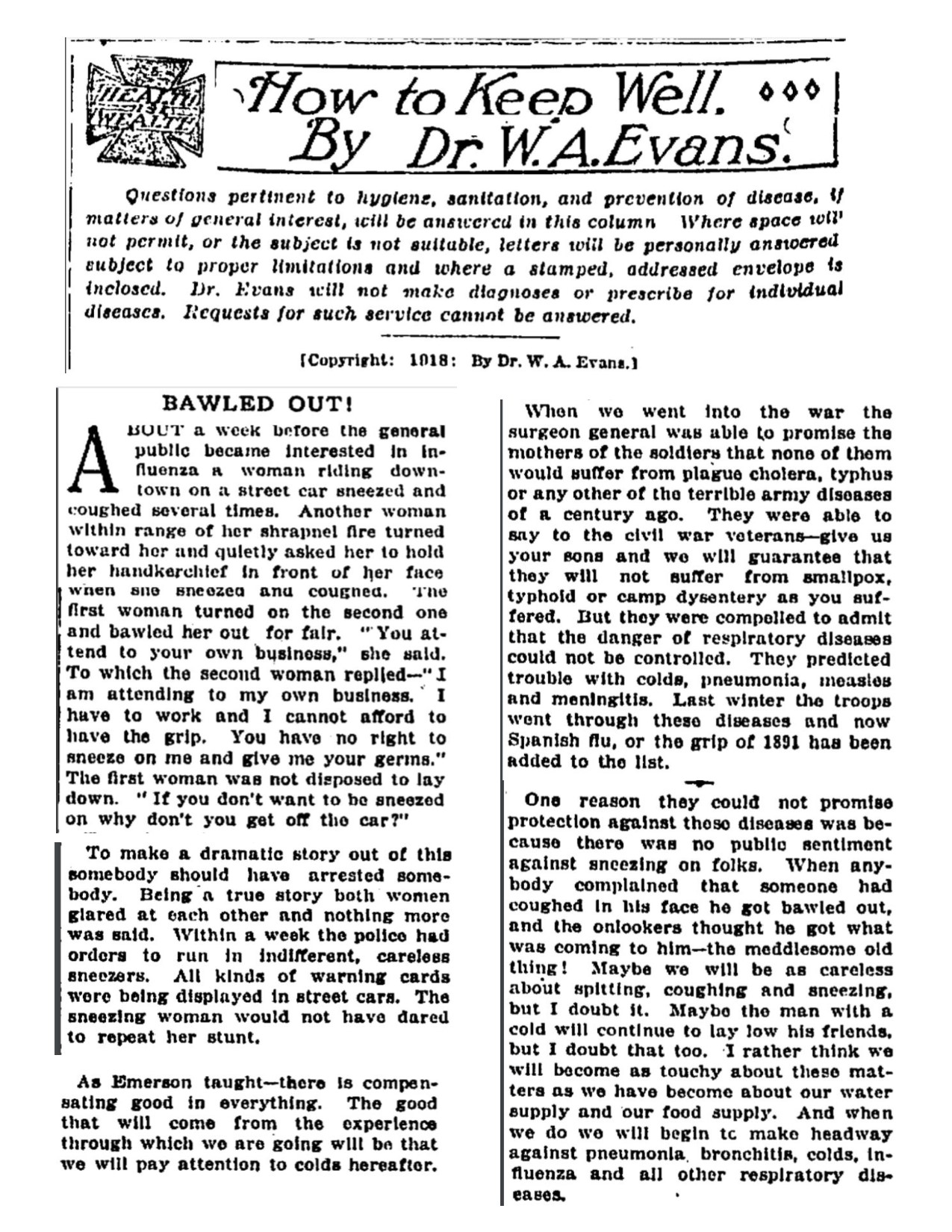
There are many similarities between the 1918 influenza pandemic and the 2020 coronavirus pandemic. Certainly one example is the reaction of some people to taking precautions not to spread the contagion.
This Chicago Daily Tribune article from Dr. Evans is a timely reminder that some attitudes from then are still around today. Some things have not changed – but maybe they will this time.
Chicago Daily Tribune, October 22, 1918