
Part 4 – The summer of 1919 finally arrived, bringing a respite to the influenza epidemic in Chicago.
On June 24 the city council lifted the ban on smoking on the el and street cars.
Dr. Evans, the columnist in the Chicago Tribune, was against this – he wrote that the epidemic was not over, no epidemic had lasted less than two years.
Evans wrote that the bacteria, which they thought the flu was, would remain virulent for 5 to 10 years. He commented that safety had been in the precautions that were taken and to let down the guard now could still result in trouble. He mentioned that smallpox was still an issue after many years.
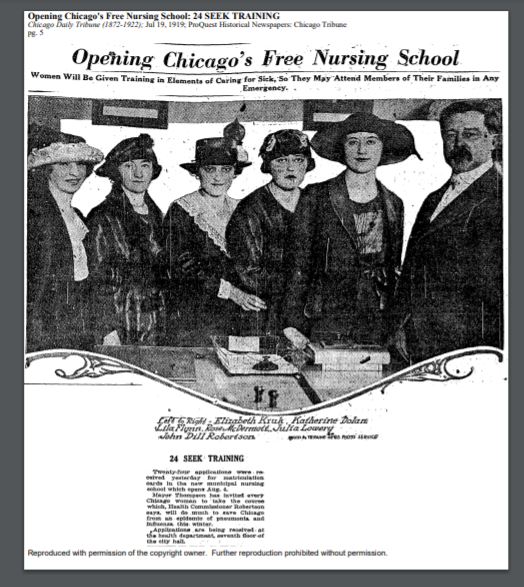
On August 4, 800 women started training as nurses in a new school set up by Dr. Robertson, the public health commissioner. This was an eight-week program to train home and public health nurses. They graduated on September 30th and another class began immediately. A register of the graduates was kept at the health department.
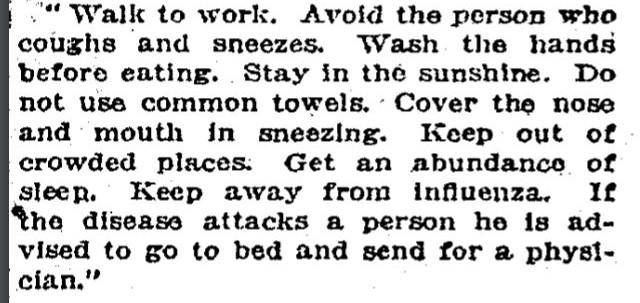
In late August/early September, deaths from influenza began to rise again. People were reminded of flu precautions.
Dr. Evans recommended that people be vaccinated, but he did state that it was now believed influenza was caused by a virus, not by bacteria, and that the vaccine could help reduce the risk of getting pneumonia.
Pollution was becoming a big issue, and it was recognized that smoke pouring into the air was exacerbating lung illnesses such as pneumonia. Armour & Co., the meat packer, was ordered to shut down furnaces that were causing pollution in the city. Over 111 violations had been reported against Armour since 1917, and fifty suits filed against the company.
But 1919 was a much milder year for the flu. In November, there were 178 new cases and 26 deaths compared to 4,177 cases and 1,155 deaths in 1918. For pneumonia, there were 610 new cases and 192 deaths compared to 2,490 cases and 639 deaths in 1918. Bigger concerns in 1919 were measles, chicken pox, mumps, whooping cough, scarlet fever and diphtheria.
Chicago didn’t do as badly with the influenza pandemic as some other cities did. Credit for this was given to the preventive measures and restrictions put in place.
In 1917, the overall mortality rate for the U.S. was 14.2 per 1000 people; this rose to 19.6 in 1918 due to the influenza outbreak. In Chicago, with a population of about 2.5 million people, the 1917 mortality rate of 14.9 per 1000 rose to 17.1 in 1918. Other cities had much higher rates – Baltimore rose to 26.8 and Nashville to 26.4, the highest increases.
The hardest hit population group was adults aged 20 to 49. One thing noted about the flu was that survivors reported complete recovery with very few after effects.
Note that scientists now classify the 1918 influenza, aka the Spanish Flu, as a strain of Influenza A virus subtype H1N1 (A/H1N1). This was an unusually severe and deadly strain of avian influenza, a viral infectious disease. Another H1N1 strain caused the 2009 pandemic. The annual flu vaccine typically gives coverage against several strains of H1N1.
Viruses are the most prevalent biological entity on earth, found in almost all ecosystems. Of the millions of viruses out there, about 5,000 have been described, and of these, at least 220 can infect humans.
Last installment: Some flu-related “good news” stories.