Although Hetherington is famous in Beverly/Morgan Park as the name of a family of distinguished local architects, the work of the father, John Todd Hetherington (1858-1936), has to some extent been eclipsed by that of his son Murray (1891-1972). It is worth seeing the sort of work the father turned out when Prairie School architecture was at the height of fashion, and the architectural dictates of Frank Lloyd Wright and George Washington Maher ruled supreme.
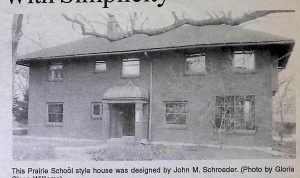
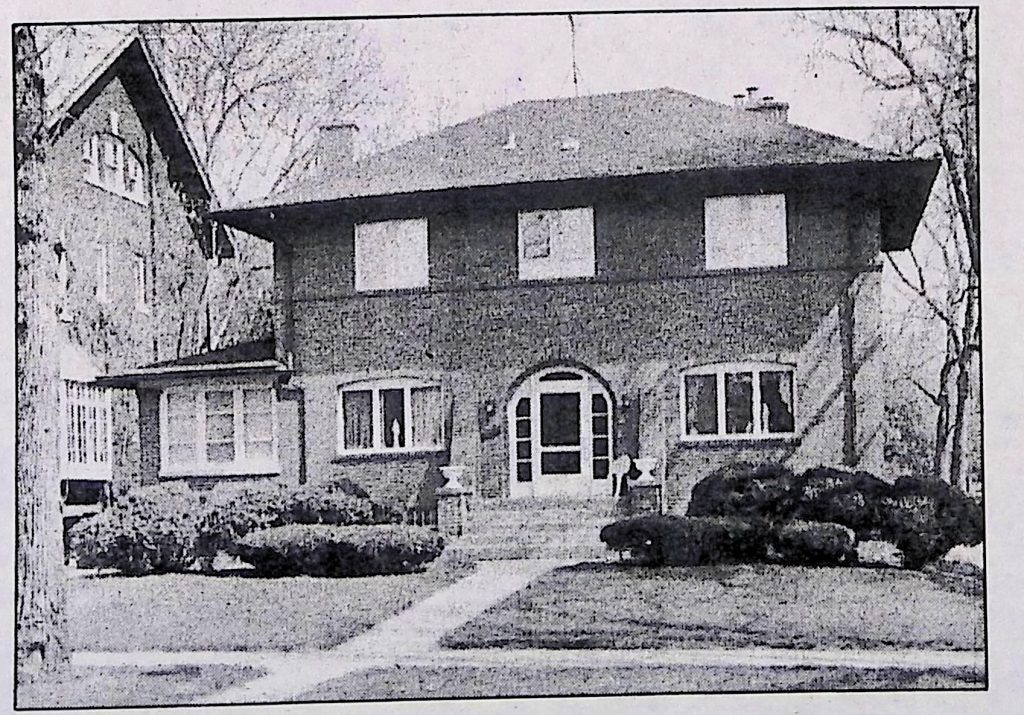
As it happens, we have a house in this style designed by John Todd Hetherington himself, at 2124 W. 103rd St. Made of brick, it was built in 1909 for William G. Kress, an insurance executive with the Conkling, Price and Webb agency.
John Todd Hetherington was born in Canada. He received his professional training in Scotland but came to the United States at the age of 20, beginning his career as a draftsman in the office of Treat & Foltz. After working for this firm for eight years, Hetherington went into practice for himself, and subsequently went into partnership with George H. Borst.
Although he is best known on the Ridge for residences, Hetherington also designed churches, banks, and park buildings throughout Chicagoland. Among local structures of note are the Ridge Park Fieldhouse and Driscoll House, the home of the Ridge Historical Society.
After World War I, Murray Hetherington began to take over the practice of his father until the firm became known as Hetherington Designers and Builders.
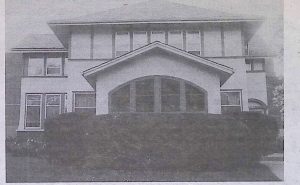
The Hetheringtons are generally known for the quality of their designs, though none attempted to develop a distinctive style of their own. The house at 2124 W. 103rd St. displays a mastery of the principles of Prairie School construction, conveying its elegance by the very simplicity of its design.
The stairs to the front door are flanked by simple buttresses, and the doorway itself framed by an archway proportioned to be welcoming rather than forbidding. The arch is reflected in the rounded top of the door, which is set far enough behind the archway to afford some protection from the elements.
The composition of the facade is symmetrical with the exception of a one-story wing to the west, probably originally a porch. The ground-floor windows have ledges below them which jut out, but the decorative arched brickwork above them is flush with the wall.
The second-story windows rest on a single jutting belt course of bricks which runs all around the house and serves to delineate the two stories. The house is capped with a hipped roof with supporting brackets left visible all the way around, as if to parade the structural elements and underscore the absence of gimmickry.
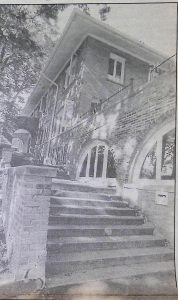
Almost as interesting as the front of the house is the rear. The chimney is flanked by narrow doorways. A tall arched window centered in the back wall illuminates the main stairway, a common feature in residences designed by George W. Maher, Frank Lloyd Wright's contemporary and the only major Prairie School figure who was not one of Wright's pupils.
Although John Todd Hetherington did not participate in the Prairie School architectural revolution, the design of this house shows that he was comfortable with its design principles.