This is the last installment from the Ridge Historical Society about the connections between the Ridge and the Iroquois Theater fire. All the sections may be viewed on the RHS Facebook page.
Part 5. A side story to the Iroquois Theater fire involves the Chicago Fire Department.
December 1903 found the Chicago fire department dealing with two important and complicated issues. First, the city council was investigating charges of graft and incompetence brought against Fire Chief William H. Musham.
Second, firemen were beginning to join and form unions. They sought to improve their working conditions, specifically, reducing the workday from 21 to 12 hours and hiring more fire fighters. Firemen only got off every tenth day to spend with their families.
City officials, and many members of the public, were against firefighters and police joining unions, fearing there could be a conflict of interest between public welfare and union demands. Strikes were especially worrisome. At Musham’s insistence, Mayor Carter Harrison, Jr., issued a rule prohibiting fire department employees from joining any organization that could conflict with their employment duties.
The Chicago Underwriters Association, made up of men who assessed the risk of applications for insurance, was a vocal critic of Musham. The members believed that his poor management was causing undue fire losses and demanded his removal. It was widely surmised that they were behind the charges pending in the city council although they denied this.
Musham, with the mayor’s backing, accused six firemen of sharing their grievances against him with the underwriters in order to advance their labor causes, leading to the city council charges. He retaliated by suspending the six men, pending their appearances before the fire trial board, which was expected to result in their dismissals from the department.
One of the six was William L. Sullivan of Hook and Ladder Company No. 8. He was born in Illinois and his father was from Ireland. He and his wife Katherine had a growing family and were living in the Pullman area at the time.
On December 30, at 2:00 p.m., the trial of the six men began at city hall. At 3:33 p.m., the fire alarm rang. News of the magnitude of the fire at the Iroquois Theater reached them. The trial broke up in confusion and Musham led everyone, including the accused, to fight the fire.
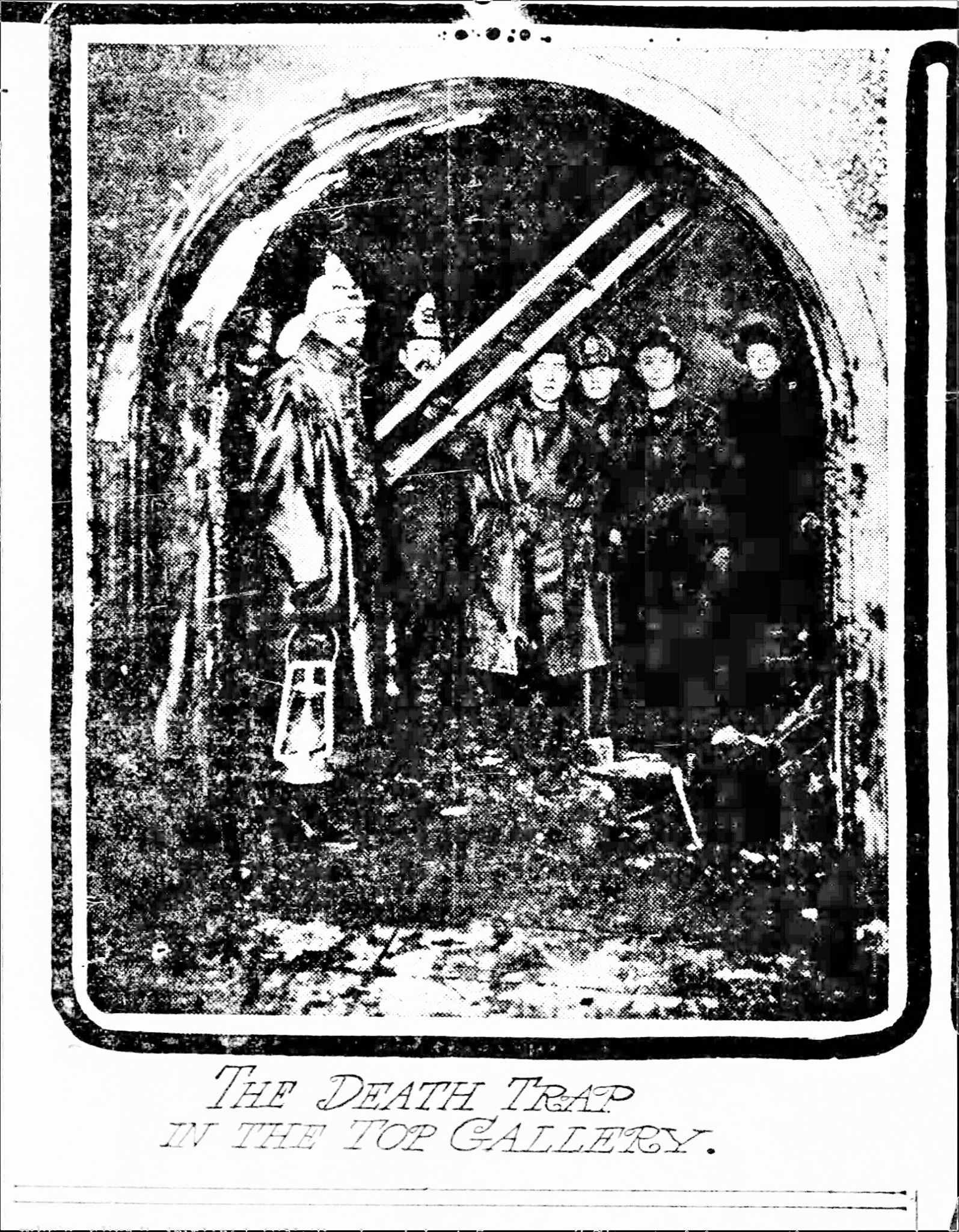
By the time they got to the theater, the worst of the fire was over. They worked their way through the smoke to the top of the theater. The first firemen to reach the second balcony, they were confronted with a wall of bodies so high they could not see over the top. They began the gruesome task of removing the dead. Being late December, it soon turned dark and they worked into the night.
On January 5, 1904, Musham restored to duty the six firemen for “gallant and heroic conduct at the Iroquois Theater fire.” He also announced he was hiring 200 additional fire fighters.
The firemen secretly organized a union, and with other organized labor help, convinced the city council to reduce their workday to 12 hours, over Musham’s objection. This necessitated hiring hundreds more firemen.
The coroner’s jury laid considerable blame for the fire on Musham, who had inspected the theater himself, although no formal charges were brought against him. The insurance underwriters continued their complaints about Musham, and he left the fire department in October of 1904.
William Sullivan died on St. Patrick’s Day in 1911 at the age of 37 and was buried with honors in Mt. Olivet Cemetery on 111th Street. He died of chronic smoke inhalation and other health issues.
The Sullivans had a large family and Katherine raised them on the pension she received as a fireman’s widow. Their sons became firefighters and a policeman.
Daughter Margaret, who married John Sullivan (same last name), and her family moved to Washington Heights and lived at 9956 S. Throop Street. They were members of St. Margaret of Scotland Parish, where the children went to school. Margaret had attended Academy of Our Lady on 95th Street and her daughters did also.
Sullivan family descendants continue to live on the Ridge.
This picture is of a group of firemen in the top gallery of the burned out theater. Musham's group was the first to reach the top of the theater. Chicago Tribune, December 31, 1903