By Harold T. Wolff,
Ridge Historical Society
Harry Hale Waterman (1869-1948) is among my favorite architects on the Ridge. His work frequently appears in this column.
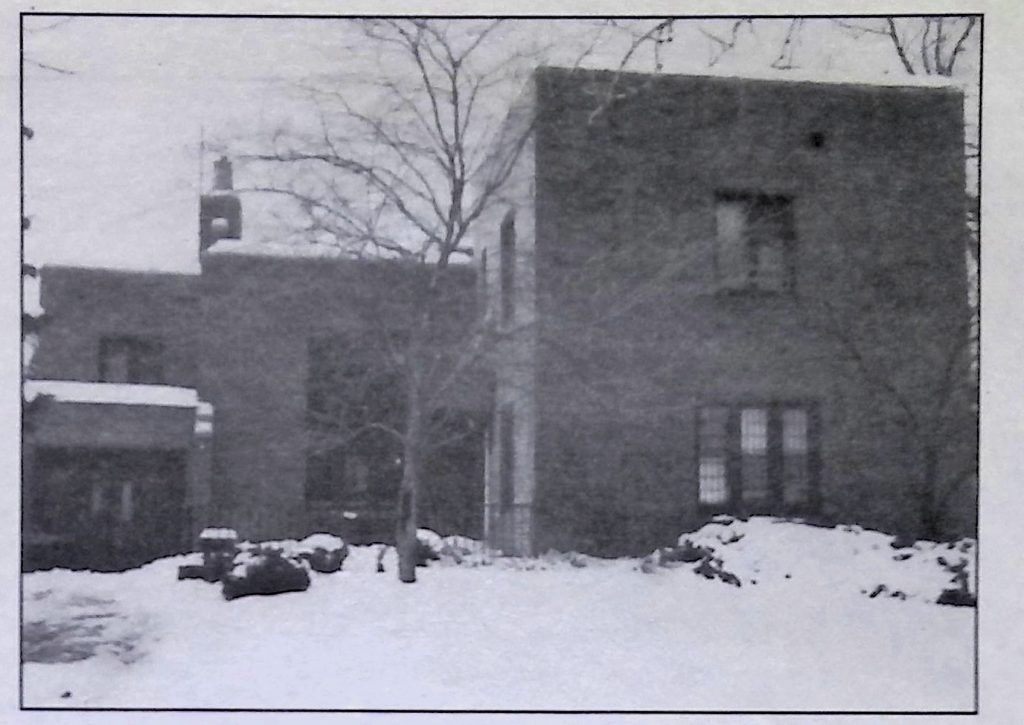
We admire Frank Lloyd Wright for the solutions he devised to an assortment of architectural problems within the two styles he originated, the Prairie and Usonian. Harry Hale Waterman originated no styles of his own, but he was a consistently inventive architect in all of the styles in vogue in his time. A case in point is the Charles Bulfus House at 11842 S. Bell Ave., erected in 1928 and 1929.
Harry Hale Waterman was born on July 10, 1869, in Oregon, Wisc. He soon moved with his parents to Chicago, where he was educated in the public schools and at Northwestern University. Waterman began his architectural career as a draftsman in the office of Joseph Lyman Silsbee between 1886 and 1893. To say that this brought him into contact with his fellow Silsbee draftsman Frank Lloyd Wright is something of an understatement. When Wright's uncle, the Rev. Jenkin Lloyd Jones, found Wright wandering the streets of Chicago looking for a career here, he arranged to have his nephew board with the Waterman family.
The contact between Wright and Waterman was physical as well as social, for both enjoyed an interest in pugilism, and they would occasionally put on boxing gloves and do a little sparring.
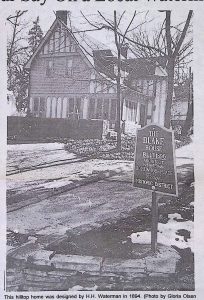
Waterman left Silsbee's firm in June, 1893, to open his own office, and almost immediately arranged to have three of his houses published in a national magazine, the Scientific American Architects and Builders Edition, a predecessor of House and Garden. One of these houses was Waterman's own, at Longwood Drive and 108th Place. The house is locally known as the honeymoon cottage, because Waterman lived there from 1893 until the death of his first wife, Louise, in 1896.
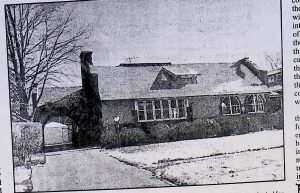
Although Waterman designed commercial buildings and apartment houses for locations in Chicago and across the Midwest, he is best known in Beverly-Morgan Park for his houses. These include Norman-style houses in North Beverly for Eugene S. Pike and H. H. Belding, the Prairie-style England J. Barker House (now Beacon Therapeutic School), and his first house for Edna (or Edmaire) Schell at 11123 S. Bell Ave., in Mission style.
He also designed the Morgan Park Methodist Episcopal (now United Methodist) Church, 11030 S. Longwood Dr. and the Calumet State Bank, now the offices of Dock's Great Fish, on Monterey Ave. at Longwood Dr.
Because of its simple massing, the Bulfus House seems clearly to belong to the Art Moderne style. Seen from above, the plan of the house would resemble the letter T on its side, the upright formed by a large central room nearly two stories high and extended by the garage to the south. The crossbar consists of two two-story cubes which flank the large room on the north and which are slightly higher. One of these cubes forms the wing which extends towards the street, and it is balanced by another cube to the rear.
All of these rectangular solid masses have a hipped limestone coping at the roofline, and there is a balcony above the garage which also has this inward-slanted coping.
Though decorative touches are sparse, they are almost more reminiscent of Gothic or Tudor than Art Deco. The garage entrance, for example, is flanked by two buttresses of different heights which are each capped by a zigzagging limestone block. The garage is enclosed by two wooden doors with simple panes of glass near where the doors meet each other.
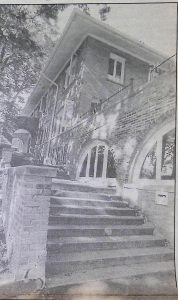
The front door, reached by crossing a patio, rests on a threshold of three limestone blocks, and has a curved top which comes to a point under a keystone. The chimney has a couple of chimney pots and another buttress topped with a limestone triangular block.
All of the windows consist of small rectangular leaded panes of clear glass, with a thin clear glass border framing the window all around. Waterman has gone to great trouble to emphasize the simplicity of all of the windows by framing them at top and bottom with bricks which slant in to the glass, the bricks apparently having been specially cut so that, even though tilted, they do not project beyond the face of the wall. The color of all of the brickwork is an unusual shade of red, which blends amazingly well into the foliage in spring and fall.
The Bulfus House represents something of a tour-de-force for Waterman, since he has managed to augment the simplicity of Art Moderne styling with traditional but congruent details out of the Tudor past. It expands the range of Art Moderne without subverting it.