In September 2004, the Commission on Chicago Landmarks bestowed Chicago Landmark Awards for Preservation Excellence to people who own houses which have previously designated landmarks and who work especially hard to care for them. Certainly none was more deserving of the award than John and Janet Martin who were recognized for the loving restoration of their house at 10415 S. Seeley Ave.
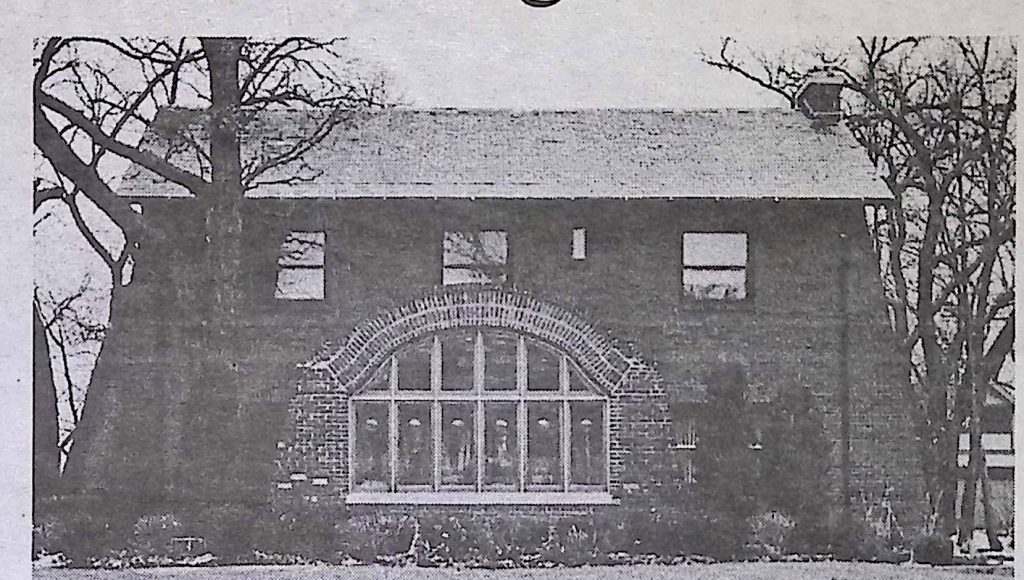
The defining feature of this historic home is the projecting front sunroom with its prominent arched opening and decorative art glass windows. But over time, the arch began to settle and crack, and the art glass was weakened and damaged. The Martins rebuilt the masonry arch and had the art glass windows painstakingly restored, returning the sunroom to all its glory.
This house, which was originally built in 1908 for James Ray McKee, a partner in a feed store in Englewood, is the design of an interesting figure in Chicago architecture. John M. Schroeder was born on Dec. 31, 1863. The son of immigrants from Prussia, his father was a farmer and his younger brother, William E. Schroeder, was a distinguished surgeon who was educated at the University of Illinois, Northwestern University, and the Chicago Medical College.
John Schroeder first appears in the “Lakeside Directory of Chicago” in 1886, as a draughtsman at Room 53 in the Lakeside Building, which was the office of the architect Joseph Lyman Silsbee. His employment with Silsbee apparently concluded in 1886, since in the 1887 directory he is listed as on his own. If this is the case, then he would have worked alongside George W. Maher, but probably would not still have been at Silsbee’s office when Frank Lloyd Wright came in 1887.
John M. Schroeder practiced until his death on February 5, 1921, at the age of 57, from pernicious anemia.
Schroeder’s best residences often seem to depend on their impact from one standout feature. In the case of the McKee House, it is the glorious sunroom, which an old photograph seems to indicate originally had a centered door and served as a porch. In that case, the passage immediately behind the front wall of the main house to the north of the sunroom which leads from driveway to a vestibule behind the sunroom would have been the motoring entrance. There is also a formal entrance door in the north wall, further back along the driveway.
The art glass of the sunroom presents a very restrained, almost chaste appearance, with roundels showing a yin-yang pattern of frosted glass set into clear glass panes.
The pattern is duplicated in a set of windows above the round-top door in the north side wall. The Craftsman affiliations of the design are apparent both in the structure of the sunroom and of the house itself. It is fairly common for porches of Craftsman houses to have pillars resting on bases with battered (sloping) sides, but here both sides of the sunroom brickwork are battered. Moreover, the main house itself displays unusual two-story-high battered buttresses at either side of the front wall. The exterior chimney on the south side also has pronounced slants. The roof appears to rest on beams whose ends project through the side walls. The segmental arch of the sunroom is a motif more associated with the Prairie style of George W. Maher, but was certainly in vogue for the times.
From time to time I have discussed the work of John M. Schroeder in my columns, and I always have cause to lament the fact that, despite the fact that his practice was city-wide, it has only drawn the attention of architectural researchers on the Ridge. My sense is that, if we had a complete picture of John M. Schroeder’s work, we would have a body of experimental detailing and massing to which we could compare the work of Wright, Griffin, Maher, and the other Prairie School guiding lights, with instructive results.